Lukla to Kathmandu Helicopter — 45 Mins | Nepal Lion Tours
Fly from Lukla to Kathmandu and Enjoy a Scenic Return Across the Himalayan Landscape
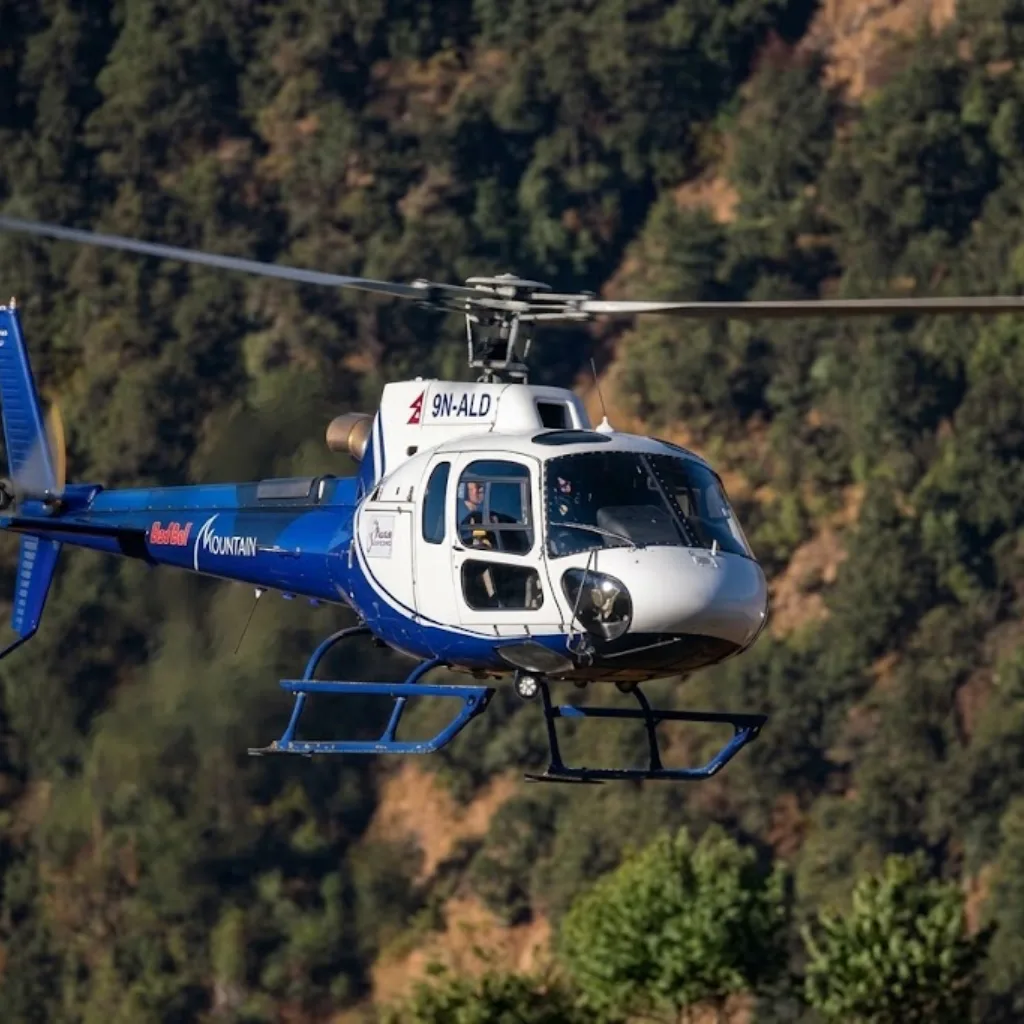

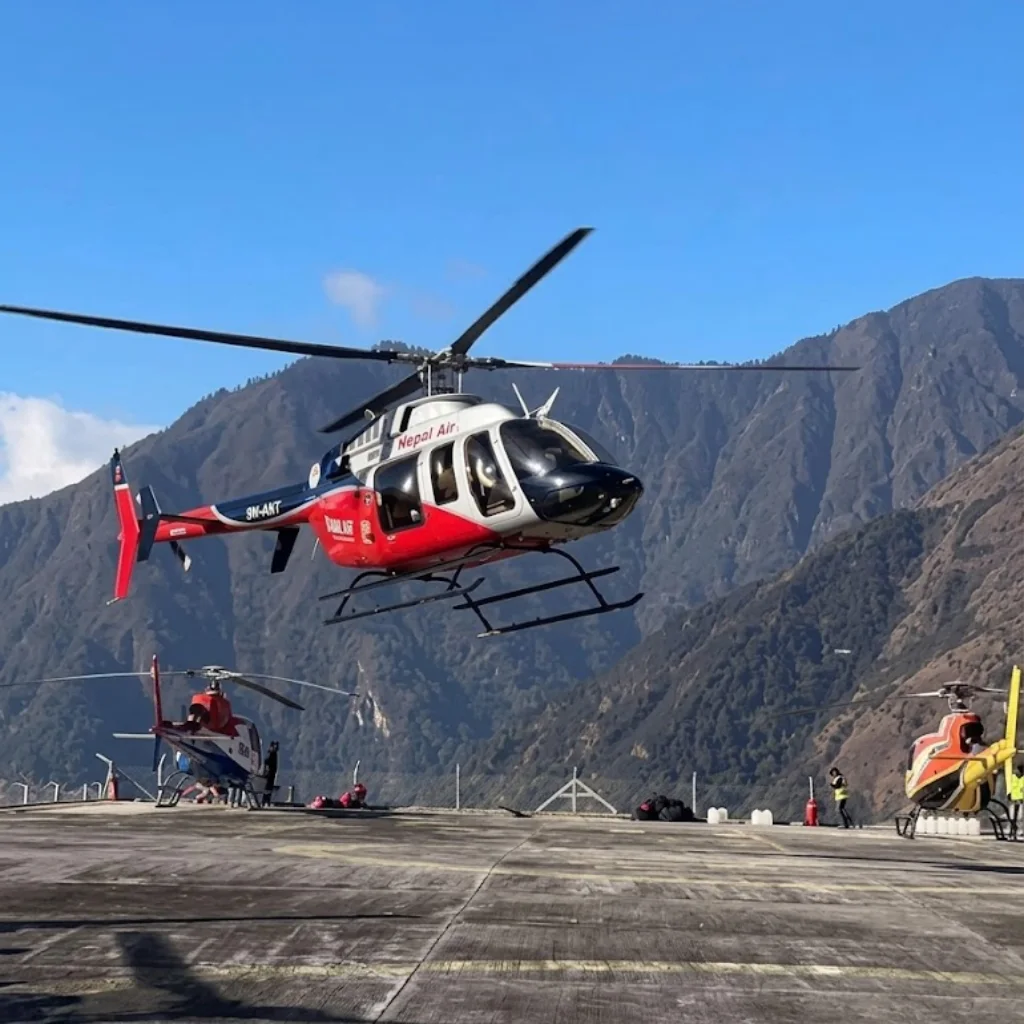
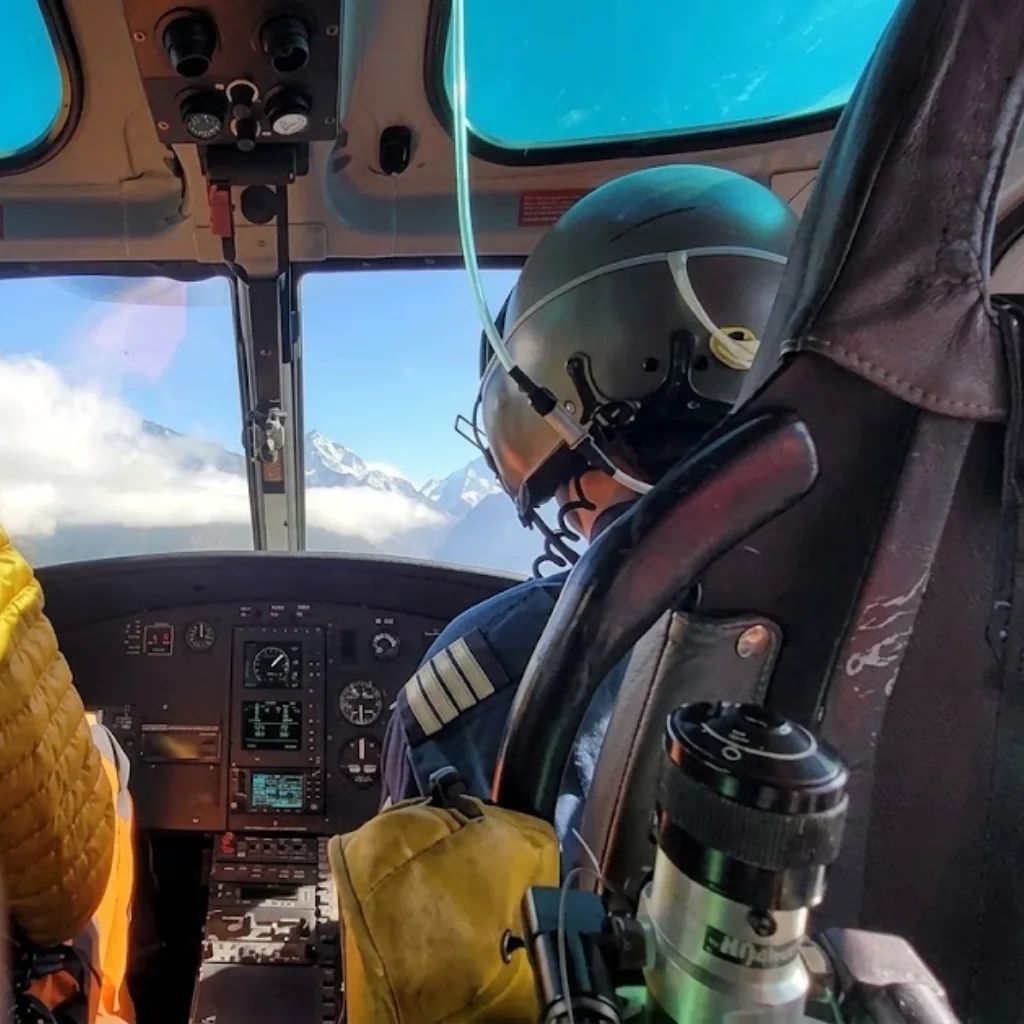

Tour Highlights
Flying from Lukla to Kathmandu is less about a single sight than about the whole country compressed into under an hour — and these are the moments that stay.
- Tenzing-Hillary Airport from the air — 2,860 m / 9,383 ft: the short, angled runway at the head of the Dudh Kosi valley is unmistakable, and seeing it drop away beneath the skids is the classic end-of-trek photograph.
- The Khumbu valley contours — dramatic ridges, hanging valleys and the blue-white threads of the Dudh Kosi and its tributaries winding north to the glaciers.
- Sherpa settlements and trail sightings — from above you can often trace the line of the trail and spot Namche Bazaar’s amphitheatre bowls as the route angles past, a satisfying final map-read of the trek you just finished.
- Ama Dablam and the high peaks — 6,812 m / 22,349 ft: on clear mornings the flight often opens views toward Ama Dablam, Thamserku and the greater Everest massif, depending on the routing and visibility.
- The alpine-to-green transition — the forested slopes, terraced farmland, rolling hills and winding rivers that mark the boundary between high Himalaya and Nepal’s fertile middle hills.
- The Kathmandu Valley approach — rural ridgelines giving way to a densely populated basin as the capital appears, ending with the landing at the designated helicopter terminal.
- A one-hour door-to-door return — from Lukla helipad to Kathmandu city the whole transfer fits inside a morning, the point of booking the flight instead of walking out.
- Reverse-framing of your trek — the outbound flight builds anticipation; the return gives the entire Everest region a closing aerial panorama you cannot get from the ground.
Lukla to Kathmandu Helicopter Overview
The Lukla to Kathmandu Helicopter is a one-way return flight from Lukla (2,860 m / 9,383 ft) in the Everest region to Kathmandu (1,400 m / 4,593 ft), the standard scenic exit for trekkers finishing an Everest Base Camp or Khumbu itinerary without adding an extra walking day — or for anyone flying into Lukla who wants a spectacular, time-efficient way back to the capital. The flight takes 40–50 minutes in the air, is graded easy (there is no walking at all), runs on a shared or private basis depending on your booking, and is arranged in coordination with Go Heli Services, with Nepal Lion Tours handling your booking, support and onward-planning.
The route lifts off from Tenzing-Hillary Airport, follows the natural contours of the Khumbu valleys southwest, crosses the dramatic green ridge country of the mid-hills, and drops into the Kathmandu Valley at the designated helicopter terminal in the capital. It is the mirror image of the outbound Kathmandu to Lukla Helicopter and combines naturally with it as a private or seat-shared round trip — you fly in, trek the Khumbu, and fly straight back out.
With Nepal Lion Tours, the package starts from USD 712.50 per person (Standard tier, 5% off the USD 750 list price) or USD 962 per person (Luxury tier). The price is per seat on a shared departure, or fully private at a higher rate, and includes the helicopter transfer, the experienced mountain pilot, airport and helipad handling, applicable government taxes and aviation fees, passenger insurance in line with Nepal aviation regulations, and flight coordination with Go Heli Services — with accommodation, meals and personal expenses paid separately.
What Makes the Lukla to Kathmandu Helicopter Special?
For trekkers who have just spent a week or more in the Khumbu, this flight is the reward at the end of the walk. The helicopter climbs out of the Lukla gorge and the flight plays the landscape in reverse: the high Sherpa country of Namche Bazaar (3,440 m) and Ama Dablam (6,812 m) glimpsed from the valley contours, then the long sweep down through forested slopes, terraced farmland and winding rivers, and finally the packed, living basin of Kathmandu. Where the inbound flight is anticipation — mountains ahead — the return is perspective: you see how far the trail actually took you, and how the high Himalayas fold down into the green heart of Nepal.
The practical value is just as strong. A return by fixed-wing airline from Lukla means a 25–35-minute flight that is frequently delayed or cancelled in busy months, the added risk of a seat that was booked weeks ahead when you did not yet know your exact trek finish, and — in peak season — the Ramechhap (Manthali) road detour, a roughly 4-hour drive that operators impose on airline departures when Kathmandu-side weather is closed. The helicopter sidesteps both problems: it flies when the weather window opens, it moves on your schedule not an airline timetable, and for a private booking it waits for your group rather than the other way around.
Why Choose the Lukla to Kathmandu Helicopter?
Time is the scarce resource at the end of a trek. Walking out of the Khumbu from Lukla adds two or three days of downhill trail; the helicopter converts it into a single 40–50-minute airborne leg, letting you keep a buffer day in Kathmandu for international connections without burning leave. The flight is also the softer option after a hard trek — no long downhill on tired knees, a seat the whole way, and the entire Khumbu panorama presented one final time without a step of effort. And because the package is arranged with Go Heli Services, the coordination burden disappears; you walk into Lukla, hand your bags over at the helipad, and step off in Kathmandu roughly an hour later.
Who Is This Helicopter Flight Suitable For?
- Trekkers finishing an Everest Base Camp, Gokyo, Three Passes or panorama trek who want to return to Kathmandu on the same day they reach Lukla.
- Travellers who flew into Lukla on the outbound Kathmandu to Lukla helicopter and want a matching private or shared return.
- Trekkers racing an international flight who need a buffer day in Kathmandu after landing.
- Less-fit or knee-conscious walkers who want to avoid the multi-day downhill walk-out from Lukla.
- Families and older travellers who are healthy enough for the short Khumbu treks and want the gentlest exit possible.
- Photographers chasing a final aerial pass over the Khumbu valleys, Namche and the green mid-hills.
- Group treks splitting the return between airlines and the helicopter to protect flight-critical dates.
- Couples and honeymooners who want a private, scenic conclusion to an Everest adventure.
No trekking experience is needed — the only stamina requirement is whatever you completed to reach Lukla in the first place. The flight is genuinely easy; the planning and weather-reading are handled for you.
Guide’s Note — Nepal Lion Tours — From our experience coordinating Everest departures, the return flight is the leg guests enjoy most because the mood is different: nobody is chasing an acclimatization plan or a morning start, and the descent into Nepal’s green belt is the part people rewatch. We schedule return departures from Lukla in the first available weather window, tell trekkers to keep their camera out from the moment the wheels leave the runway, and recommend carrying your walking bag organized so you relax at the helipad rather than repacking at Lukla airport. — Nepal Lion Tours
Quick Facts
Lukla to Kathmandu Helicopter at a Glance
| Tour Fact | Details |
|---|---|
| Tour Name | Lukla To Kathmandu Helicopter |
| Duration | Single 40–50 minute one-way flight |
| Region | Everest (Khumbu), Koshi, Nepal |
| Maximum Altitude | 2,860 m / 9,383 ft at Lukla (Tenzing-Hillary) |
| Difficulty | Easy |
| Main Highlight | Scenic aerial return down the Khumbu to the Kathmandu Valley |
| Flight Direction | Lukla to Kathmandu (one way) |
| Route | Lukla – Khumbu valleys – mid-hills – Kathmandu Valley |
| Typical Flight Time | 40–50 minutes in the air |
| Best Season | Spring–Autumn |
| Price From | USD 712.50 per person |
| Accommodation | Not included (Lukla lodges and Kathmandu hotels available on request) |
| Arrangements | Nepal Lion Tours booking & support; Go Heli Services flight coordination |
Lukla to Kathmandu Helicopter Route and Elevation
The route runs almost due west-to-southwest from the head of the Khumbu: take-off from Lukla, a crossing of the high ridge country bordering the Dudh Kosi catchment, a descent through the Solu middle hills, and a final approach across the rim of the Kathmandu Valley. Because it is a transfer rather than a tour, the exact line varies with the morning’s weather and air-traffic routing, but the published maximum altitude is 2,860 m / 9,383 ft (Lukla) and the finish is 1,400 m / 4,593 ft (Kathmandu) — a gentle, comfortable profile for everyone aboard.
Lukla to Kathmandu Helicopter Route at a Glance
Day | Route | Altitude | Highlights |
|---|---|---|---|
Day 1 | Lukla → Kathmandu (direct transfer) | 2,860 m → 1,400 m | Khumbu valleys, ridge country, green mid-hills, Kathmandu Valley approach |
The itinerary is a single flight day because that is the honest shape of the product: you are not trekking between stops, you are flying the return corridor in one continuous leg of 40–50 minutes, with airport and helipad handling at each end.
Lukla to Kathmandu Helicopter Elevation Profile
The profile is a descending one, which is the whole comfort of the flight. You leave Lukla at 2,860 m / 9,383 ft — the highest terrain of the journey and the point where the aircraft does its real work, climbing along the valley before gaining the ridgelines that separate the Khumbu catchments. Once over the first crests the ground trends down through the Solu–Khumbu middle hills, where terraces and forested ridges sit at roughly 1,500–2,500 m, and the final approach crosses the valley rim into the Kathmandu basin at 1,400 m / 4,593 ft. Physically the profile means almost nothing to your body — the cabin is at a stable altitude and the brief Lukla exposure is the only touch — but visually it is the entire country’s geography played in reverse in under an hour. A written route-and-elevation overview for the flight is available with the package materials from Nepal Lion Tours.
How to Get to the Lukla to Kathmandu Helicopter
Because this is a return transfer, “getting there” means two things: getting yourself to the Lukla helipad in time for departure, and knowing what waits for you at the Kathmandu end. The flight itself starts from Tenzing-Hillary Airport (Lukla), so the practical journey is about finishing your trek or your inbound flight on schedule, then following the simple departure-day routine.
Lukla Helipad: Arrival and Departure Routine
The helicopter departure point sits at the Lukla airstrip compound, which every outgoing trekker walks through at the end of the standard Khumbu routes. Our team confirms the return departure time over WhatsApp the evening before — usually reported about an hour before the scheduled lift — so the morning is relaxed: trekkers drop bags at helipad handling, present passports for the manifest, and settle into the waiting area until the boarding call. Because conditions at Lukla change fast, the departure is slotted into the first available weather window of the morning rather than a fixed-by-the-clock time; build a little flexibility into your downstream plans on the day of travel.
If you are booked on the outbound Kathmandu to Lukla Helicopter, the return is the second half of a round-trip transfer — the same team handles both legs and your bags travel with you. If you are flying in by airline or arriving at the end of a trek, you simply arrive at the Lukla compound with your walking baggage; the helipad handling team marshals it. Allow the walking-standard permitted baggage allowance listed at booking (an extra-charge note applies above the allowance, so pack to the number warned at confirmation), keep your passport and permit documents on your person, and be camera-ready before you board.
Flying Back to Kathmandu: Helicopter, Airline or Walking Out
| Option | Approx. Time | Best For |
|---|---|---|
| Helicopter (this package) | 40–50 minutes flying | Fixed schedules, scenic aerial return, weather-window flexibility, no road detour |
| Fixed-wing airline (Lukla–Kathmandu) | ~25–35 minutes flying | Budget travellers willing to accept subject-to-weather scheduling |
| Walking out (Lukla downhill exit) | 2–3 days on foot | Trekkers with spare days and energy in reserve |
The helicopter is the option that treats your exit date as fixed. Fixed-wing services are cheaper but famously weather-fragile at Lukla: when wind or cloud closes the corridor, departure slots collapse in cascade, and in October’s rush some airline operations shift to Ramechhap (Manthali), turning a short hop into a road-bus transfer you did not sign up for. The helicopter holds a personal scheduling advantage too — on a private booking it waits for your group, and on shared departures it moves in the same first-window discipline. Measured against the walking exit, the comparison is simply a matter of how much time and downhill you have left; after two weeks in the Khumbu, most trekkers spend their remaining days in Kathmandu, not on the trail to Phakding.
Guide’s Note — Nepal Lion Tours — From our experience running Everest-region returns, the single best habit is giving the morning an hour of slack: winds at Lukla build through the day, so departures concentrate in the first window, and a trek that ends at the airport before report time always flows better than one that arrives exactly at it. We also ask returning trekkers to have their passport in hand rather than buried in a duffel — it is the only document the helipad check actually cares about, and it saves the bag-dig of the week. — Nepal Lion Tours
Returning to Kathmandu After the Flight
Landing is at the designated helicopter terminal in Kathmandu, inside or adjacent to the city’s aviation area. From the terminal it is a short ride to your hotel — a private transfer can be arranged in advance through Nepal Lion Tours so you walk straight from the helipad to the car. If you have an international connection, the terminal’s position keeps the transfer-to-airport step short; confirm the terminal location with the coordination team at booking, since the exact pad can vary with the operator and morning traffic.
A Practical Tip for International Travellers
Do not book an international departure for the same clock-hour as your Lukla return. Book the helicopter with a buffer — a same-day afternoon or next-morning international flight, not a mid-morning one — because mountain departures move with the weather and a delayed window is better met with slack than apologized for. With a morning flight off Lukla and a night in Kathmandu, the whole return becomes comfortable rather than stressful.
Lukla to Kathmandu Helicopter Difficulty, Fitness & Altitude
The flight is graded easy for the simplest of reasons: there is no walking, no climbing and no long descent. The only altitude exposure is the brief ground stop at Lukla (2,860 m / 9,383 ft) before and after boarding, which returning trekkers have already acclimatized to, and the cabin itself holds a stable altitude throughout the 40–50-minute leg. For anyone who has reached Lukla, the helicopter return is physically the easiest part of the entire Everest region experience.
Where the Effort Actually Is?
For the flight itself, the effort is essentially scheduling: being at the Lukla helipad at report time with your documents ready and your bags within allowance. Flying by helicopter to Kathmandu rather than walking out means you skip the multi-day downhill from Lukla through Phakding and the Dudh Kosi valley — which is exactly the point. If you are on a seat-shared departure, the only coordination effort is matching the group’s arrival at the helipad; on a private departure the aircraft waits for your group, which makes the morning even easier.
How to Prepare for the Flight
- Reach Lukla the afternoon or morning before with enough slack that a weather hold on your return doesn’t touch your international plans.
- Have your passport and, if trekking onwards, your permit documents within reach for the helipad manifest check.
- Keep your walking bag within the allowance confirmed at booking to avoid extra-charge time at the pad.
- Pack the camera and spare battery on top — the Khumbu-to-green-hills transition is over faster than most guests expect.
- Eat and hydrate normally before the morning flight — mountain air and a light breakfast sit better than a rushed or empty morning.
- Plan a buffer in Kathmandu after landing — give yourself a night or an afternoon before the next fixed commitment.
How This Flight Compares with Walking Out or Flying Airline
Against the fixed-wing airline from Lukla, the helicopter trades money for reliability and flexibility: it moves in the first weather window rather than an airline timetable, it avoids the peak-season Ramechhap road detour, and a private booking waits for you. Against walking out (the old two-to-three-day descent), it compresses days into 40–50 minutes and spares tired knees entirely. Measured against staying in the mountains for another trek, it is simply the fastest, most scenic route back to national and international connections.
Altitude & Safety on the Flight
Lukla to Kathmandu Helicopter Altitude Profile
- Lukla — 2,860 m / 9,383 ft: departure point and the flight’s published maximum; a brief exposure that returning trekkers have already acclimatized to.
- Solu–Khumbu mid-hills — roughly 1,500–2,500 m: the crossing ridge country below the aircraft; ground only, no exposure.
- Kathmandu — 1,400 m / 4,593 ft: arrival and return base; no altitude consideration at all.
How the Body Responds on the Flight
A 40–50-minute descent through this profile gives the body almost nothing to react to. The cabin holds a stable altitude, Lukla is far below the threshold where short or even longer stays provoke problems for the acclimatized, and the arrival elevation of 1,400 m is the same as the city trekkers spent time in before the trek. The moments that feel like “altitude” are the cool air and the mountain views, not any physical strain.
Symptoms of Altitude Sickness to Watch For
On the return flight the risk window effectively does not exist — you are descending, and any trekkers carrying mountain sensitivities from the walk would have shown them already on the trail where the real altitude conversations happen. The mild, transient sensations some guests notice are a light headache or slight light-headedness from a rapid start-of-day and a morning in the air, which settle quickly once you are down in the valley traffic. Anyone finishing a trek below their felt-fit level should mention it to the support team before boarding, so the morning is paced accordingly.
How Nepal Lion Tours Supports Your Safety
- Licensed, experienced mountain pilot commanding the aircraft under Nepal Civil Aviation rules.
- Weather-first scheduling — departures run from Lukla in the first stable window and hold or re-sequence rather than force a marginal crossing.
- Helicopter passenger insurance carried in accordance with aviation regulations; confirm the exact policy detail at booking.
- Helipad handling at both ends — Lukla departure marshalling and Kathmandu arrival support are included in the package.
- Trek-aware handover — for trekkers, permits, documents and onward Kathmandu plans line up before the flight, and a private transfer to your hotel can be arranged for arrival.
Guide’s Note — Nepal Lion Tours — In our experience the genuine effort on the return is the morning discipline at Lukla, not the flying: a lodger’s alarm, bags at the confirmed weight, and a passport hand has to be simpler than a duffel dig. The flight itself does the easy work — the cabin descends without a single step, and the view trekkers describe as the week’s punctuation is over in under an hour, so we suggest sitting back and saving the packing for Kathmandu. — Nepal Lion Tours
Best Time to Take the Lukla to Kathmandu Helicopter
The package lists spring–autumn as its official season, and that grading is accurate: autumn (October–November) and spring (March–May) bring the clearest skies and the calmest morning flying conditions over the Kathmandu–Lukla corridor. The helicopter operates across more of the year than the airlines in practice, because an aircraft can thread a weather window a fixed-wing operator cannot hold — but the same weather that chases the airlines constrains the helicopter too, and Lukla’s afternoon winds are a year-round consideration.
| Season | Months | Weather & Flight Conditions | Mountain Views | Overall |
|---|---|---|---|---|
| Autumn | Sep–Nov | Stable mornings, dry clear air, busy trail traffic | Excellent | Best overall |
| Spring | Mar–May | Clear mornings, warmer, some late haze | Very good | Highly recommended |
| Winter | Dec–Feb | Cold, crisp clear days; brief morning windows | Good on clear days | Good with flexibility |
| Monsoon | Jun–Aug | Rain and cloud bases low; windows narrower and shorter | Frequently limited | Less suitable |
Autumn — September to November
Autumn is the flagship return season: October and November give the driest air and the most reliable early-morning clearances on both sides of the corridor. Views of the Khumbu peaks from the outbound climb are at their sharpest, and the turbulence risk is at its lowest. Demand matches the conditions — the helicopters book out alongside the airlines, so trekkers who know their end date should reserve the return early.
Spring — March to May
Spring is the strong second season: mornings are clear and warming, the ridge country flushes green, and the famous rhododendron colour of the lower Khumbu is visible from the air in the mid-hills. Occasional spring haze in the Kathmandu Valley can shorten the final-approach views a little, but the departure windows from Lukla are usually clean. Expect busy helipad traffic with the treks and climbs of the season.
Winter — December to February
Winter flies on crisp, cold mornings with superb visibility when the windows open. The catch is the windows themselves: cold-air mornings can hold cloud in the valleys into mid-morning, and Lukla’s high-altitude weather moves quickly. This is a good season for a private booking with a flexible downstream plan rather than a tight same-day international connection.
Monsoon — June to August
Monsoon is the least favourable season for the corridor. Rain clouds sit low over the ridges, visibility shrinks, and the departure windows from Lukla shorten; the fixed-wing airlines cancel in batches and the helicopter runs only when the pilot can see the whole line. Travel in this season with a lodged buffer — and treat the flight as a morning-window-dependent transfer, not a guaranteed clock time.
Which Season Should You Choose?
Choose autumn for the most reliable combination of views, calm air and schedule certainty; choose spring for green lower country and near-equal reliability. Winter rewards flexible travellers, monsoon suits only those with slack in their plans. Whichever month you pick, the rule is the same: fly early, and keep a night in Kathmandu after landing before anything is fixed.
Guide’s Note — Nepal Lion Tours — In our experience the Khumbu-to-Kathmandu corridor gives its best flying in the first morning window, every season: the valley mists sit low, the ridges are already in sun, and the thermals that roughen afternoon departures from Lukla have not yet built. We counsel returning trekkers in October and March to book the helicopter several weeks out — those are the months when the airline cancellations spike and the seat-shared helicopters sell through. — Nepal Lion Tours
Lukla to Kathmandu Helicopter Permits & Regulations
The return flight itself requires no hiking permits of any kind — a helicopter transfer between Lukla and Kathmandu is aviation, not trekking, and no conservation or restricted-area permit applies to the flight corridor. Permits matter only for the trek you are stepping off: trekkers returning from the Khumbu should carry the documents they used to walk, and anyone flown in purely for the transfer needs nothing beyond normal travel papers. Nepal Lion Tours coordinates the applicable trek paperwork for trekkers and confirms flight-side requirements at booking.
Flight Permits at a Glance
| Requirement | Who Needs It? | Who Arranges It? |
|---|---|---|
| Helicopter flight permits / clearances | Operator (air-side clearances) | Nepal Lion Tours / Go Heli Services coordination |
| Sagarmatha National Park Entry Permit | Trekkers entering the park on the preceding trek | Nepal Lion Tours (for trekkers) |
| Khumbu Pasang Lhamu Rural Municipality Permit | All trekkers in the Khumbu | Nepal Lion Tours (for trekkers) |
| Personal documents (passport) | Every passenger, for the helipad manifest | Traveller carries original |
The Sagarmatha National Park Entry Permit
If your return follows a standard Khumbu trek, you will already hold a Sagarmatha National Park Entry Permit, required for foreign trekkers entering the park and currently priced at NPR 3,000 foreign / NPR 1,500 SAARC. It is an entry-honoured paperwork rather than a flight document — you do not need to present it at the Lukla helipad, but carrying the original is the rule for the trek itself. Nepal Lion Tours arranges this permit for trekkers as part of pre-trek preparation.
Khumbu Pasang Lhamu Rural Municipality Permit
Trekkers walking the Khumbu also carry the Khumbu Pasang Lhamu Rural Municipality Permit, currently NPR 3,000 foreign / NPR 2,000 SAARC, which replaced the TIMS card in the Everest region. It applies to the walking itinerary, not the flight, and Nepal Lion Tours arranges it for trekkers in the standard package. Return-only passengers on a pure helicopter transfer do not need it.
Do You Need a Restricted-Area Permit for the Return?
No. The Lukla–Kathmandu corridor crosses no restricted area, and the reverse flight ends at the capital without touching the restricted-zone rules that apply to Upper Mustang, Manaslu or similar regions. The standard Khumbu routes that most returning trekkers have just finished are likewise not restricted areas; the Sagarmatha and Khumbu municipality permits above are the complete set needed. Rules can be revised and modified itineraries can differ — confirm current requirements at booking.
Who Arranges the Permits?
For trekkers, Nepal Lion Tours arranges the Sagarmatha and Khumbu municipality permits as part of pre-trek paperwork, held against your passport details and carried in original form on the trail. For the flight itself, air-side clearances are the operator’s responsibility and are handled through the Go Heli Services coordination. Government fees and regulations can change — confirm the current figures with our team at booking so nothing surprises you at the final trail checkpoint.
Food & Accommodation on the Lukla to Kathmandu Helicopter
The source package is a transfer product, so meals and lodging are deliberately not included — and that is a feature, not a gap: at the end of a trek you decide where and when you eat, and the flight is short enough that food is a matter of a light snack in the air rather than a meal. Nepal Lion Tours can add Lukla accommodation before an early departure and Kathmandu hotels after landing to the booking on request, so the package can still be arranged as a complete end-to-end return.
Where to Stay the Night Before the Flight
If your trek ends at Lukla the afternoon before a morning return, the town’s small lodges offer the standard twin-sharing teahouse bedding of the lower Khumbu — simple, comfortable rooms, a warm dining area, and the classic dal bhat dinner. Nepal Lion Tours can pre-book a Lukla lodge so you roll off the trail into a confirmed bed, eat well, and walk the two minutes to the helipad the next morning. For trekkers arriving by morning airline the same day, the accommodation question disappears and the routine shortens to a cup of tea at the terminal.
What Food Is Available Around the Flight
Lukla’s lodges and cafes cover the standard Khumbu menu — dal bhat, momos, noodles, fried rice, soups, potatoes, eggs, porridge, pancakes and toast — with the baked-goods offerings that the bigger villages carry. Vegetarian food is widely available, and the usual guidance applies: tell Nepal Lion Tours about vegan, gluten-free or allergy needs before travel so the lodge and any pre-arranged meals can adapt. On board, carry a light snack and water; the flight is too short for catering, and a low-tier breakfast is what most guests feel like anyway.
What the Flight Package Includes (Food-Wise)
| Included in the Flight Package | Usually Paid Separately |
|---|---|
| Helicopter transfer Lukla → Kathmandu | Meals and beverages on the ground |
| Helipad and airport handling at both ends | Lukla or Kathmandu accommodation |
| Experienced mountain helicopter pilot | Personal and medical travel insurance |
| Government taxes and aviation fees | Extra baggage above the permitted allowance |
| Passenger insurance per aviation regulations | Weather-delay or rescheduling expenses |
| Go Heli Services flight coordination | Tips and gratuities for pilot and support staff |
The table above reflects the published inclusion and exclusion lists for the package, in full. Confirm the final details with our team at booking, especially the exact baggage allowance and the name and location of the Kathmandu arrival terminal.
Drinking Water and Comfort on the Day
Carry a reusable bottle with water for the morning — tap water should not be assumed safe to drink, so use bottled, boiled or treated water as you would on the trail. The helicopter cabin is small and mountain mornings are cool, so a light mid-layer and comfortable clothing keep the flight pleasant, and layers come straight off again in Kathmandu’s lower altitude and busier warmth.
Why Book with Nepal Lion Tours?
The Lukla to Kathmandu Helicopter is an aviation product, and Nepal Lion Tours applies the same standards to it as to its treks: a licensed operation you can verify, a local team you can actually reach, and arrangements that hold together when the weather does not cooperate.
- A registered trekking company you can verify — Nepal Lion Tours is based in Kathmandu as a registered Nepali operator, and company and licence details are provided on request, so the flight is booked through a business you can check rather than an anonymous broker page.
- Flexible shared or private departure — the package runs seat-shared, private, or a mix, and our team matches the arrangement to your group size and dates instead of forcing a one-size-fits-all booking.
- The itinerary feature that stands out — a true end-of-trek escape — one 40–50-minute airborne leg replaces the multi-day walking exit from Lukla, with the Khumbu panorama closing the adventure properly.
- Straightforward end-to-end logistics — helipad handling at both ends, a coordinated departure window, and optional Lukla lodge and Kathmandu hotel additions turn the return into a single arranged morning.
- Weather-aware scheduling — departures move with the first stable window and re-sequence rather than rush, because our coordinating partners read the corridor the same way our treks approach Kala Patthar.
- Budget-friendly by design — the Standard seat rate of USD 712.50 (from a USD 750 list price) keeps the exit accessible without stripping the inclusions that matter: pilot, handling, taxes, insurance and coordination.
- A local team reachable before, during and after — from confirming report time over WhatsApp the evening before to arranging your Kathmandu transfer on arrival, contact us at +977-9851039020 at any point in the process.
Book the Lukla to Kathmandu Helicopter
One flight, one morning, and the whole Everest region behind you — the Lukla to Kathmandu Helicopter is the cleanest exit a Khumbu trek can have. Book the Standard seat-share from Lukla, upgrade to Luxury for a softer private-style morning, or take it as the return half of a round-trip transfer with the outbound Kathmandu to Lukla Helicopter.
Lukla to Kathmandu Helicopter Pricing at a Glance
| Tier | 1 Pax | 2–4 Pax | 5–9 Pax | 10+ Pax |
|---|---|---|---|---|
| Standard | USD 712.50 | USD 677 | USD 641 | USD 606 |
| Luxury | USD 962 | USD 914 | USD 866 | USD 818 |
- Duration: single 40–50 minute helicopter flight, one way.
- Price: from USD 712.50 per person (Standard, 5% off the USD 750 list price); Luxury from USD 962 per person. Group discounts apply at every tier.
- Difficulty: easy — no walking.
- Maximum altitude: 2,860 m at Lukla.
- Accommodation: not included; Lukla lodge and Kathmandu hotel nights can be added on request.
- Meals: not included; purchased locally.
- Permits & registration: no permits for the flight itself; trek permits arranged by Nepal Lion Tours for trekkers.
- Transportation: helicopter transfer with helipad handling at both ends; optional Kathmandu private transfer on arrival.
- Cancellation: free cancellation up to 14 days before departure, subject to booking terms.
Ready to Fly Back to Kathmandu?
Send us your trek end date, your group size and your preferred tier through the booking form or WhatsApp at +977-9851039020, and we will match you to the available return window — with your Lukla report time confirmed the evening before. Whether you are a solo returner, a couple closing a honeymoon trek, a group holding international connections, or a family finishing a panorama walk, we will make the exit as smooth as the summit day was memorable. The Everest region’s last view of you is waiting — choose your return morning and let’s bring you home.
Related Everest Region Helicopter Tours & Treks
If the Lukla to Kathmandu return fits your Everest plans, these packages pair naturally with it — a matching way in, a scenic alternative, or the trek you are coming off.
| Heli Tour / Trek | Duration | Difficulty | Max Altitude | Best For |
|---|---|---|---|---|
| Kathmandu to Lukla Helicopter | 3–4 hrs round trip | Easy | 2,860 m (Lukla) | Flying in to start an Everest trek; pairs with this return |
| Everest Basecamp Helicopter Tour with Kalapatthar Landing | 1 day | Easy | 5,545 m (Kala Patthar) | Everest views and a Kala Patthar landing in a day |
| Everest View Hotel Helicopter Tour with Overnight | 2 days | Easy | 3,880 m | An overnight panorama stay at the Everest View Hotel |
| Everest Panorama Trek | 6 days | Easy–Moderate | 3,880 m (Everest View Hotel) | The shortest route to big Everest views from Lukla |
| Everest Base Camp Trek | 12–14 days | Moderate | 5,545 m | The classic EBC + Kala Patthar experience this flight exits from |
The return helicopter is most often booked as the final transfer of an Everest Base Camp, Gokyo or Everest Panorama itinerary, and it combines with the Kathmandu to Lukla Helicopter as a complete round trip. Nepal Lion Tours can also attach Kathmandu sightseeing, a Chitwan Jungle Safari, or a spiritual stop in Lumbini after you land, so the flight slots into a longer Nepal route rather than ending anything.
Trip Essentials
Packing advice, required equipment & gear recommendations
Essential
Because the flight is a transfer, the packing list is short — this is the one Everest-region day where the advice is to bring less, not more. You are packing for a cool mountain morning in a helicopter and a warm afternoon in Kathmandu, and everything you carry travels with you.
Essential Carry
- Passport (original) — required for the helipad manifest check at Lukla.
- Permit documents (trekkers) — Sagarmatha and Khumbu municipality permits, carried as on the trail.
- Boarding and booking confirmation — report details confirmed over WhatsApp the evening before.
- Camera and spare battery — the first 20 minutes over the Khumbu is the photographic payoff.
- Light snacks and a water bottle — for the airport wait and the short flight.
- Cash in small notes — for last meals at Lukla, tips at the helipad, and a snack in Kathmandu.
- Your walking baggage was packed for the trek — within the allowance confirmed at booking.
Clothing: Layers for a Changing Day
The morning at Lukla is alpine-cold; the afternoon in Kathmandu is city-warm.
Base layer: a light merino or synthetic top.
Mid-layer: a fleece or light insulated jacket — this is the piece you actually wear on the helipad.
Outer layer: a windproof or light shell against the rotor wash and the cold cabin.
Trekking clothes: the comfortable trousers you finished the trek in work fine; no special kit needed.
Headwear and gloves: a beanie and light gloves make the Lukla wait and the take-off far more pleasant, and come off on landing.
High-Altitude Comfort at Lukla
Superior cold protection, sun protection and hydration apply: the Lukla platform at 2,860 m sits in strong, clear sun even when the air is cold, so sunglasses, lip balm and sunscreen are genuinely useful, and a light hat helps both ways. The altitude itself should not trouble you on the day — your acclimatized body reads Lukla as home — but the discipline of resting the night before a return holds.
Toiletries and Personal Health Items
Small, personal and minimal: any regular medication; a compact personal first-aid kit for the trail; wet wipes and hand sanitizer for airport surfaces; lip balm and moisturizer for the dry mountain air; and any daily skin and oral-care basics packed at the top of your bag so the Lukla lodge morning is easy.
Electronics
The camera is the essential device; a power bank secures it for an empty battery on arrival; a phone with the WhatsApp line to our team covers the report-time confirmations; and a light set of headphones makes the brief flight more comfortable if you want them. Charging at Lukla lodges works on the usual power points and costs, as it does across the Khumbu.
Documents and Money
Passport, booking confirmation, and any permit originals go on your person, never in a checked-style duffel. Carry spending money for the day in cash — the small denominations that work at a Lukla tea shop and a Kathmandu cafe — plus the note that the flight’s inclusions already cover taxes, fees, handling and insurance, so there are no surprise pay-out points at the pad beyond tips if you wish to leave them.
How Much Should You Pack?
For the flight day, lighter is better: the helicopter is a working machine, and a bag you can hold on your lap for 40–50 minutes is a bag that spends the flight with you instead of being a puzzle. Keep your trek-heavy duffel within the confirmed allowance so helipad handling moves it cleanly, and keep one small personal bag — documents, camera, layers, snack — ready for the cabin. The right mental model is an airport day, not a trek day: arrive slim, fly comfortably, and step off in Kathmandu with everything already in hand. Nepal Lion Tours can include the standard down jacket, sleeping bag and duffel accommodations in trek packages before this flight, but for the return itself, less truly is more.
Read Before You Book
Permits, terms, medical considerations & advisory guidelines
Advisory
The Lukla to Kathmandu Helicopter is simple to fly and simple to understand, but a few points are worth absorbing before you book so the morning runs exactly as planned.
Helicopter Operations and Weather
The flight operates on the first available weather window from Lukla rather than a clock-hour guarantee, because the corridor’s conditions decide when it is safe. On marginal mornings the operator holds or re-sequences rather than forces the crossing, and expenses arising from weather-related delays or rescheduling are excluded from the package, so allow slack in downstream plans. The published one-way airtime is 40–50 minutes; the ground process at each end adds a comfortable buffer, and a full transfer fits inside a morning.
Departure Times and Meeting Points
Report time at the Lukla helipad is confirmed the evening before, usually about an hour ahead of the lift. The Kathmandu arrival is at the designated helicopter terminal, whose exact location and access are confirmed with the coordination team at booking. If you are continuing to an international flight or a fixed meeting, book with a night of margin rather than a same-hour connection.
Health, Altitude and Insurance
The flight profile is a gentle descent and the risk is minimal, but trekkers finishing a Khumbu route should still carry travel insurance that covers mountain trekking and, where relevant, helicopter evacuation — an evacuation-capable policy is the standard advice for the region. Return-only passengers need ordinary travel cover plus any aviation cover already inside the package’s passenger insurance line.
Money and Tipping
The published price carries the helicopter, pilot, handling, taxes, fees and insurance; personal spending — meals, extra baggage, and tips for the pilot and support staff — is yours. Tipping follows the customary Nepali travel norm: modest and at your discretion, offered to the pilot and helipad handlers if the service was good.
Culture and Responsible Travel
The return flight closes a journey through a region that has hosted travellers since the first 1953 ascent. Keep the moments respectful and tangible: photograph people with permission, buy from the lodges and shops that season your arrival, and leave the Khumbu exactly as clean as you found it. A single flight’s footprint is far smaller when you fly full, share or choose a private slot only when your group genuinely fills it.
Route Options
The return flight can be booked as a shared seat, a private charter for your group, or the return half of a Kathmandu to Lukla → Lukla to Kathmandu round trip. For trekkers finishing on alternative schedules, the same team can arrange a return from other Khumbu points on request, and the flight can be paired with an Everest View Hotel overnight, a Kala Patthar landing tour, or a scenic EBC helicopter exit instead of the direct transfer.
Booking and Before You Arrive
When you book, make sure you understand: the exact baggage allowance and any extra-charge threshold; whether your departure is shared or private; the name and location of the Kathmandu arrival terminal; how weather holds and re-sequencing are communicated; the inclusion and exclusion lists in full; the group-discount tier that applies to your party size; and the free-cancellation window of 14 days. Everything you need is confirmed over WhatsApp the evening before.
A Few Final Tips
Keep your passport reachable, pack light, and do not race in the morning — the walk to the Lukla helipad is minutes, not hours. Leave the determined schedule at the trailhead, fly in the window the pilot gives you, and spend the last 40–50 minutes of the Khumbu facing backwards with a camera in hand. The descent into green is the view you did not know you were buying.
Day-by-Day Itinerary
Explore each day's route, trekking elevation, and activities
Leaving Lukla Behind
Your return flight begins at Lukla, the gateway to the Everest region. As the helicopter lifts off from Tenzing-Hillary Airport, the mountain town and surrounding ridges gradually unfold below. Enjoy aerial views of steep hillsides, forested slopes, narrow valleys, and the rugged terrain that defines the Khumbu region.
Across the Khumbu Landscape
Continue flying through the heart of the Khumbu, following the natural contours of the Himalayan valleys. From above, observe winding trekking trails, remote Sherpa settlements, river corridors, and dramatic mountain scenery. Depending on the flight route and visibility, you may also enjoy views toward Namche Bazaar, Ama Dablam, and other prominent Himalayan peaks.
From Alpine Terrain to Green Hills
As the helicopter descends toward central Nepal, the landscape changes dramatically. The rugged alpine environment gradually gives way to green forests, terraced farmland, rolling hills, and winding rivers. This scenic transition provides a unique aerial perspective of Nepal's remarkable geographical diversity, from high Himalayan wilderness to the fertile middle hills.
Final Approach to Kathmandu
The final section of the journey brings you toward the Kathmandu Valley. Mountain ridges and rural settlements gradually transition into a more densely populated landscape as the capital comes into view. Enjoy the final aerial panorama before landing at the designated helicopter terminal in Kathmandu.
Journey Completion
The Lukla to Kathmandu Helicopter Flight provides a direct and scenic return from the Everest region, combining convenient air travel with remarkable views of Nepal's changing landscapes. From the remote Himalayan valleys of the Khumbu to the green hills and urban surroundings of Kathmandu, the journey offers a memorable final perspective on your Everest adventure.
Want to customize this itinerary?
Tailor duration, lodges, acclimatization days, or add private helicopter flights.
Inclusions & Exclusions
Everything that is covered and what you'll need to budget separately
What is Included
Fully covered in your package price
- Direct helicopter transfer from Lukla to Kathmandu.
- Spectacular aerial views of the Khumbu Valley and surrounding Himalayan landscapes.
- Professional and experienced mountain helicopter pilot.
- Assistance with airport and helipad handling procedures.
- Shared or private helicopter flight arrangement, according to the booking.
- Applicable government taxes and aviation-related fees.
- Passenger insurance coverage in accordance with aviation regulations.
- Flight coordination and booking assistance provided by Go Heli Services.
What is Excluded
Personal expenses & optional extras
- Personal travel and medical insurance.
- Accommodation in Lukla or Kathmandu.
- Meals, beverages, and personal expenses.
- Additional baggage charges exceeding the permitted baggage allowance.
- Expenses resulting from weather-related delays or flight rescheduling.
- Tips and gratuities for pilots and support staff.
Our Customer Reviews
Authentic experiences and feedback from our travelers
Write a Review
Share your adventure experience with other travelers
Thank You!
Your review has been submitted and is awaiting approval.
Please Wait
You've submitted several reviews recently. Please wait a few minutes before trying again.
No reviews yet
Be the first to share your experience with this trek!
Frequently Asked Questions
Essential information on preparation, route specifics, safety standards, and logistical details.