Annapurna Base Camp Helicopter Return Trek — 8 Days | Nepal Lion Tours
Trek through the spectacular Annapurna Sanctuary and return by helicopter, combining an immersive Himalayan trekking experience with a scenic flight from Annapurna Base Camp.
Annapurna Base Camp Helicopter Return Trek
Tour Highlights
Four days in the Sanctuary, one morning of flight — a complete arc from roadhead to rooftop of the Annapurna amphitheatre and back out by helicopter.
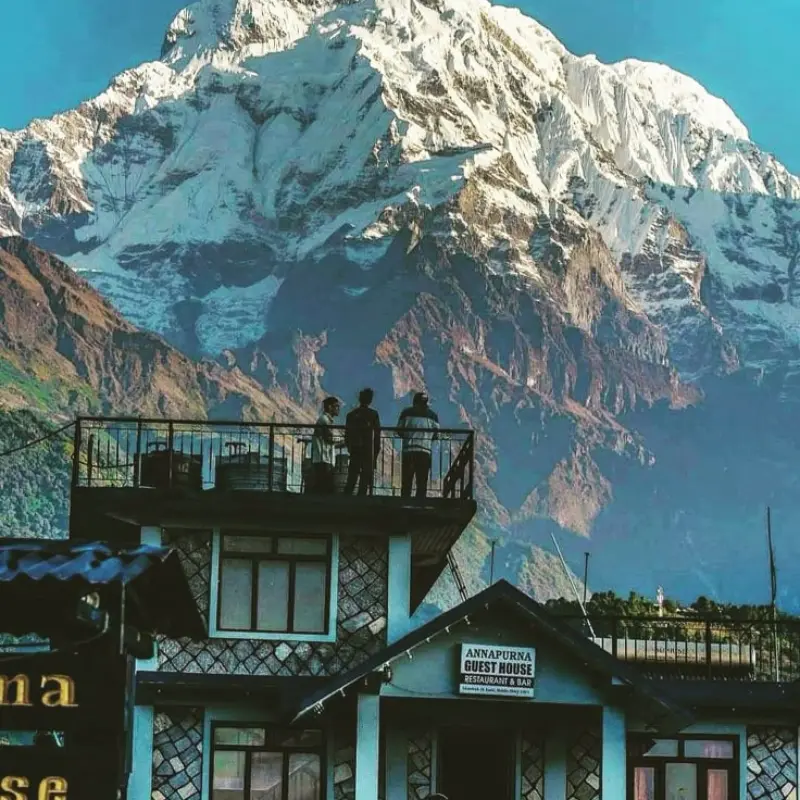
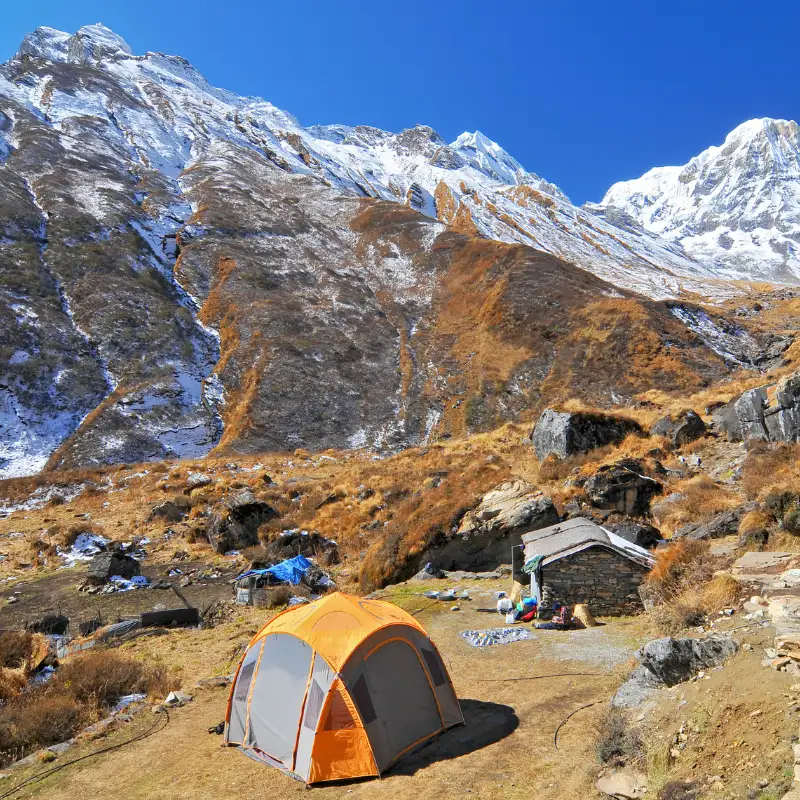
- Annapurna Base Camp — 4,130 m / 13,549 ft: the flat, prayer-flagged plateau at the head of the Sanctuary, ringed by the Annapurna range, Machhapuchhre, Hiunchuli, Gangapurna, Singuchuli and Tent Peak.
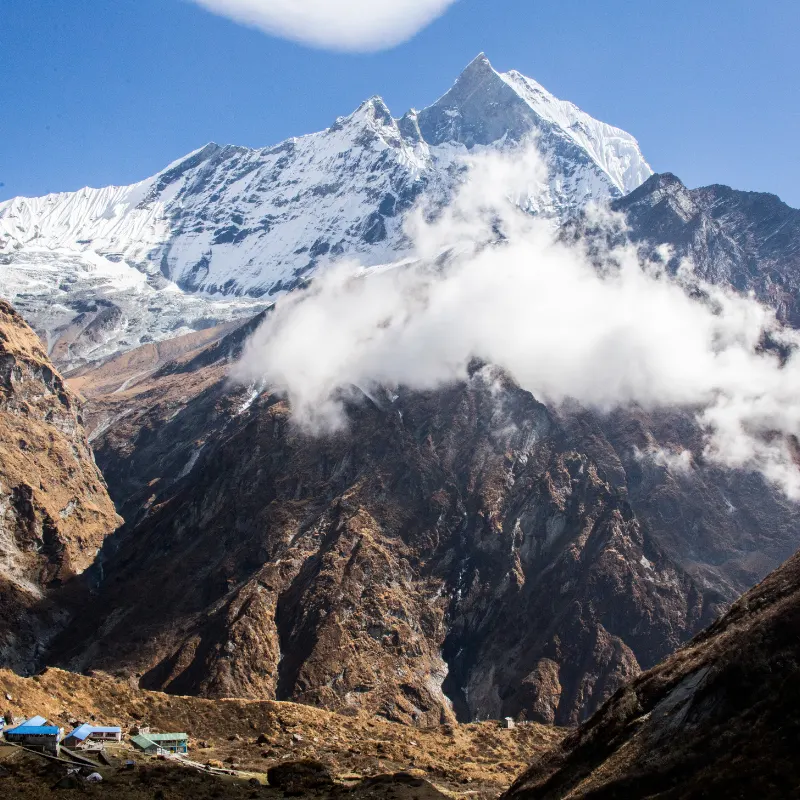
- Machhapuchhre Base Camp — approx. 3,700 m / 12,140 ft: the gateway before ABC, where Machhapuchhre (Fishtail, 6,993 m / 22,943 ft) dominates the sky in almost every direction.
- Chomrong — 2,170 m / 7,119 ft: the famous Gurung village on the slopes overlooking the Sanctuary, reached via the Chomrong Khola suspension bridge and long stone stairways.
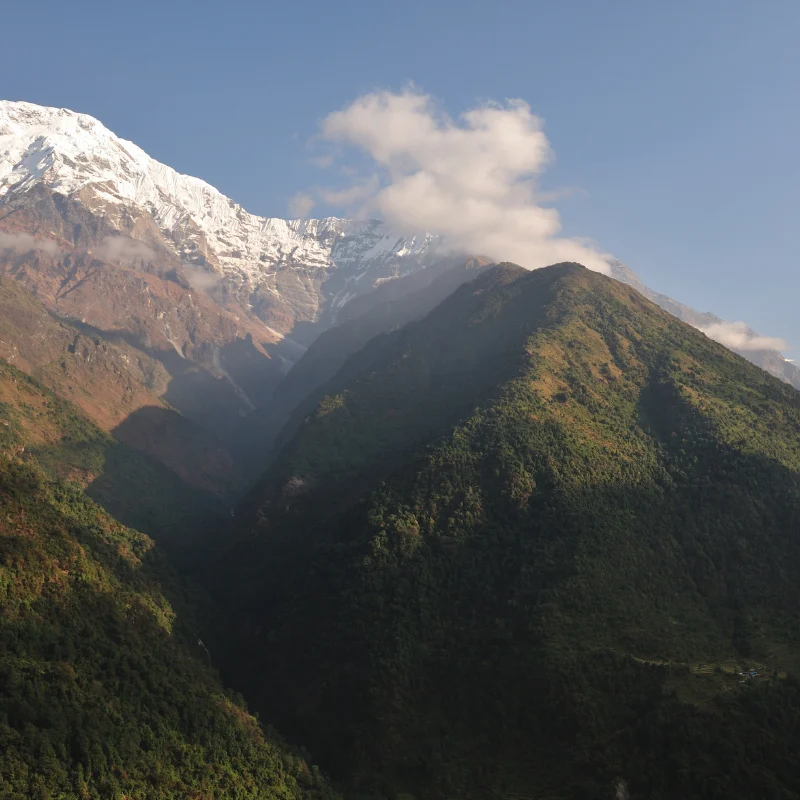
- Sunrise helicopter exit — 4,130 m / 13,549 ft to 850 m / 2,789 ft: the scenic flight from ABC to Pokhara, over the very valley you walked, with Annapurna I (8,091 m / 26,545 ft) and the glaciers passing below.
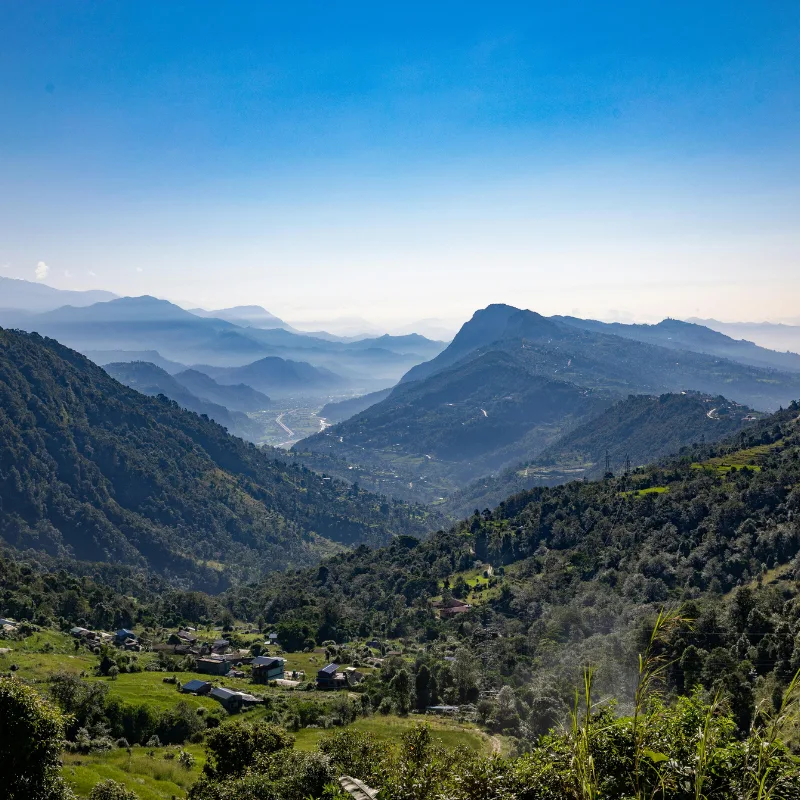
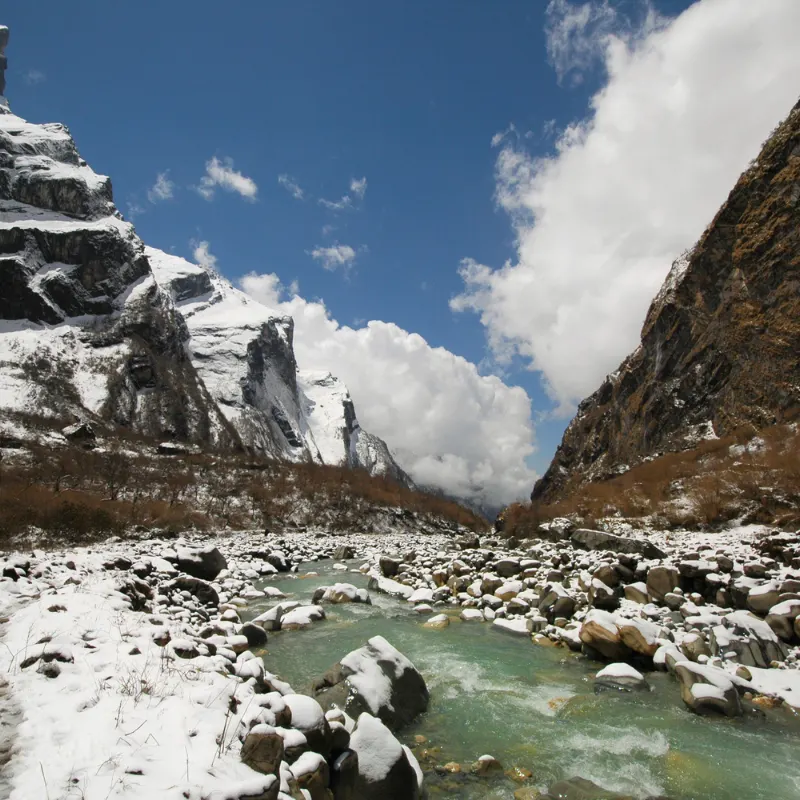
- The Modi Khola valley: terraced fields, Gurung villages, rhododendron and bamboo forest, waterfalls and the calm no-loud-noise temple section around Dovan.
- Sinuwa, Bamboo and Khuldighar stops: the mid-valley teahouse settlements on the way up from Chomrong to Dovan, where the forest is still thick and the trail is punctuated by stone staircases.
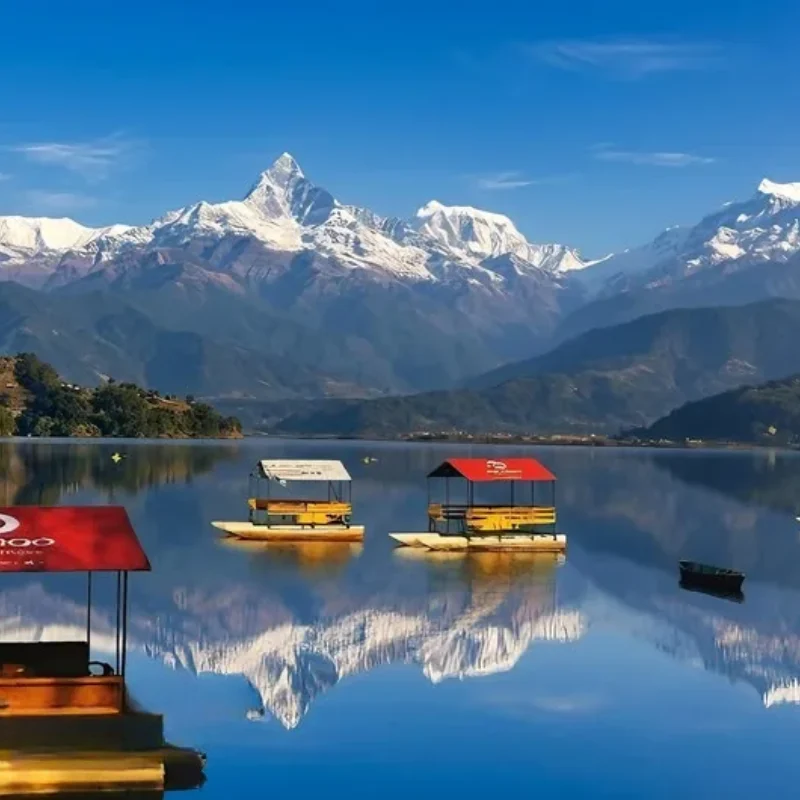
- Pokhara’s lakes and peaks: from the lakeside city you see Phewa, Begnas, Rupa and the rest of Pokhara’s eight lakes, with Annapurna, Machhapuchhre, Dhaulagiri, Manaslu and Lamjung Himal on the horizon.
- Kathmandu’s cultural beginning and end: arrival day in Thamel, mountain flight, and the celebration dinner that closes the trek — culture at both ends of the adventure.
Annapurna Base Camp Helicopter Return Trek Overview
The Annapurna Base Camp Helicopter Return Trek is an 8-day trek in Nepal’s Annapurna region that combines the classic walk into the Annapurna Sanctuary with a scenic helicopter flight out on the final mountain day. You trek from Siwai through Chomrong, Dovan and Deurali to Annapurna Base Camp at 4,130 m / 13,549 ft over four walking days, sleep inside the Sanctuary, then fly back by helicopter to Pokhara and a domestic flight to Kathmandu. The route is graded Challenging, yet the helicopter exit is exactly what makes it special — you earn the amphitheatre on foot, then let the mountains slip away below you.
The journey begins and ends in Kathmandu. Day one is arrival in the capital; day two is the transfer to Pokhara by tourist bus (7–8 hours) or optional domestic flight (~25 minutes); days three to six take you from the roadhead at Siwai up the Modi Khola valley; day six ends at Annapurna Base Camp; day seven opens with a helicopter flight back to Pokhara, a domestic flight to Kathmandu and a celebration dinner; day eight is departure or onward travel. In four walking days you cover the same Sanctuary that standard itineraries stretch across five or six.
With Nepal Lion Tours, the Annapurna Base Camp Helicopter Return Trek starts from USD 1,545 per person, stepping down to USD 1,468 (2–4 pax), USD 1,391 (5–9 pax) and USD 1,313 (10+ pax), with a Luxury tier from USD 2,086. The price includes the guide, teahouse meals and lodging during the trek, 3-star hotels in Kathmandu and Pokhara, the helicopter flight from Annapurna Base Camp to Pokhara, the Pokhara–Kathmandu flights, permits and transfers — the complete loop with nothing hidden.
What Makes the Annapurna Base Camp Helicopter Return Trek Special?
Two experiences that rarely happen in one trip are fused into a single week: the four-day walk into the heart of the Annapurna Sanctuary, and the sunrise helicopter exit straight off the base camp plateau. Most ABC trekkers walk four days down the same valley they climbed; here you trade that return slog for a ~30-minute flight over the very trail you walked, with Annapurna I, Machhapuchhre, Gangapurna and Hiunchuli passing beneath the skids.
It is also the gentlest of the “hikes up, rides down” formulas in the Annapurnas because the maths is honest: 4 walking days in, 1 flight out. You still earn the Sanctuary, but you save the physical return — which is what makes this package attractive to trekkers who want the Amphitheatre without the 6–8 day full out-and-back commitment, grandparents and adult children travelling together, and anyone whose Nepal dates are finite.
Why Choose the Annapurna Base Camp Helicopter Return Trek?
The answer is the last mountain morning. After the Deurali → Annapurna Base Camp push on day six, you wake inside the Sanctuary, photograph the south face of Annapurna I and the Fishtail in the first light, and board a helicopter from 4,130 m / 13,549 ft instead of walking the six-hour descent back to the forest line. The flight lands you in Pokhara in the morning and puts you back in your Thamel hotel for a celebration dinner — a one-day finale that normally takes ABC trekkers three.
It also keeps your Nepal holiday shorter and lighter: 8 days including arrival, transfers and departure, with the physical peak concentrated into four trekking days. Pair it with a few golden-filtered days in Kathmandu and Pokhara — lakes, temples, paragliding — and you have a complete Annapurna trip without the dead walking time that a full out-and-back ABC trek carries on the way down.
Who Is This 8-Day Trek Suitable For?
- Hikers who want the full ABC experience but want to skip the multi-day walk back out of the Sanctuary.
- Travellers on a fixed 1–2 week Nepal itinerary — 8 days including arrival, transfers and departure.
- Couples and families who want a shared challenge with a relaxed, scenic final day.
- Moderately active travellers with 2–3 months of regular walking behind them; no technical or climbing skills needed.
- Return trekkers in the Annapurnas looking for a different perspective — flying out over the route they walked in.
- Photographers chasing the Sanctuary amphitheatre from the ground and from the air.
- Celebrations — the day-seven celebration dinner in Thamel rounds off the trek properly.
- Adventurers who enjoy the contrast of slow walking and fast flying in one unforgettable week.
You do not need trekking or mountaineering experience, but the daily 4–7 hours of walking and the stone stairways around Chomrong deserve steady legs. The highest night is Annapurna Base Camp at 4,130 m / 13,549 ft, and the helicopter-dependent finale makes the itinerary weather-aware — details covered in the sections below.
Guide’s Note — Nepal Lion Tours
“From our experience running Annapurna Base Camp departures, the helicopter return is the feature trekkers remember longest — but the Deurali to Annapurna Base Camp morning is the one we plan around. We encourage an early start, a light pack and a slow, steady rhythm on that final climb; the reward is arriving at the Sanctuary before the clouds build, with the whole amphitheatre to yourselves. On the last morning the helicopter ideally lifts off between 7:00 and 8:00 AM, when the valley weather is still calm.”
— Nepal Lion Tours, Trekking and Helicopter Operations Team
Quick Facts
Trek Fact | Details |
|---|---|
Trek Name | Annapurna Base Camp Helicopter Return Trek |
Duration | 8 days / 7 nights (4 trekking days to ABC + helicopter return) |
Region | Annapurna, Gandaki, Nepal |
Maximum Altitude | 4,130 m / 13,549 ft at Annapurna Base Camp |
Difficulty | Challenging |
Main Highlight | Trekking into the Annapurna Sanctuary and flying out by helicopter |
Start / End | Kathmandu → Kathmandu |
Route | Siwai – Chomrong – Dovan – Deurali – Annapurna Base Camp – helicopter to Pokhara – flight to Kathmandu |
Trekking Days | 4 (days 3–6), 5–7 hours walking per day |
Best Season | Spring (Mar–May) and Autumn (Sep–Nov) |
Price From | USD 1,545 per person (Standard, 1 pax); 2–4 pax $1,468; 5–9 pax $1,391; 10+ pax $1,313 |
Accommodation | Teahouse or lodge during trek, 3-star hotels in Kathmandu and Pokhara |
Guide | Licensed English-speaking trekking guide throughout |
Group Size | 1–10 pax; helicopter shared with trek companions |
Annapurna Base Camp Helicopter Return Trek Route and Elevation
The route climbs the modular ABC corridor for four days and then abandons it from the air. From the jeep roadhead at Siwai, the trail follows the Modi Khola valley through Chomrong, Sinuwa, Bamboo, Khuldighar, Dovan, Deurali and Machhapuchhre Base Camp before opening onto Annapurna Base Camp’s plateau. Day seven replaces the standard two-to-three-day walk out with a helicopter flight straight back to Pokhara, followed by a domestic flight to Kathmandu.
Annapurna Base Camp Helicopter Return Trek Route at a Glance
Day | Trek Route | Altitude | Highlights |
|---|---|---|---|
1 | Arrival Kathmandu | 1,400 m / 4,593 ft | Airport pickup, Thamel hotel, guide briefing |
2 | Kathmandu → Pokhara (bus or flight) | 1,400 m / 4,593 ft | Trishuli and Marsyangdi rivers, 7–8 h drive or 25-min flight |
3 | Pokhara → Siwai → Chomrong (jeep + trek) | 2,170 m / 7,119 ft | Chomrong Khola bridge, stone stairways, Sanctuary views |
4 | Chomrong → Dovan | 2,600 m / 8,530 ft | Sinuwa, Bamboo, Khuldighar forest trail |
5 | Dovan → Deurali | 3,230 m / 10,597 ft | Rhododendron forest, Hinku Cave, glacial river |
6 | Deurali → Annapurna Base Camp | 4,130 m / 13,549 ft | Machhapuchhre Base Camp, the Sanctuary amphitheatre |
7 | Helicopter ABC → Pokhara → Flight → Kathmandu | 1,400 m / 4,593 ft | Scenic exit flight, celebration dinner in Thamel |
8 | Kathmandu → departure or extension | 1,400 m / 4,593 ft | Transfer ~3 h before your international flight |
Annapurna Base Camp Helicopter Return Trek Elevation Profile
The walking profile is a steady 4-day staircase. From Siwai the trail climbs through Chomrong (2,170 m / 7,119 ft) — via its famous staircase of roughly a thousand steps up and the Chomrong Khola descent beneath — then continues through the forest belt to Dovan (2,600 m / 8,530 ft), up the tightening valley to Deurali (3,230 m / 10,597 ft), and finally to Machhapuchhre Base Camp (~3,700 m / 12,140 ft) and Annapurna Base Camp (4,130 m / 13,549 ft). The single biggest physical moment is the Chomrong Khola descent-and-reclimb; the most altitude-loaded moment is the Deurali → ABC section, where you gain over 900 m / 2,952 ft across roughly 4–5 hours.
Then comes the graceful part of the profile: day seven drops from 4,130 m to 850 m in about 30 minutes by helicopter instead of over three walking days. It is the only ABC itinerary where the elevation profile goes up for four days, down in thirty minutes, and still feels complete. A trekking map and printed elevation profile are supplied with the tour materials, and your guide points out the landmarks you flew over during the return.
How to Get to the Annapurna Base Camp Helicopter Return Trek
The trek starts in Kathmandu, where Nepal Lion Tours meets you at Tribhuvan International Airport and transfers you to your 3-star hotel in Thamel for the guide briefing. The next morning you move to Pokhara — by tourist bus (7–8 hours) or the optional domestic flight (~25 minutes) — and on day three continue to the Siwai roadhead by private jeep. The entire surface transfer chain, plus the helicopter and domestic flights on day seven, is arranged by the Nepal Lion Tours team.
Kathmandu to Pokhara: Flight or Road?
Option | Approx. Travel Time | Best For |
|---|---|---|
Domestic flight | ~25 minutes | Saving time and day-two energy for the trek |
Tourist bus | 7–8 hours | Scenic highway, budget-friendly (included in price) |
Private vehicle | Around 5–7 hours* | Flexible stops, private comfort |
The tourist bus is included in the package; the domestic flight is optional at an additional cost (approximately USD 90–120 one-way — confirmed at booking). The road follows the Prithvi Highway beside the Trishuli and Marsyangdi rivers past green hills and small settlements, while the flight makes a useful gift of most of the day. *Road times approximate; affected by traffic, weather and road construction.
Whichever you choose, day two ends in Pokhara, where the itinerary offers lakes you can name and mountains you can see from the valley floor: Phewa, Begnas, Rupa, Dipang, Maidi, Khaste, Gunde and Nyureni, with Annapurna, Machhapuchhre, Dhaulagiri, Manaslu and Lamjung Himal framed on the horizon.
From Pokhara to the Siwai Trailhead
On day three, a private jeep takes you from Pokhara to Siwai, the roadhead where the walking begins — usually a 1.5–2 hour drive along the road toward the Modi Khola valley. Siwai sits below the forest line, which keeps day three long but non-technical: a climb through villages and forest to Chomrong (2,170 m / 7,119 ft), crossing the Chomrong Khola suspension bridge that marks the gateway to the Sanctuary side. The transfer is included in the tour, so your only task is breakfast and a full water bottle.
Returning from Annapurna Base Camp by Helicopter
The return is the package’s signature: on day seven a helicopter lifts off from Annapurna Base Camp (4,130 m / 13,549 ft) and sets down at Pokhara Airport around 25–30 minutes later, gliding back over the trail you spent four days climbing. From Pokhara you take the short domestic flight to Kathmandu, are met at the Kathmandu Domestic Airport, and transferred to your Thamel hotel in time for the evening celebration dinner. If you prefer to discuss a direct ABC-to-Kathmandu charter or an extra night in Pokhara, the standard itinerary can be adjusted on request.
A Practical Tip for International Travellers
Keep your international departure flexible on day eight. The standard plan transfers you to Tribhuvan International Airport about 3 hours before your flight, which suits most schedules — but day-seven weather can shift the helicopter, and with it everything after. Building in one spare day in Kathmandu (for sightseeing or a delay buffer) is the safest way to enjoy the mountains without a race to the airport.
Guide’s Note — Nepal Lion Tours
“Please do not schedule your international flight for the same evening as the helicopter return unless you have a generous buffer — the ABC → Pokhara helicopter flies only in acceptable weather and visibility, exactly as CAAN rules require. In practice the morning window is reliable in spring and autumn, but a one-day buffer in Kathmandu turns a possible stress into no stress at all. We happily turn that spare day into Kathmandu sightseeing — temple circuit, garden lunch — as part of your itinerary.”
— Nepal Lion Tours, Trekking and Helicopter Operations Team
Annapurna Base Camp Helicopter Return Trek Difficulty, Fitness and Altitude
The trek is graded Challenging, and that stems from the daily walking load — 4–7 hours a day of stone stairways, forest trails, steep ascents and descents — more than from technical difficulty. There is no climbing, no ropework and no exposed scrambling; the route is a long, rewarding mountain walk with a high-altitude climax at 4,130 m / 13,549 ft. The one structural advantage this itinerary holds over the classic ABC trek is the finale: the helicopter removes the long walk back down, which is the part of the standard ABC route that wears trekkers out most.
Where the Effort Actually Is?
Two sections concentrate the hard work. The first is the Chomrong approach on day three: the stone staircase into Chomrong and, even steeper on the memory, the Chomrong Khola descent to the suspension bridge and the climb back out toward Sinuwa on day four — a singletrack staircase in the forest that demands steady legs. The second is day five to six, the ridge-line climb from Deurali (3,230 m / 10,597 ft) through Machhapuchhre Base Camp (~3,700 m / 12,140 ft) to Annapurna Base Camp (4,130 m / 13,549 ft), where the air thins and the pace slows. Everything else — bamboo forests, the gentle Himalaya section, the valley walks — is steady and pleasant.
Guide’s Note — Nepal Lion Tours
“From our experience, the hardest hour on this trek is the morning of day four — dropping from Chomrong to the Chomrong Khola bridge and climbing the far side toward Sinuwa. Trekkers underestimate it because it comes so early in the trip. The advice we give everyone: keep your pack light, use trekking poles on the downhill, and take the stairways in a slow rhythm. The Deurali → ABC climb is high but gradual by comparison, and with the helicopter on day seven, the hardest work is genuinely finished by lunchtime on day six.”
— Nepal Lion Tours, Trekking and Helicopter Operations Team
How to Prepare for the Annapurna Base Camp Helicopter Return Trek
- Walk 3–4 times a week for 2–3 months before departure, building to 5–7 hour days on rolling terrain.
- Practice stairs and hills — the most tested muscle on this trek is the one that handles the Chomrong staircases.
- Build leg strength with squats, lunges and step-ups; they make the Chomrong Khola climb-out feel manageable.
- Train with a loaded daypack so your body is used to carrying 8–12 kg (or the weight your porter will be saving you).
- Prepare for early starts — the itinerary favours morning walking and the helicopter departs ABC early on day seven.
- Avoid overtraining in the final week; arrive rested, not exhausted.
How Difficult Is This Compared with the Full ABC Trek?
The walking days mirror the first four days of the classic Annapurna Base Camp Trek, so the daily effort is the same as the standard route — but the overall toll is lighter because you skip the three-day walk back out through Dovan, Bamboo and Sinuwa, which is where cumulative fatigue and knee strain tend to appear. Measured against the Annapurna region’s harder journeys, this sits below the Annapurna Circuit’s high passes (5,416 m / 17,769 ft) and about on a par with the standard ABC trek to 4,130 m — demanding on the legs, forgiving on the knees, and graded Challenging mostly for the daily hours and altitude rather than for risk.
Altitude, Acclimatization and Safety
Annapurna Base Camp Helicopter Return Trek Altitude Profile
- Kathmandu — 1,400 m / 4,593 ft: arrival city and sleep at moderate altitude before the trek.
- Pokhara — 850 m / 2,789 ft: the lakeside base; near-lake-level air is easy on the first nights.
- Chomrong — 2,170 m / 7,119 ft: night three; above the forest line, the Sanctuary opens behind the village.
- Dovan — 2,600 m / 8,530 ft: night four, inside the narrowing Modi valley.
- Deurali — 3,230 m / 10,597 ft: night five; the top of the forest band, where the valley opens to the Sanctuary.
- Machhapuchhre Base Camp — approx. 3,700 m / 12,140 ft: the day-six climb-through below the Fishtail.
- Annapurna Base Camp — 4,130 m / 13,549 ft: the highest night of the trek, and the morning helicopter lift-off.
How the Body Adapts to Altitude
The route climbs from 850 m to 4,130 m / 13,549 ft over three nights and four days — a gradual profile close to the textbook “climb high, sleep low” pattern. The body responds by making more red blood cells and breathing more efficiently, and the itinerary supports it with steady daily gains, a night at Deurali (3,230 m) before the ABC push, and hydration and slow walking along the trail. On the ABC night, the guide keeps the group to the usual mountain rules: drink plenty, eat lightly, sleep high only once properly adapted, and tell the guide immediately if anyone feels unwell. Because the exit is a helicopter rather than a walk down, respond to symptoms without hesitation — descending is a phone call and a take-off away.
Symptoms of Altitude Sickness to Watch For
Mild symptoms that are common and manageable:
- A dull headache that eases with rest and simple pain relief.
- Fatigue or slower recovery than usual between stops.
- Shortness of breath on stairs or uphill — normal at 3,000–4,000 m.
- Loss of appetite or mild nausea in the evening.
- Poor sleep at Annapurna Base Camp, common at 4,130 m / 13,549 ft.
Signs that should end the ascent immediately:
- A worsening headache that does not respond to rest or medication.
- Repeated vomiting or constant nausea.
- Confusion, clumsiness or slurred speech.
- Breathlessness while sitting still.
- A cough producing frothy or discoloured sputum — a serious signal.
If any of these appear, the correct action is the same on every ABC itinerary: stop climbing, descend, and get advice. On this trek descending is fast and certain — the helicopter on standby, or the walk back to Deurali under the guide’s care.
How Nepal Lion Tours Supports Altitude Safety
- A gradual 4-day profile with a night at Deurali (3,230 m / 10,597 ft) and steady daily gains towards 4,130 m / 13,549 ft.
- Licensed English-speaking guides trained to recognise AMS and to adjust the plan calmly.
- Early communication culture — trekkers are encouraged to report any symptom, no matter how small.
- A short sleep-high night — one night at ABC only, followed by descent (or helicopter) the next morning.
- Insurance and evacuation guidance — travel insurance covering trekking to 4,130 m, helicopter travel and emergency rescue is required; the team briefs you on it before departure.
Best Time to Trek the Annapurna Base Camp Helicopter Return Trek
The best time for the Annapurna Base Camp Helicopter Return Trek is spring (March to May) and autumn (September to November), the two seasons of stable skies in the Annapurnas. Both matter twice over on this itinerary: good weather means good walking and, critically, a reliable helicopter window on the final mountain morning.
Season | Months | Weather & Trail Conditions | Mountain Views | Overall |
|---|---|---|---|---|
Autumn | Sep–Nov | Post-monsoon clear skies, dry trails | Outstanding, wide-open Sanctuary | Best overall |
Spring | Mar–May | Warming days, blooming rhododendrons | Excellent on clear mornings | Highly recommended |
Winter | Dec–Feb | Cold nights, possible snow above 3,000 m | Good on crisp clear days | Good with preparation |
Monsoon | Jun–Aug | Wet, muddy trails, leeches, thick cloud | Frequently limited | Less suitable |
Autumn — September to November
Autumn is the classic Annapurna season and the strongest option for this trek. October and November deliver the most reliable stretches of cloud-free mornings, dry stone stairways, and the crispest views of Annapurna I, Machhapuchhre and the Sanctuary walls — and the same stability favours the day-seven helicopter. Expect popular teahouses to fill earlier in these months; booking dates in September–November well ahead is sensible, and mornings at Chomrong, Deurali and ABC are cold enough for a good down jacket.
Spring — March to May
Spring runs from March through May and is the second peak window, especially loved for the rhododendron forests around Sinuwa, Bamboo and Dovan, which bloom in pink and red alongside the trail. The weather is slightly more variable than autumn — generally fine mornings, the occasional afternoon build-up — but the early-start itinerary keeps walking ahead of it, and the helicopter still flies in the stable morning window. April and early May are the sweet spots.
Winter — December to February
Winter is quieter and much colder. Days in the forest are pleasant, but nights at Deurali (3,230 m / 10,597 ft) and Annapurna Base Camp (4,130 m / 13,549 ft) drop well below freezing, snow can dust the upper trail, and a few ABC lodges close for the season. Crisp blue-sky days pair brilliantly with the helicopter, but you need the right gear — the four-season sleeping bag from Nepal Lion Tours’ kit and proper cold layers. Travellers comfortable with winter trekking and flexible about one day’s delay get the mountain almost alone.
Monsoon — June to August
Monsoon (June to August) is the least suitable season. Trails turn muddy, leeches appear in the forest belt, and the Sanctuary spends much of the time wrapped in cloud. It is also the season when the helicopter is most likely to be grounded by low ceilings at ABC. Flights and treks can work in a clear spell, but only with flexible days and realistic expectations; for the full magic of the helicopter return, our honest advice is to choose spring or autumn instead.
Which Season Should You Choose?
Choose autumn (Sep–Nov) for the best overall combination of trail conditions, views and helicopter reliability; choose spring (Mar–May) for the blooming forests and excellent weather. Winter rewards well-prepared trekkers with quiet trails and piercing clarity, and monsoon is best avoided. Whatever the season, the itinerary’s early starts and the ABC morning take-off window are your best friend — the mountains cooperate most before the day’s clouds arrive.
Guide’s Note — Nepal Lion Tours
“On a clear autumn or spring morning the view from Annapurna Base Camp opens in the traditional order: Annapurna I and Hiunchuli first, the Fishtail catching light soon after. We aim for the helicopter to lift off around 7:00–8:00 AM — early enough to beat valley clouds, late enough for camera-gold on the amphitheatre. If cloud sits low on the Sanctuary, our operators watch the trend and rebook to the next clear morning; that is one more reason to keep a spare day in your plan.”
— Nepal Lion Tours, Trekking and Helicopter Operations Team
Annapurna Base Camp Helicopter Return Trek — Permits and Regulations
The trek enters the Annapurna Conservation Area (ACA) from the moment you cross into the Modi Khola valley, so Annapurna Conservation Area Permit (ACAP) and the trekker TIMS (Trekkers’ Information Management System) entry are required, and Nepal Lion Tours arranges both as part of the pre-trek paperwork. The helicopter exit also sits inside the Annapurna Conservation Area, plus the routine CAAN flight clearance handled by the helicopter operator.
Annapurna Base Camp Helicopter Return Trek Permits at a Glance
Requirement | Who Needs It? | Who Arranges It? |
|---|---|---|
Annapurna Conservation Area Permit (ACAP) | All foreign and SAARC trekkers in the ACA | Nepal Lion Tours |
TIMS (Trekkers’ Information Management System) | Trekkers on the walking section of the route | Nepal Lion Tours |
Passport / photo ID | All trekkers, for permit issue and checks | Carried by the trekker |
Helicopter flight paperwork | All helicopter passengers (CAAN manifest) | Nepal Lion Tours / helicopter operator |
Restricted-area permit | Not required for this route | N/A |
Annapurna Conservation Area Permit (ACAP)
The Annapurna Conservation Area is Nepal’s largest protected area, and every trekker walking to Annapurna Base Camp needs the ACAP entry — valid for the whole route from Siwai through Chomrong to ABC. The current fee schedule is approximately NPR 3,000 for foreign nationals and NPR 1,000 for SAARC nationals (government rates change; confirmed at booking). Issue requires your passport details, and Nepal Lion Tours manages the processing so the card is ready before you leave Kathmandu.
TIMS — Trekkers’ Information Management System
The TIMS card is the trekker registration that records your route and emergency contact details with the Nepali authorities, and it applies on the walking days of this itinerary. It sits alongside the ACAP as the standard two-permit pair for ABC-route treks. The TIMS fee varies by nationality and current regulations — confirmed at booking. Both permits are checked at a few points along the trail, so carry your original passport to match the paperwork.
Do You Need a Restricted-Area Permit?
No. The Annapurna Base Camp Helicopter Return Trek follows the open-access Annapurna Conservation Area corridor and requires no restricted-area permit — restricted zones such as Upper Mustang and Manaslu sit on different routes entirely. The only “restriction” to note is operational: the helicopter flight needs CAAN weather minima and a booked landing slot, which the operator clears before the morning of day seven.
Who Arranges the Permits and Flight Paperwork?
Nepal Lion Tours handles the permits and flight logistics together. When you book, we collect passport details for the ACAP and TIMS applications and for the CAAN helicopter manifest, and everything is prepared before your briefing on day one. The helicopter slot from ABC to Pokhara is booked around your trek dates and confirmed in the day-one briefing; if weather reshuffles the flight, our team rebooks it to the next available clear window. Government fees and aviation rules are revised periodically, so the figures confirmed at booking are the ones that count.
Food and Accommodation on the Annapurna Base Camp Helicopter Return Trek
The trek uses the teahouse system end to end: B/L/D meals and twin-sharing rooms at simple mountain lodges during the walking days, 3-star hotels in Kathmandu (Thamel) and Pokhara on the city nights, and the celebration dinner in Kathmandu on day seven. Guides coordinate rooms and order times, so you walk, arrive, eat and sleep without juggling logistics.
Tea House Accommodation on the Annapurna Base Camp Trek
The teahouses along the Chomrong–Dovan–Deurali–ABC corridor are the standard Nepali mountain lodges — simple, clean, and wonderfully social. Expect twin-sharing rooms with mattresses and blankets, a shared dining room with a wood stove where everyone gathers, and meals cooked to order from the printed menu. Facilities vary with altitude: Chomrong and Sinuwa lodges are larger and more comfortable; the ABC lodges at 4,130 m / 13,549 ft are simplest, with basic rooms and a hot, busy dining hall. Bigger stops often have attached bathrooms and hot water, while smaller high camps keep showers and charging simple.
What Food Is Available on the Trek?
The menus follow the classic Nepali trekking repertoire — and the golden rule is dal bhat (lentil soup with rice) for energy: the local favourite, served with vegetables, and usually the largest and most satisfying portion on the menu. Around it you will find momos (dumplings), vegetable chowmein and fried rice, pasta, soups, potatoes, eggs, porridge, pancakes and toast. Vegetarian food is widely available — the standard across the Annapurna teahouses — and vegans, gluten-free diets and food allergies can be managed with notice, as long as the kitchen is told early. Coffee, tea, hot chocolate and the always-popular masala tea round off most dinners.
What Food and Accommodation Are Included?
Included in the Package | Usually Paid Separately |
|---|---|
B/L/D during trekking days (3–6) at teahouses | Drinks (soft drinks, beer, extra snacks) at lodges |
Breakfast on transfer and flight days (2, 7, 8) | Hot showers at some teahouses (NPR 200–300 typical) |
3-star hotels in Kathmandu (2 nights) and Pokhara (1 night) | Meals not listed on day 1 or others unless stated |
Helicopter flight ABC → Pokhara and domestic flights Pokhara ↔ Kathmandu | Wi-Fi charges at some teahouses |
Celebration dinner in Kathmandu on day 7 | Tips for the guide, porter and crews |
Teahouse meal orders coordinated by the guide | Alcoholic drinks and personal expenses |
The details can shift slightly by tier and booking date, so the final inclusions are confirmed at booking.
Drinking Water on the Trek
Assume tap water is not safe to drink at teahouses. Use boiled water (boil in the dining room or order a factory-sealed bottle), purification tablets or drops, or a filter bottle — the standard trio of choices on ABC routes. Carry a reusable bottle and refill from the kettle at each lodge; this reduces plastic and keeps you drinking the 2–3 litres a day the altitude favours. Many lodges sell bottled water at a premium and boiled water cheaply or free — ask your guide and he will point you to the honest option at each stop.
Staying Comfortable at Teahouses
- Carry a refillable water bottle and fill it with boiled or treated water whenever you stop.
- Bring a four-season sleeping bag — Nepal Lion Tours provides one; nights at ABC are cold.
- Carry a power bank — wall sockets are shared and scarcer at high lodges.
- Keep cash in NPR for showers, drinks, charging and teahouse extras.
- Use the layer system — the dining room is warm, the room is cold; plan for both.
- Tell us about dietary needs early so the kitchens can prepare.
Why Book with Nepal Lion Tours?
Nepal Lion Tours is a registered trekking company based in Kathmandu with years of Annapurna experience, and this helicopter-return package joins together everything we do well: certified guides, verified operators, pre-arranged permits, steady teahouse logistics and a licensed helicopter operator for the day-seven flight.
- Local, licensed English-speaking guides.
Your trek is led by a government-licensed English-speaking guide with real ABC-route experience — and Chinese, Korean and Hindi speaking guides are available on request.
- A registered trekking company you can verify.
Nepal Lion Tours is a registered trekking company in Kathmandu, and company and licence details are provided to travellers on request. You book directly with the operator who runs the trek, not through a chain of middlemen.
- Private departures from two trekkers.
The package runs as a private departure from just two trekkers — your dates, your pace, your guide. The standard group size is 1–10 pax, and the helicopter flies with your own trek group, not strangers.
- The one itinerary that walks in and flies out.
The signature logic of this trek — four walking days to the Sanctuary, a helicopter exit from Annapurna Base Camp — removes the hardest days of the return and is the reason this package exists.
- Helicopter and flight logistics handled end to end.
The ABC → Pokhara helicopter, the Pokhara ↔ Kathmandu domestic flights, the jeep to Siwai and the hotel transfers are all arranged by one local team, and permit and flight paperwork is prepared before you arrive.
- Transparent pricing with group discounts.
The Standard tier steps down from USD 1,545 (1 pax) to USD 1,468 (2–4 pax), USD 1,391 (5–9 pax) and USD 1,313 (10+ pax); the Luxury tier runs from USD 2,086 (1 pax) down to USD 1,773 (10+ pax) — clear per-person rates published up front.
- A local team you can contact before and during the trek.
From your first enquiry to the celebration dinner, our Nepal-based office answers on WhatsApp and phone throughout the journey, and the 24/7 response guarantee covers every departure.
Book the Annapurna Base Camp Helicopter Return Trek
Eight days. Four walking days to the roof of the Annapurna Sanctuary, one helicopter morning over the valley you climbed, and a celebration dinner in Thamel to finish. The Annapurna Base Camp Helicopter Return Trek is the complete ABC experience for trekkers who want all the reward without the long walk out.
Annapurna Base Camp Helicopter Return Trek at a Glance
- Duration: 8 days / 7 nights; 4 trekking days (3–6), transfer and flight days around them.
- Price: from USD 1,545 per person (Standard); $1,468 (2–4 pax), $1,391 (5–9 pax), $1,313 (10+ pax); Luxury from USD 2,086.
- Difficulty: Challenging; daily walking 4–7 hours; solid moderate fitness recommended.
- Maximum Altitude: 4,130 m / 13,549 ft at Annapurna Base Camp.
- Accommodation: teahouse/lodge on trek; 3-star hotels in Kathmandu and Pokhara.
- Meals: B/L/D on trekking days; breakfast on transfer/flight days; celebration dinner day 7.
- Permits & registration: ACAP + TIMS arranged by Nepal Lion Tours; helicopter flight cleared by the operator.
- Transportation: KTM airport transfers, tourist bus or optional flight KTM ↔ Pokhara, jeep to Siwai, helicopter ABC → Pokhara, domestic flight Pokhara → KTM.
- Guide: licensed English-speaking trekking guide throughout.
- Cancellation: free cancellation up to 14 days before departure (subject to booking terms).
Ready to Start Your Annapurna Adventure?
Send us your preferred departure date and group size through the booking form or WhatsApp at +977-9851039020, and tell us whether you want the included tourist bus or the optional domestic flight to Pokhara. We will confirm your per-person tier (USD 1,545 / 1,468 / 1,391 / 1,313), book the helicopter slot from Annapurna Base Camp, arrange the permits and flights, and prepare your hotel and teahouse bookings before you arrive.
Your Annapurna Sanctuary is waiting — walk it in, fly it out, and let the mountains wave goodbye.
Related Annapurna Treks and Tours
The Annapurna region offers every rhythm from 1-day helicopter views to two-week crossings of the massif. If the helicopter-return idea suits you, these packages map the same Sanctuary and its surroundings at different speeds.
Trek | Duration | Difficulty | Max Altitude | Best For |
|---|---|---|---|---|
Annapurna Base Camp Helicopter Tour | 1 day | No trekking | 4,130 m / 13,549 ft | Fly-in, fly-out look at the Sanctuary |
Ghorepani Poon Hill Trekking | 4 days | Easy–Moderate | 3,210 m / 10,531 ft | Short sunrise-viewpoint getaway |
Poon Hill Teahouse Trekking | 7 days | Easy–Moderate | 3,210 m / 10,531 ft | Slower village-paced trekking |
Annapurna Panorama View Trek | 9 days | Easy–Moderate | 3,210 m / 10,531 ft | Wider foothill scenery, villages and views |
Annapurna Base Camp Trek | 10–12 days | Moderate | 4,130 m / 13,549 ft | The full out-and-back Sanctuary trek |
Annapurna Circuit Trek | 14–18 days | Moderate–Challenging | 5,416 m / 17,769 ft | Long high-altitude circumnavigation |
The 1-day Annapurna Base Camp Helicopter Tour pairs naturally with this trek for trekkers who want a preview (or a second visit) of the landing zone. A day in Pokhara on either side — lakeside walking, paragliding, the World Peace Pagoda — or a Chitwan Jungle Safari after trekking completes a rounded Nepal holiday, all arrangeable through the Nepal Lion Tours team.
Trip Essentials
Packing advice, required equipment & gear recommendations
Essential
Packing List for the Annapurna Base Camp Helicopter Return Trek
This is a teahouse trek with a flight out, so the pack is the classic spring/autumn ABC list — lighter version. All in, aim for a main rucksack of 15–20 kg (or one porter, included on request) plus a 20–30 litre daypack you carry with water, snacks, layers and documents.
Hiking Gear for the Trek
- Hiking boots, broken in — the Chomrong stone stairways demand grip and ankle support.
- Trekking poles — genuinely worth their weight on the Chomrong Khola descents and the final Deurali → ABC climb.
- 20–30 litre daypack with a rain cover.
- Main rucksack or duffel (Nepal Lion Tours provides a duffel bag) for porter or luggage transfer.
- Water bottles or bladder (2–3 L capacity) with purification tablets or a filter.
- Headlamp or torch with spare batteries — teahouse dining rooms go dark early.
- Multi-tool or small knife and sealing bags for wet gear.
Clothing: Use Layers Rather Than Bulk
- Base layers — a moisture-wicking long-sleeve top (merino or synthetic); wear it every walking day.
- Mid-layers — a fleece or light down jacket for the mornings and the ABC evening.
- Outer layers — a waterproof shell with hood; the valley has passing rain in every season.
- Trekking clothes — 2–3 walking shirts and trekking trousers (convertible zip-offs handy); one warm pair of trousers for lodge evenings.
- Headwear and gloves — a beanie, sun hat and light gloves; the early ABC morning is cold.
- Underwear and socks — 3–4 pairs of wool/polyester socks; change daily and air them at dinner.
- Sleeping liner for extra warmth and hygiene inside the provided four-season sleeping bag.
Sleeping and Evening Comfort
- Four-season sleeping bag — provided by Nepal Lion Tours if you need it; nights at ABC drop below freezing.
- Comfortable lodge clothes for the dining room (light fleece trouser set).
- Inflatable pillow or buff-style pillowcase if you like.
- Earplugs and a sleep mask — lodges share thin walls and early risers.
Toiletries and Personal Health Items
- Personal medication and prescriptions (pack in your daypack, not the main bag).
- First-aid basics kept with the guide: plasters, antiseptic, blister pads.
- Sun cream (SPF 30+), lip balm with SPF, moisturiser.
- Hand sanitiser and wet wipes — teahouse bathrooms vary.
- Toothbrush, toothpaste, small towel, tissues.
- Personal hygiene items (feminine products, etc.).
- Insect repellent for the lower forest sections (essential in monsoon).
- Rehydration salts or electrolyte tablets for long trekking days.
- Pain relief suitable for altitude headaches (paracetamol-style), if your doctor approves.
- Blister plasters — your best friend on stone stairways.
- Small scissors or nail clippers.
- Thermometer — the guide will ask about symptoms, not numbers, but it helps.
- Spare glasses or contact-lens supplies if you wear them.
Electronics
- Smartphones charged each evening; in-flight photos the priority on the helicopter morning.
- Power bank (10,000–20,000 mAh) for daily recharges on the trail.
- Camera with spare battery and memory card — the Sanctuary and the helicopter deserve it.
- Charging cables and a Nepal adapter (Type C/D).
Documents and Money
- Passport and a copy (digital and paper) — needed for ACAP/TIMS and hotel check-ins.
- Nepali rupees in cash — showers, drinks, snacks, tips (the ATMs in Pokhara are your last reliable stop).
- Travel insurance documents and emergency numbers.
- Flight and booking confirmations printed or offline.
- Local SIM or eSIM — arranged with the briefing materials for connectivity on the trail.
How Much Should You Pack?
Pack lighter than you fear is the rule. The classic ABC formula is a main bag of 12–15 kg carried by porter or yourself, plus a daypack under 8 kg. The provided down jacket, sleeping bag and duffel come from Nepal Lion Tours, so you are not buying or hauling cold-weather kit across the world. Everything that isn’t essential — dressy clothes, extra electronics, full-size toiletries — stays behind in your Kathmandu or Pokhara hotel; the trail is a place for light packs and heavy views.
Read Before You Book
Permits, terms, medical considerations & advisory guidelines
Advisory
What to Know Before Booking
A few practical points make the Annapurna Base Camp Helicopter Return Trek run smoothly — read them alongside the itinerary.
Accommodation and Facilities
City nights use 3-star hotels in Kathmandu (Thamel) and Pokhara, each with private bathrooms, hot water, wi-fi and safes. Mountain nights use teahouse lodges where rooms are twin-sharing and facilities vary — Chomrong and Sinuwa are the most comfortable, Dovan and Deurali are solid mid-trail, and the ABC lodges at 4,130 m / 13,549 ft are basic but atmospheric. Attached bathrooms and hot showers are common lower down; at the top expect shared facilities and cold water taps — the price of sleeping inside the Sanctuary.
Food and Dietary Requirements
The package covers B/L/D on trekking days, breakfast on transfer/flight days, and the celebration dinner on day seven. Teahouse kitchens cook the standard dal bhat – momo – noodle repertoire, with vegetarian food as the norm across the Annapurnas. Vegans, gluten-free diners and allergy sufferers will be well catered for with advance notice — tell us at booking and confirm again with your guide on day one.
Altitude, Health and Insurance
The route sleeps at 4,130 m / 13,549 ft, so travel insurance covering trekking above 4,000 m plus helicopter ride and emergency evacuation is essential — some policies exclude mountain flying, so check the fine print against this itinerary. Trekkers with heart, lung or blood-pressure conditions, or previous altitude problems, should get medical clearance before booking, and everyone should be honest with the guide about symptoms.
Money and Tipping
Carry Nepali rupees in cash for teahouse extras — hot showers (NPR 200–300), drinks, snacks, wi-fi at some lodges, and tips. Tipping is voluntary but customary: a typical guideline for the ABC region is USD 10–15 per day for your guide and USD 6–8 per day per porter, adjusted to what you feel was delivered. ATMs are plentiful in Kathmandu and Pokhara; there are none on the trail.
Culture and Responsible Trekking
- Respect the no-noise tradition near the temple section around Dovan — silence is part of the experience.
- Carry out everything you carry in; the Sanctuary is a protected area, and the rule is carry in, carry out.
- Take photos of prayer flags and chortens freely, but do not lean on or move them.
- Stay on the trail — shortcuts cause erosion and harm fragile alpine plants.
- Support teahouses fairly — buying tea or a soda at each lodge you overnight in keeps the system healthy.
- Ask before photographing people, especially in villages.
Route Options
The standard loop is fixed at 8 days: Kathmandu → Pokhara → Siwai → ABC → helicopter → Kathmandu. Options that fit the same skeleton: the optional domestic flight Kathmandu ↔ Pokhara (day 2), an extra acclimatisation or photography day at ABC (a 9th day), a stay in Pokhara after day seven, a direct helicopter from ABC to Kathmandu on request, and a porter for the walking days. Combine with a Poon Hill add-on or a Chitwan safari for a fuller Nepal holiday.
Booking and Before You Arrive
Make sure you understand the following before you confirm:
- A passport is required for the ACAP and TIMS permits and the helicopter manifest.
- The helicopter is weather-dependent — day seven may shift by a day in poor conditions; keep buffers.
- Total price depends on group size — per-person rates step down to USD 1,313 at 10+ pax.
- Pack light — porters carry to 15–20 kg; your daypack must cover the whole walking day.
- Cash in NPR beats cards on the trail; withdraw in Pokhara at the latest.
- Peak season fills fast — October, November, April and May dates need early booking.
- Insurance must be arranged before arrival and shown to the team at the briefing.
A Few Final Tips
Arrive in Kathmandu a day before day one if you are flying long-haul, so jet lag does not steal the day-two bus ride from you. Take trekking poles — the downhill staircases repay them every day. Trust the early starts: they buy you clear mountain light, the best teahouse tables, and the best helicopter weather. And on the last morning, sit on the ABC plateau with your camera ready — the flight hangs over everything you earned, and it is worth a good look before you go.
Day-by-Day Itinerary
Explore each day's route, trekking elevation, and activities
Our representative will meet you at Tribhuvan International Airport and arrange a private transfer to your hotel. After checking in, you can relax after your journey or take some time to explore the fascinating attractions of Kathmandu.
Later, you will meet your trekking guide and receive a detailed briefing about the Annapurna Base Camp Trek with Helicopter Return. Any required trekking equipment can also be arranged or provided during the briefing.
After an early breakfast, you will board a tourist bus for the scenic journey from Kathmandu to Pokhara. The drive takes approximately 7 to 8 hours. Along the way, you can enjoy views of the Trishuli and Marsyangdi rivers, lush hills, rocky mountain landscapes, small settlements, and cascading streams.
For travelers who prefer to save time, we can also arrange a domestic flight from Kathmandu to Pokhara at an additional cost. The flight takes around 25 minutes, giving you more time to explore the beautiful Pokhara Valley.
Pokhara is renowned for its beautiful lakes, including Phewa, Begnas, Rupa, Dipang, Maidi, Khaste, Gunde, and Nyureni. From the valley, you can also enjoy views of magnificent peaks such as Annapurna, Machhapuchhre, Dhaulagiri, Manaslu, and Lamjung Himal.
After breakfast, you will leave Pokhara by jeep and drive toward Siwai, where your trekking adventure begins. From Siwai, the trail gradually leads toward Chomrong through beautiful Himalayan landscapes.
The route takes you through lush forests, traditional villages, and stone stairways. You will cross the Chomrong Khola via a suspension bridge before continuing through the forest toward Sinuwa. The trail then passes through Bamboo and Khuldighar before continuing toward the higher settlements.
As you progress along the trail, you will experience a mixture of steep ascents, descents, and forested paths before reaching Chomrong, a beautiful village situated on the slopes overlooking the Annapurna Sanctuary.
After breakfast, you will continue your Annapurna Base Camp Trek with Helicopter Return from Chomrong toward Dovan.
The trail begins with a descent along stone steps toward the Chomrong Khola, followed by a crossing over a suspension bridge. From there, the path climbs gradually toward Sinuwa and continues through dense Himalayan forests.
You will pass through Bamboo and Khuldighar before following the trail deeper into the valley. The route includes forested sections, steep descents, and gradual climbs as you make your way toward Dovan, located within the Annapurna Sanctuary.
Today's trek takes you deeper into the Annapurna Sanctuary as you travel from Dovan toward Deurali.
The trail passes through peaceful bamboo and rhododendron forests, with several waterfalls and streams along the route. Because of a nearby temple, loud noises are traditionally avoided in parts of the forest, creating a particularly calm atmosphere during the walk.
After reaching Himalaya, the landscape gradually changes as the forest becomes thinner and glacial rivers and open sections appear. You will continue toward Hinku Cave before following the trail toward Deurali. The route descends briefly toward the river before climbing again to reach Deurali, where you can enjoy impressive views of the surrounding valley.
Today is one of the major highlights of the Annapurna Base Camp Trek with Helicopter Return as you make your way to Annapurna Base Camp.
After leaving Deurali, you will gradually ascend toward Machhapuchhre Base Camp (MBC). From here, magnificent Himalayan peaks surround you from almost every direction, including Annapurna, Machhapuchhre, Gangapurna, and Hiunchuli.
The trail then continues through the Annapurna Sanctuary toward Annapurna Base Camp at 4,130 meters. The vegetation becomes increasingly sparse as you gain altitude, while the surrounding mountain scenery becomes more dramatic.
Upon reaching ABC, you will be rewarded with spectacular views of the snow-covered Annapurna range, Machhapuchhre, Hiunchuli, Singuchuli, Tent Peak, and other Himalayan peaks. As the area can be exposed to avalanche risks, your guide will advise you to follow the appropriate safety precautions.
After enjoying the spectacular surroundings of Annapurna Base Camp, you will begin your return journey by helicopter.
Instead of retracing the trekking trail, you will board a scenic helicopter flight from Annapurna Base Camp to Pokhara. The flight provides an incredible aerial perspective of the Annapurna region, allowing you to appreciate the dramatic Himalayan peaks, valleys, glaciers, and landscapes from above.
The helicopter journey offers a memorable and comfortable conclusion to your trekking adventure. After landing at Pokhara Airport, you will take a domestic flight back to Kathmandu.
Upon arrival at Kathmandu Domestic Airport, our representative will meet you and transfer you back to your hotel in Thamel. In the evening, you can enjoy a celebration dinner marking the successful completion of your Annapurna Base Camp Trek with Helicopter Return.
Your Annapurna Base Camp Trek with Helicopter Return officially comes to an end today.
A private vehicle will transfer you from your hotel to Tribhuvan International Airport approximately 3 hours before your scheduled flight. If you have additional time in Nepal, you can also extend your stay or arrange another adventure with us.
Want to customize this itinerary?
Tailor duration, lodges, acclimatization days, or add private helicopter flights.
Inclusions & Exclusions
Everything that is covered and what you'll need to budget separately
What is Included
Fully covered in your package price
- Private vehicle transfers will be provided for both your airport arrival and departure.
- Your Kathmandu and Pokhara stays will be arranged on a bed-and-breakfast basis, following the accommodation plan outlined in the Annapurna Base Camp Trek with Helicopter Return itinerary.
- During the trekking days, you will stay in comfortable local teahouse lodges.
- Breakfast, lunch, and dinner will be provided throughout the trek.
- The required Trekkers’ Information Management System (TIMS) permit will be arranged.
- Your Annapurna Conservation Area Permit (ACAP) will be included and prepared before the trek.
- Private vehicle transportation will be provided for all ground transfers specified in the itinerary.
- A highly experienced and professional trekking guide will accompany you throughout the journey.
- The guide and supporting staff will receive their meals, accommodation, insurance, salary, and required clothing.
- A chartered helicopter will transport you directly from Annapurna Base Camp to Pokhara.
- After reaching Pokhara, your onward journey to Kathmandu will be covered by a regular scheduled flight.
- A farewell dinner will be arranged in Kathmandu at the end of the trip.
- Government taxes, VAT, service charges, and all necessary documentation and paperwork are included.
What is Excluded
Personal expenses & optional extras
- Personal travel and medical insurance are not included in the package.
- Any personal expenses incurred during the journey will be your own responsibility.
- Alcoholic beverages, bar charges, and other drinks are excluded.
- Tips and gratuities for the guide and other staff are not included.
Our Customer Reviews
Authentic experiences and feedback from our travelers
Write a Review
Share your adventure experience with other travelers
Thank You!
Your review has been submitted and is awaiting approval.
Please Wait
You've submitted several reviews recently. Please wait a few minutes before trying again.
No reviews yet
Be the first to share your experience with this trek!
Frequently Asked Questions
Essential information on preparation, route specifics, safety standards, and logistical details.