Annapurna Circuit Trek with Tilicho Lake — 15 Days | Nepal Lion Tours
A spectacular Himalayan journey through Manang, Tilicho Lake, Thorong La Pass, and the Annapurna region.
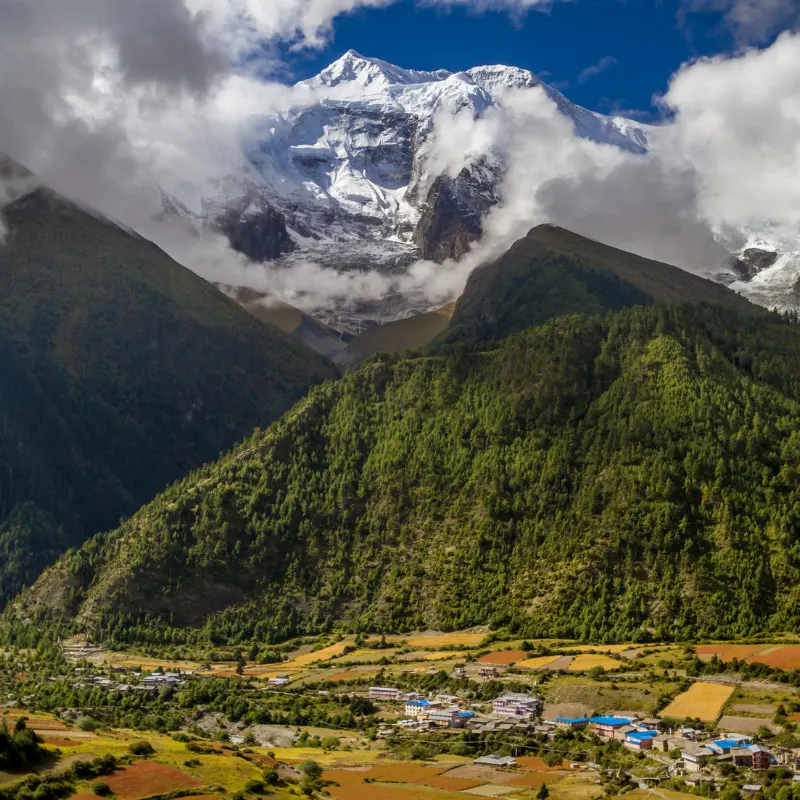


Tour Highlights
A full circuit, a high-altitude lake, a world-class pass and a famous sunrise — the Annapurna Circuit Trek with Tilicho Lake delivers a new highlight at almost every stage of its 15 days:
- Tilicho Lake — about 4,920 m / 16,142 ft: one of the world’s highest-altitude lakes, reached on a Day 8 excursion beneath Tilicho Peak at 7,134 m / 23,406 ft, with yaks and deer often spotted on the way.
- Thorong La Pass — 5,416 m / 17,769 ft: one of the world’s highest trekking passes, crossed at dawn on Day 10 with views of Annapurna, Gangapurna and Khatungkang at 6,484 m / 21,273 ft.
- Poon Hill — 3,210 m / 10,531 ft: the region’s most famous sunrise viewpoint, climbed before dawn on Day 13 for a full panorama of the Annapurna and Dhaulagiri ranges.
- Manang — 3,540 m / 11,300 ft: the Manang District’s trekking heart, with a full acclimatization day and the ancient Braga monastery nearby.
- Braga Monastery: regarded as one of the most important monasteries in the Manang region, visited on the Pisang to Manang day.
- Chame — 2,710 m / 8,891 ft: the administrative centre of Manang District, reached via Tamang Village, Thanchowk and Koto.
- Muktinath — about 3,800 m / 12,467 ft: a sacred Hindu and Buddhist pilgrimage site with 108 water spouts and eternal flames, the Thorong La descent finish.
- Dhaulagiri from the pass descent: as you drop from Thorong La, the Dhaulagiri massif — including Dhaulagiri I at 8,167 m / 26,795 ft, the highest mountain lying entirely within Nepal — comes into view.
- The continuous circuit: unlike road-supported versions, this itinerary walks all the way from Muktinath through Tatopani and Ghorepani to Nayapul, threading rhododendron forests, terraced farmland and villages on the way to the Poon Hill finale.
Annapurna Circuit Trek with Tilicho Lake Overview
The Annapurna Circuit Trek with Tilicho Lake is a 15-day trek in Nepal’s Annapurna region that combines the classic Annapurna Circuit with a high-altitude excursion to Tilicho Lake at approximately 4,920 m / 16,142 ft, one of the world’s highest-altitude lakes, and the crossing of Thorong La Pass at 5,416 m / 17,769 ft, one of the world’s highest trekking passes. Graded challenging, it suits well-prepared trekkers who want the circuit’s full range of scenery — from forest valleys to a glacial lake, a high pass, sacred temples and the famous Poon Hill sunrise.
The journey starts with a drive from Kathmandu to Dharapani at 1,960 m / 6,430 ft, then follows the classic circuit north through Chame at 2,710 m / 8,891 ft, Pisang at 3,115 m / 10,200 ft and Manang at 3,540 m / 11,300 ft (with an acclimatization day). From Manang the route branches to Tilicho Base Camp at 4,150 m / 13,615 ft, summits Tilicho Lake at about 4,920 m / 16,142 ft, and returns via Siri Kharka and Thorong Phedi to cross Thorong La at 5,416 m / 17,769 ft on Day 10. The descent reaches sacred Muktinath, then the route continues over Tatopani, Ghorepani and Poon Hill down to Nayapul and drives to Pokhara before returning to Kathmandu.
With Nepal Lion Tours, the package starts from USD 1,450 per person and includes a licensed English-speaking trekking guide (Chinese, Korean and Hindi speaking guides available), all required permits (ACAP and TIMS), guesthouse and hotel accommodation, breakfast, lunch and dinner on trekking days, the road transfers from Kathmandu to Dharapani, Muktinath to Tatopani, Nayapul to Pokhara and Pokhara to Kathmandu, a down jacket, all-season sleeping bag and duffel bag for the trail, a mobile SIM card and a trekking map of the region.
What Makes the Annapurna Circuit Trek with Tilicho Lake Special?
The Annapurna Circuit with Tilicho Lake stacks four signature Annapurna experiences into one 15-day journey: the Manang Valley circuit village trail, the Tilicho Lake excursion at about 4,920 m / 16,142 ft, the Thorong La crossing at 5,416 m / 17,769 ft, and a closing Poon Hill sunrise at 3,210 m / 10,531 ft. Most circuit treks skip the Poon Hill section by driving out from Muktinath; this one keeps walking south through Ghorepani to earn the region’s most famous sunrise view before finishing at Nayapul. The Manang acclimatization day, the Braga monastery, the Tilicho Base Camp yaks and deer, the Dhaulagiri panorama from the pass descent, and the 108 water spouts of Muktinath give the journey a new highlight almost every day.
Why Choose the Annapurna Circuit Trek with Tilicho Lake?
This is the full-circuit experience with the two biggest extras attached: Tilicho Lake and Poon Hill. Trekking the complete circuit — from Dharapani over Thorong La and down through Tatopani and Ghorepani — is more continuous than the road-supported versions, and finishing with the Poon Hill sunrise is the classic way to close an Annapurna journey. The route is fully supported by guesthouse and teahouse accommodation, the approach is road-based (no flight dependency), and the Manang acclimatization day plus the measured Tilicho excursion keep the altitude progression safe. At 5,416 m / 17,769 ft, the Thorong La crossing is the centrepiece; the Poon Hill finale is the reward.
Who Is This 15-Day Trek Suitable For?
- Experienced trekkers who want the full Annapurna Circuit plus Tilicho Lake and Poon Hill in one continuous journey.
- Fit trekkers with prior altitude experience comfortable with 7–9 hour days and a night near 4,150 m / 13,615 ft at Tilicho Base Camp.
- Couples and small groups travelling privately from 2 trekkers with their own guide, dates and pace.
- Photographers chasing glacial lakes, high passes, Tibetan-style villages and sunrise viewing platforms.
- Cultural travellers drawn to Manang’s Braga monastery, Muktinath’s temples and the Manang District settlements.
- Nature lovers hoping to see yaks, deer, blue sheep and Himalayan griffons along the high route.
- Trekkers who want to combine the circuit with Pokhara or a Chitwan safari before or after the trek.
The route has no technical climbing, and previous trekking experience is helpful but not mandatory — but you should be physically prepared for several consecutive days of long walking at high altitude, with the hardest efforts on the Tilicho day and the Thorong La crossing.
Guide’s Note — Nepal Lion Tours “We have walked the full circuit with Tilicho departures more times than we can count, and the trekkers who enjoy it most treat Manang like a gift, not a delay. From our experience, the acclimatization day — a low, easy hike toward Khangsar — is what makes both the 4,920 m lake day and the 5,416 m pass possible. And do not rush the Poon Hill finish: on a clear morning the sunrise turns the whole Annapurna and Dhaulagiri ranges pink, and it is the perfect way to close 15 days of walking.” — Nepal Lion Tours Trekking Guide
Quick Facts
Trek Fact | Details |
|---|---|
Trek Name | Annapurna Circuit Trek With Tilicho Lake |
Duration | 15 days / 14 nights |
Region | Annapurna, Gandaki, Nepal |
Maximum Altitude | 5,416 m / 17,769 ft at Thorong La Pass |
Highest Lake Reached | Tilicho Lake — about 4,920 m / 16,142 ft |
Difficulty | Challenging (fact box lists Moderate; the itinerary’s pass days and altitude make it demanding) |
Best Season | All-season operations; best in spring (March–May) and autumn (September–November) |
Main Highlight | Tilicho Lake plus Thorong La Pass and Poon Hill sunrise |
Start / End | Kathmandu to Kathmandu |
Route | Dharapani – Chame – Pisang – Manang – Tilicho Base Camp – Tilicho Lake – Siri Kharka – Thorong Phedi – Thorong La – Muktinath – Tatopani – Ghorepani – Poon Hill – Nayapul – Pokhara |
Typical Walking | 4–8 hours per day (plus two 8–9 hour drive days) |
Best Season | Spring and Autumn |
Price From | USD 1,450 per person |
Accommodation | Guesthouses and teahouses on the trail, hotels in Kathmandu and Pokhara |
Guide | Licensed English-speaking trekking guide (Chinese, Korean, Hindi available) |
Annapurna Circuit Trek with Tilicho Lake Route and Elevation
The route is a continuous clockwise circuit of the Annapurna massif with one high-altitude side excursion. It starts with a road transfer to Dharapani at 1,960 m / 6,430 ft, walks the Marsyangdi valley through Chame, Pisang and Manang, branches west to Tilicho Lake at about 4,920 m / 16,142 ft, returns to the main circuit at Siri Kharka, and crosses Thorong La at 5,416 m / 17,769 ft to Muktinath. From there it keeps walking south through Tatopani and Ghorepani, summits Poon Hill, and descends to Nayapul for the drive to Pokhara.
Annapurna Circuit with Tilicho Lake Route at a Glance
Day | Route | Altitude (High Point) | Highlights |
|---|---|---|---|
Day 1 | Arrival in Kathmandu | 1,400 m / 4,593 ft | Airport pickup, briefing, trekking map |
Day 2 | Kathmandu → Dharapani (drive) | 1,960 m / 6,430 ft | 8–9 hour scenic drive through green hills and terraced farms |
Day 3 | Dharapani → Chame | 2,710 m / 8,891 ft | Tamang Village, Danaque, Mount Manaslu views, Thanchowk, Chame |
Day 4 | Chame → Pisang | 3,115 m / 10,200 ft | Telekhu, Pisang Peak, pine forests, Marsyangdi bridge |
Day 5 | Pisang → Manang | 3,540 m / 11,300 ft | Braga monastery, Tibetan-style architecture |
Day 6 | Acclimatization in Manang | 3,540 m / 11,300 ft | Easy hike toward Khangsar, acclimatization |
Day 7 | Manang → Tilicho Base Camp | 4,150 m / 13,615 ft | Khangsar, Kang Guru views, remote valley |
Day 8 | Tilicho Base Camp → Tilicho Lake → Siri Kharka | 4,920 m / 16,142 ft | Tilicho Lake, Tilicho Peak, yaks and deer |
Day 9 | Siri Kharka → Thorong Phedi | 4,500 m / 14,764 ft | Tare Gumba, Old Khangsar, Yak Kharka |
Day 10 | Thorong Phedi → Thorong La → Muktinath | 5,416 m / 17,769 ft | World-famous pass crossing, Muktinath temples |
Day 11 | Muktinath → Tatopani (drive) | 1,300 m / 4,265 ft | Scenic drive along the Kali Gandaki valley |
Day 12 | Tatopani → Ghorepani | 2,870 m / 9,416 ft | Ghara, Sikhar, rhododendron forests, Dhaulagiri views |
Day 13 | Poon Hill → Nayapul → Pokhara | Poon Hill 3,210 m / 10,531 ft | Sunrise panorama, descent to Nayapul, drive to Pokhara |
Day 14 | Pokhara → Kathmandu (drive) | 1,400 m / 4,593 ft | 6–7 hour return drive, optional activities |
Day 15 | Final departure | 1,400 m / 4,593 ft | Airport transfer, journey home |
Annapurna Circuit with Tilicho Lake Elevation Profile
The profile is a long clockwise arc with two distinct summits. It begins at Dharapani at 1,960 m / 6,430 ft and climbs the Marsyangdi valley over four stages to Manang at 3,540 m / 11,300 ft, gaining roughly 300–500 m / 984–1,640 ft a day before the acclimatization stop. The first real summit is the Tilicho excursion on Day 8, which climbs from Tilicho Base Camp at 4,150 m / 13,615 ft to Tilicho Lake at about 4,920 m / 16,142 ft and back down to Siri Kharka in about 7–8 hours.
The second, higher summit is Thorong La at 5,416 m / 17,769 ft, crossed on Day 10 from Thorong Phedi at 4,500 m / 14,764 ft and descended the same day to Muktinath at about 3,800 m / 12,467 ft. From there the profile falls steadily south through Tatopani at 1,300 m / 4,265 ft, climbs back up through Ghorepani at 2,870 m / 9,416 ft to Poon Hill at 3,210 m / 10,531 ft, and finishes with a long descent to Nayapul and the roads to Pokhara at 850 m / 2,788 ft and Kathmandu at 1,400 m / 4,593 ft. The full elevation profile and a trekking map are included with your Nepal Lion Tours materials.
How to Get to the Annapurna Circuit Trek with Tilicho Lake
The Annapurna Circuit with Tilicho Lake starts from Kathmandu with a long road approach up the Marsyangdi valley to Dharapani, so the trek is fully road-connected and has no Lukla-style flight dependency. The same logic applies on the return, where the journey ends via Pokhara by road.
Kathmandu to Dharapani: The Road Approach
The first transfer is a direct drive from Kathmandu to Dharapani on Day 2, taking about 8–9 hours:
Option | Approx. Travel Time | Best For |
|---|---|---|
Direct private vehicle Kathmandu → Dharapani | Around 8–9 hours | The itinerary’s standard approach |
Tourist bus to Besisahar, then jeep | Around 5–6 hours, then 2–3 hours | Budget-conscious travellers |
Fly Kathmandu → Pokhara, then drive | 25–30 minutes, then around 4–5 hours | Travellers who want a shorter single road stretch |
Road times are approximate and affected by traffic, weather and road construction. The direct private drive moves the whole group in one go with built-in breaks; it passes green hills, flowing rivers, terraced farmland and traditional settlements, and the mountain views build steadily as the road approaches the Annapurna region.
Dharapani to the Trail: First Steps
The trek proper begins at Dharapani at 1,960 m / 6,430 ft, a village on the classic Annapurna Circuit trail. On Day 3 the group walks through Danaque and Tamang Village — with its traditional stone houses and slate-covered roofs and views of Mount Manaslu at 8,163 m / 26,781 ft — then climbs through the Tibetan-influenced villages of Thanchowk and Koto before arriving at Chame, the administrative centre of Manang District.
Guide’s Note — Nepal Lion Tours “From our experience operating Annapurna Circuit with Tilicho departures, Day 2 is the longest single block of the trip — up to 8–9 hours of road between Kathmandu and Dharapani. We recommend a proper breakfast, water for the drive, and loose layers, because the valley warms up below 2,000 m. Reach Dharapani early and take a short evening walk along the Marsyangdi; it stretches the legs before the real climbing begins.” — Nepal Lion Tours Trekking Guide
Returning to Kathmandu After the Trek
The return happens in two road legs. On Day 13, the group descends from Poon Hill to Nayapul and transfers by road to Pokhara at 850 m / 2,788 ft for the night. On Day 14, a drive of about 6–7 hours returns the group to Kathmandu at 1,400 m / 4,593 ft. This is Nepal Lion Tours’ included road transfer; travellers with extra time can arrange optional add-ons such as a Chitwan National Park visit, rafting, a scenic Everest flight, mountain biking or a Kathmandu sightseeing and shopping tour before departure.
A Practical Tip for International Travellers
Do not schedule your international departure too tightly after Day 14 — the Pokhara–Kathmandu drive takes about 6–7 hours and can be delayed by traffic. Keep at least one full day in Kathmandu after the trek before flying home. Access on this itinerary is straightforward and road-based, so with that buffer day the logistics are easy to manage even for first-time visitors to Nepal.
Annapurna Circuit Trek with Tilicho Lake Difficulty, Fitness & Altitude
The Annapurna Circuit with Tilicho Lake is graded challenging, and the demanding label is supported by the itinerary: a 5,416 m / 17,769 ft pass crossing, a lake excursion to about 4,920 m / 16,142 ft, long walking days and significant elevation changes throughout. There is no technical climbing, but solid fitness and proper acclimatization are essential.
Where the Effort Actually Is?
Three sections demand the most:
- The Tilicho day (Day 8): from Tilicho Base Camp at 4,150 m / 13,615 ft up to Tilicho Lake at about 4,920 m / 16,142 ft and on to Siri Kharka — about 7–8 hours at the trip’s highest sustained altitude outside Thorong La.
- The Thorong La crossing (Day 10): a pre-dawn climb from Thorong Phedi at 4,500 m / 14,764 ft to Thorong La at 5,416 m / 17,769 ft, followed by a long descent to Muktinath — the toughest 7–9 hours of the trek, in cold mountain air.
- The long valley days (Days 2–5): the 8–9 hour drive to Dharapani, then consecutive 4–7 hour walking days up the Marsyangdi valley with steady, unrelenting climbs.
Outside those sections the trail is a mix of forested valley paths, suspension-bridge crossings, ridge trails, high-desert stretches and terraced farmland — all manageable in good trekking shoes with a steady pace.
Guide’s Note — Nepal Lion Tours “The Thorong La start is the moment most of our groups remember best — headlamps in the dark, wind at the pass, then the Dhaulagiri wall opening up on the descent. From our experience, the trekkers who do well treat the day before exactly like a rest day: early dinner, full water bottles, layers laid out, headlamp checked. And the same goes for Day 8 at Tilicho — altitude over effort, every time.” — Nepal Lion Tours Trekking Guide
How to Prepare for the Annapurna Circuit Trek with Tilicho Lake
- Walk 8–10 weeks beforehand, building to 6–8 hours of continuous walking with a daypack.
- Practise hills and stairs — the Marsyangdi and Tatopani–Ghorepani climbs are steady and endless.
- Strengthen your legs with squats, lunges and step-ups for the long descents from Thorong La and Poon Hill.
- Do at least one prior high-altitude trek if possible, so you know how your body responds above 3,500 m / 11,483 ft.
- Front-load your endurance — the hardest days are Day 8 and Day 10, not Day 1.
- Avoid last-minute overtraining — arrive rested, not exhausted.
How Difficult Is This Compared with Other Annapurna Treks?
The Annapurna Circuit with Tilicho Lake is one of the most demanding routes in the Annapurna region. It reaches 5,416 m / 17,769 ft at Thorong La — higher than Annapurna Base Camp at 4,130 m / 13,550 ft and far higher than Poon Hill at 3,210 m / 10,531 ft — and adds the Tilicho excursion to about 4,920 m / 16,142 ft. It is similar in altitude to the standard circuit, but the Tilicho side trip and the continuous walk to Nayapul make it longer and more sustained. Previous trekking experience is helpful but not mandatory; what matters is physical preparation for consecutive long days at altitude.
Altitude, Acclimatization & Safety
The Annapurna Circuit with Tilicho Lake crosses 5,416 m / 17,769 ft on Day 10 and reaches about 4,920 m / 16,142 ft on Day 8, so altitude awareness is the main safety factor. The itinerary is structured to minimise risk — a full acclimatization day at Manang, a measured Tilicho excursion and a proper rest evening before the pass — but every trekker should understand the body’s response.
Altitude Profile
- Kathmandu — 1,400 m / 4,593 ft: overnight city at the start and end.
- Dharapani — 1,960 m / 6,430 ft: trailhead village on the Marsyangdi.
- Chame — 2,710 m / 8,891 ft: Manang District’s administrative centre (page value).
- Pisang — 3,115 m / 10,200 ft: upper Manang Valley overnight.
- Manang — 3,540 m / 11,300 ft: acclimatization base with the Day 6 rest day.
- Khangsar — around 3,700 m / 12,139 ft (page cites 3,756 m and 3,734 m on different days): the acclimatization-day hike and the Tilicho Base Camp route village.
- Tilicho Base Camp — 4,150 m / 13,615 ft: rugged high camp for the lake excursion.
- Tilicho Lake — about 4,920 m / 16,142 ft: high point of Day 8, beneath Tilicho Peak at 7,134 m / 23,406 ft.
- Tare Gumba — about 3,870 m / 12,697 ft: monastery stop on Day 9.
- Thorong Phedi — 4,500 m / 14,764 ft: base for the pass on Day 10.
- Thorong La — 5,416 m / 17,769 ft: the trek’s highest point.
- Muktinath — about 3,800 m / 12,467 ft: descent finish and pilgrimage town.
- Tatopani — 1,300 m / 4,265 ft: low-altitude hot-spring town on Day 11.
- Ghorepani — 2,870 m / 9,416 ft: overnight village before Poon Hill.
- Poon Hill — 3,210 m / 10,531 ft: sunrise viewpoint on Day 13.
- Pokhara — 850 m / 2,788 ft: low-altitude rest night.
- Kathmandu — 1,400 m / 4,593 ft: return city.
How the Body Adapts to Altitude
The body acclimatizes best when the climb is slow and gradual. This itinerary caps daily gains at a moderate 300–500 m / 984–1,640 ft through the valley, adds a full acclimatization day at Manang, and reaches both high points as daylight excursions before returning to lower sleep. On the trail: keep a conversational pace, drink 3–4 litres of fluid a day, eat regularly even without appetite, sleep low where the plan allows, and tell the guide immediately if you feel unwell.
Symptoms of Altitude Sickness to Watch For
- Persistent headache that does not clear with rest or paracetamol
- Loss of appetite and nausea
- Unusual tiredness or weakness
- Dizziness and poor sleep
- Shortness of breath after mild effort
More concerning signs needing immediate attention:
- Confusion, clumsiness or loss of balance
- Repeated vomiting
- Bluish or grey lips and fingertips
- Breathlessness at rest
- Inability to walk a straight line
The response is always the same: stop ascending, tell your guide, and be prepared to descend. With the ACAP–TIMS registration, a licensed guide and the itinerary’s rest structure, Nepal Lion Tours keeps trekkers safe.
How Nepal Lion Tours Supports Altitude Safety
- A full acclimatization day at Manang (Day 6) before the high trail.
- Daylight ascents to both high points — no sleeping at Tilicho Lake or Thorong La.
- Licensed, experienced guides who monitor pace, hydration and symptoms throughout.
- Early communication encouraged — small complaints are always taken seriously.
- Pre-trek health briefing plus advice on travel insurance covering trekking above 5,000 m and emergency evacuation.
Best Time to Trek Annapurna Circuit with Tilicho Lake
The best time is spring (March–May) and autumn (September–November) — the two windows the page’s FAQ names directly. The fact box lists all-season operations, so treks run year-round, with winter and monsoon offering different trade-offs around the high passes and the Tilicho excursion.
Season | Months | Weather & Trail Conditions | Mountain Views | Overall |
|---|---|---|---|---|
Autumn | September–November | Clear, dry trails; Thorong La usually firm | Excellent on clear days | Best overall |
Spring | March–May | Warmer days; rhododendrons below Ghorepani | Very good in mornings | Highly recommended |
Winter | December–February | Cold — well below 0 °C above 4,000 m / 13,123 ft; snow possible on passes | Good on clear days | Good with preparation |
Monsoon | June–August | Wet, slippery trails; passes can cloak in cloud | Frequently limited | Less suitable |
Autumn — September to November
Autumn is the classic season. Between September and November, the monsoon drains away and skies sharpen, giving the clearest possible views from Tilicho Lake at about 4,920 m / 16,142 ft, the top of Thorong La at 5,416 m / 17,769 ft, and the Poon Hill sunrise platform at 3,210 m / 10,531 ft. October typically offers the driest trails and most stable weather, while November brings colder mornings but thinner crowds — the busiest teahouse windows are Manang, Thorong Phedi and Ghorepani in October, so Nepal Lion Tours books them ahead.
Spring — March to May
Spring runs a close second. From March to May, days warm quickly, trails dry after winter, and the rhododendron forests between Tatopani and Ghorepani flower in pink and red — a highlight the standard circuit’s jeep exit misses. Mornings stay clear for the pre-dawn Thorong La crossing, though afternoon clouds builds more than in autumn, and March can hold late snow on the passes. Nepal Lion Tours checks current pass conditions and recommends flexible March dates.
Winter — December to February
Winter trekking is possible but serious. From December to February, temperatures drop below -10 °C at Manang, Thorong Phedi and Tilicho Base Camp, and snow can settle on Thorong La for days at a time. Trails are quiet and teahouses cheaper, and clear days reward the prepared — but the pass crossing and the Tilicho day both require patience and a guide willing to turn back if conditions are unsafe. Nepal Lion Tours runs winter departures only with careful weather and trail checks.
Monsoon — June to August
Monsoon (June–August) is the least suitable season. Trails turn slippery, leeches appear in the lower forests, and the high passes and Tilicho Lake frequently sit in clouds, hiding the views that make the trek special. Some trekkers still go for the green valleys and quiet teahouses, but the Thorong La window is unreliable — Nepal Lion Tours recommends the dry seasons unless dates are fixed.
Which Season Should You Choose?
Choose autumn (September–November) if clear views at Tilicho Lake and Thorong La are the priority — it is the best overall window. Choose spring (March–May) for warm days, flowering forests and still-excellent mornings. Choose winter if you want solitude and are prepared for real cold, and avoid monsoon unless you have no choice. Whichever you pick, weather in the Himalaya changes quickly — check the forecast for Manang and Mustang before you fly and leave a buffer day at the end of the trek.
Guide’s Note — Nepal Lion Tours “On clear autumn mornings the Poon Hill sunrise develops in layers — first the silhouette of Dhaulagiri, then Annapurna I and Machhapuchhre catching colour, then the whole amphitheatre glowing pink. In our experience, the trekkers who do the full circuit with the Poon Hill finish always say the last sunrise is worth every step of the extra two days. We plan the next day with a decision point: if conditions are poor at Thorong Phedi, we hold rather than risk a storm near 5,416 m.” — Nepal Lion Tours Trekking Guide
Annapurna Circuit Trek with Tilicho Lake Permits & Regulations
The Annapurna Circuit with Tilicho Lake enters the Annapurna Conservation Area, so trekkers need the applicable permits — the ACAP and, where required, the TIMS card — before they begin walking at Dharapani. Nepal Lion Tours arranges both as part of pre-trek preparation, and your guide carries the paperwork for the route’s checkpoint on the circuit.
Permits at a Glance
Requirement | Who Needs It? | Who Arranges It? |
|---|---|---|
ACAP — Annapurna Conservation Area Permit | Foreign and SAARC trekkers entering the Annapurna Conservation Area | Nepal Lion Tours |
TIMS Card (Trekkers’ Information Management System) | Trekkers on applicable Annapurna routes | Nepal Lion Tours |
Annapurna Conservation Area Permit (ACAP)
The ACAP is the entry permit for the Annapurna Conservation Area, covering the entire route from Dharapani through Manang, Tilicho, Thorong La, Muktinath, Tatopani, Ghorepani and Poon Hill. It is issued against your passport number, checked at the conservation-area checkpoints, and costs around NPR 3,000 for foreign trekkers and NPR 1,000 for SAARC nationals (government fees can be revised — confirm at booking). Nepal Lion Tours arranges the ACAP before the trek.
TIMS Card (Trekkers’ Information Management System)
The TIMS Card records your trekking route and emergency contact details in the official trekkers’ database, supporting safety on routes like this one. The fee varies by nationality and current regulations, and the card is checked alongside the ACAP at the boundary checkpoints. Nepal Lion Tours handles TIMS registration as part of pre-trek preparation; you simply carry your original passport for identification.
Do You Need a Restricted-Area Permit?
No, not for this standard route. The classic Manang – Tilicho – Thorong La – Muktinath – Tatopani – Ghorepani alignment is not a restricted area, so no special permit is needed. Restricted-area permits apply only to treks that branch into Upper Mustang, Nar Phu or the Manaslu region, which this itinerary does not enter. Regulations can change, so Nepal Lion Tours confirms current requirements before each departure.
Who Arranges the Permits?
Nepal Lion Tours arranges the ACAP and TIMS card as part of your booking, so you pick up a prepared set of documents before the trek. You only need to carry your original passport for identification checks. Because government fees and rules can be revised, final costs and any changes are confirmed before departure.
Food & Accommodation on the Annapurna Circuit Trek with Tilicho Lake
The Annapurna Circuit with Tilicho Lake rides the region’s teahouse and guesthouse network, with lodges every few hours from Dharapani all the way to Nayapul. Rooms are basic and comfortable, facilities thin out at the higher stops, and Nepal Lion Tours guides coordinate meals and beds throughout.
Teahouse and Guesthouse Accommodation
- Rooms: basic twin-sharing rooms with foam mattresses; private options improve at Manang, Jomsom-side villages and Ghorepani.
- Bathrooms: shared facilities are the norm at smaller lodges; attached bathrooms exist at some Manang and valley-floor guest houses.
- Hot showers: available at most guest houses for a small fee, powered by solar or wood; hotter earlier in the day.
- Electricity: solar and generator power at most lodges; charging is fine below 4,000 m / 13,123 ft and limited above, especially at Tilicho Base Camp and Thorong Phedi.
- Heated dining rooms: the stove or fireplace room is the warm meeting point every evening.
- Wi-Fi: free but slow at larger villages like Chame, Manang, Muktinath and Ghorepani; unreliable at Tilicho Base Camp, Siri Kharka and Thorong Phedi.
- Bedding: pillow and blanket provided; the loaned all-season sleeping bag makes cold nights at Tilicho Base Camp and Thorong Phedi comfortable.
What Food Is Available on the Trek?
Guest-house kitchens serve the classic trekking menu: dal bhat, noodles, rice, pasta, soup, Tibetan bread, vegetables, eggs and other local and basic international dishes. Dal bhat (lentil soup with rice) is the reliable energy meal — hot, filling and easy to refill — and Nepal Lion Tours guides recommend it before Tilicho Lake and Thorong La. Vegetarian food is the default; tell Nepal Lion Tours in advance about vegan, gluten-free or allergy needs so kitchens can prepare alternatives.
What Food and Accommodation Are Included?
Included in the Trek Package | Usually Paid Separately |
|---|---|
Breakfast, lunch and dinner plus tea or coffee on trekking days | Drinks, bottled water, desserts and extra snacks |
Guesthouse and teahouse accommodation (twin-sharing) on the trail | Hot showers and heater fees as charged by lodges |
Hotels in Kathmandu and Pokhara as per itinerary | Food and accommodation in Kathmandu outside the itinerary |
Welcome or farewell dinner in Kathmandu (complimentary) | Wi-Fi, laundry and phone calls where lodges charge |
Airport pickup and drop on a private vehicle | Tips for guide and porter teams |
The exact split varies by departure, so confirm your inclusions at booking — Nepal Lion Tours lists them clearly in your confirmation.
Drinking Water on the Trek
Do not assume tap water is safe to drink. Use bottled, boiled or treated water from lodge kitchens, or a reusable bottle with purification tablets/filter. Target 3–4 litres a day, especially on Day 8 (Tilicho) and Day 10 (Thorong La). A thermos lets you refill from dining-room urns and reduces plastic on the trail.
Staying Comfortable at Guest Houses
- Carry a refillable bottle or thermos and top up at each dining room.
- Sleep in the loaned all-season sleeping bag — the difference is obvious at Tilicho Base Camp and Thorong Phedi.
- Pack a power bank because sockets are limited and shared.
- Keep warm layers, headlamp and water by your bed for the pre-dawn Thorong La and Poon Hill starts.
- Carry small-denomination Nepali rupees for hot showers or extra treats.
- Confirm dietary needs with Nepal Lion Tours in advance so even remote kitchens are ready.
Why Book with Nepal Lion Tours?
Nepal Lion Tours is a registered trekking company based in Kathmandu that operates the Annapurna Circuit with Tilicho Lake as a private departure, with one point of contact from enquiry to return. Seven reasons trekkers choose us for this 15-day route:
- Local, licensed English-speaking guides.
Every departure is led by a government-licensed guide who knows the Manang, Tilicho, Thorong La, Tatopani, Ghorepani and Poon Hill route personally — the same guides who read the weather at the passes and the snow on the high trail.
- A registered trekking company you can verify.
Nepal Lion Tours is a registered Nepali operator based in Kathmandu; licence and company details are provided to travellers on request.
- Private departures from two trekkers.
The trek runs with a minimum of just 2 trekkers, so couples, friends and families get their own dates, their own pace and no waiting for group minimums.
- A full circuit with Tilicho Lake and Poon Hill in one journey.
This is the 15-day route that joins Tilicho Lake at about 4,920 m / 16,142 ft, Thorong La at 5,416 m / 17,769 ft and the Poon Hill sunrise at 3,210 m / 10,531 ft — the three experiences most trekkers search for specifically.
- All transfers are arranged privately by road.
The Kathmandu–Dharapani drive, the Muktinath–Tatopani transfer, the Nayapul–Pokhara transfer and the Pokhara–Kathmandu drive are all included, so no part of the logistics depends on public transport once you are on trek.
- Budget-friendly pricing without cutting the main experiences.
From USD 1,450 standard and USD 1,958 luxury, the difference lies in comfort (hotels, rooms, service class), not in removing Tilicho Lake, Thorong La or Poon Hill from the route.
- A local team you can contact before and during your trek.
One call — WhatsApp at +977-9851039020 — reaches the office that arranged your trek, before you fly and while you are on the trail.
Book the Annapurna Circuit Trek with Tilicho Lake
A full circuit, a lake at about 4,920 m / 16,142 ft, a pass at 5,416 m / 17,769 ft and a sunrise at Poon Hill — the Annapurna Circuit with Tilicho Lake is the complete Annapurna journey, and spring and autumn dates fill early in Manang’s teahouses.
Trek at a Glance
- Duration: 15 days / 14 nights
- Price: From USD 1,450 per person (standard), tiered by group size — 1 trekker USD 1,450, 2–4 trekkers USD 1,378, 5–9 trekkers USD 1,305, 10+ trekkers USD 1,233; luxury from USD 1,958 — 1 trekker USD 1,958, 2–4 USD 1,860, 5–9 USD 1,762, 10+ USD 1,664
- Difficulty: Challenging
- Maximum Altitude: 5,416 m / 17,769 ft at Thorong La Pass
- Highest Lake: Tilicho Lake — about 4,920 m / 16,142 ft
- Accommodation: Guesthouses and teahouses on the trail, hotels in Kathmandu and Pokhara
- Meals: Breakfast, lunch and dinner on trekking days
- Permits & Registration: ACAP and TIMS, arranged by Nepal Lion Tours
- Transportation: Road transfers for Kathmandu–Dharapani, Muktinath–Tatopani, Nayapul–Pokhara and Pokhara–Kathmandu
- Guide: Licensed English-speaking trekking guide throughout (Chinese, Korean, Hindi available)
- Cancellation: Free cancellation up to 14 days before departure (subject to booking terms)
Ready to Start Your Annapurna Adventure?
Send your preferred travel date and group size through the booking form or WhatsApp at +977-9851039020, and Nepal Lion Tours will confirm teahouse availability in Manang, Thorong Phedi and Ghorepani before you commit. Whether you are travelling solo, as a couple, with friends, or with family, we will help you prepare for a smooth and enjoyable trek — from the Kathmandu briefing to the views at Tilicho Lake and Poon Hill. Your circuit is waiting — choose your dates and start planning your trek today.
Related Annapurna Treks
If the Annapurna Circuit with Tilicho Lake tempts you but the 15 days or the 5,416 m / 17,769 ft pass feel too big, the Annapurna region offers a ladder of shorter, lower-altitude treks:
Trek | Duration | Difficulty | Max Altitude | Best For |
|---|---|---|---|---|
Ghorepani Poon Hill Trekking | 4 days | Easy–Moderate | 3,210 m / 10,531 ft | Short getaway focused on the sunrise viewpoint |
Poon Hill Teahouse Trekking | 7 days | Easy–Moderate | 3,210 m / 10,531 ft | Slower-paced, more time in villages |
Annapurna Panorama View Trek | 9 days | Easy–Moderate | 3,210 m / 10,531 ft | Wider foothill scenery, villages and views |
Annapurna Base Camp Trek | 10–12 days | Moderate | 4,130 m / 13,550 ft | Reaching the heart of the Annapurna amphitheatre |
Annapurna Circuit Trek | 14–18 days | Moderate–Challenging | 5,416 m / 17,769 ft | The classic long high-altitude circuit |
All of these run through the same teahouse network and combine easily with Pokhara or a Chitwan Jungle Safari. If you want Tilicho Lake without the full circuit, Nepal Lion Tours can craft a shorter Tilicho-specific trek from Manang as a standalone option.
Trip Essentials
Packing advice, required equipment & gear recommendations
Essential
Annapurna Circuit Trek with Tilicho Lake Packing List
This is a guesthouse and teahouse trek, not a camping expedition — you sleep and eat at lodges every night — but the Annapurna Circuit with Tilicho Lake still needs a serious kit because it crosses 5,416 m / 17,769 ft in cold conditions and visits Tilicho Lake at about 4,920 m / 16,142 ft. Nepal Lion Tours provides a down jacket, all-season sleeping bag, duffel bag and trekking map for the trail.
Hiking Gear
- Waterproof trekking boots that are broken in, with ankle support for the long descents
- Trekking poles — strongly recommended for the Thorong La, Poon Hill and Tilicho sections
- A 25–35 litre daypack with a rain cover, carried daily
- A headlamp with spare batteries — essential for the pre-dawn Thorong La and Poon Hill starts
- A reusable water bottle or thermos (1–2 litres) plus purification tablets/filter
- Sun hat, sunglasses and high-SPF sunscreen — the sun is intense above 4,000 m / 13,123 ft
- Blister plasters, painkillers and personal medication in a small first-aid kit
Clothing: Use Layers Rather Than Bulk
Base layers - 1–2 merino or synthetic long-sleeve tops for warmth - 3–4 pairs of wool/synthetic trekking socks (never cotton)
Mid-layers - A fleece jacket for cold villages and pass mornings - Quick-dry trekking trousers plus thermal bottoms for nights at Tilicho Base Camp and Thorong Phedi
Outer layers - A waterproof and windproof shell jacket — the wind on Thorong La at 5,416 m / 17,769 ft is the real hazard - A warm down jacket (loaned by Nepal Lion Tours)
Trekking clothes - 2–3 trekking shirts and 1 pair of spare quick-dry trousers - Rain trousers for wet valley days in spring and monsoon
Headwear and gloves - A warm beanie or balaclava and a sun hat - Warm gloves for the passes and thin gloves for everyday walking
Sleeping and Evening Comfort
- All-season sleeping bag rated to about -10 °C (loaned) — nights at Tilicho Base Camp and Thorong Phedi are genuinely cold
- A thin liner or sheet for hygiene in guest-house beds
- Earplugs and a sleep mask for shared rooms and early starts
- Warm sleeping socks and a fleece top
Toiletries and Personal Health Items
- Travel towel (fast-drying) and toiletries
- Toilet paper (a small stash) and hand sanitiser
- Lip balm with SPF and moisturiser — dry air cracks skin fast above 4,000 m / 13,123 ft
- Personal medication plus painkillers, throat lozenges and stomach tablets
- Anti-diarrhoeal tablets and rehydration salts
- Electrolyte sachets for the Tilicho and Thorong La days
- Sunscreen with high SPF and moisturising eye drops
- Blister plasters, antiseptic cream and light bandages
- A note with your insurance, medical and emergency contacts
- Period products if needed — scarce in the high villages
- Wet wipes — showers are limited at the highest lodges
- A small sewing kit and duct tape for repairs
Electronics
- Smartphone with offline maps loaded (valley signal is limited)
- Power bank (10,000–20,000 mAh) — charging is scarce above 4,000 m / 13,123 ft
- Camera or GoPro plus spare batteries/cards — protect from cold at Tilicho Lake and Thorong La
- Universal adapter (Nepal type C/D plugs) and cables
Charging is available at most guest houses up to Manang; beyond it, the power bank is essential for Tilicho Base Camp, Siri Kharka and Thorong Phedi.
Documents and Money
- Your original passport — needed for ACAP/TIMS identification checks
- Permits (ACAP and TIMS) prepared by Nepal Lion Tours
- Travel insurance documents covering trekking above 5,000 m
- Cash in Nepali rupees — hot showers, drinks, extra snacks and tips; ATMs are scarce beyond Chame and Manang
- A credit/debit card as backup for city hotels
How Much Should You Pack?
Lighter is better on the Annapurna Circuit with Tilicho Lake. Keep the main duffel under 10–12 kg / 22–26 lb; your daypack carries just water, layers, snacks, rain shell, first aid and camera. Because you move almost every day, keep your sleeping layer and toiletries accessible. Pack for the pass, not the valley — the warm jacket, gloves and thermos pay for themselves the moment the wind starts at 5,416 m / 17,769 ft.
Read Before You Book
Permits, terms, medical considerations & advisory guidelines
Advisory
What to Know Before Booking
The Annapurna Circuit Trek with Tilicho Lake is a challenging high-altitude trek with changing landscapes, long walking days and a visit to one of the world's highest lakes, so good preparation is important. Here are the practical things worth knowing before you book.
Accommodation and Facilities
Expect basic, locally run guest houses for most of the route, with the biggest villages — Chame, Manang, Muktinath and Ghorepani — offering the best rooms. The simplest lodges sit at Tilicho Base Camp, Siri Kharka and Thorong Phedi, where shared bathrooms, solar power and no mobile signal are normal. This is part of the experience, and Nepal Lion Tours sets expectations before you book.
Food and Dietary Requirements
The menu repeats across lodges — dal bhat, momos, noodles, fried rice, pasta, soup and eggs — and portions are generous. Vegetarian travellers eat very well; vegan and gluten-free travellers need notice so Nepal Lion Tours can confirm kitchen options. Bring trusted snacks for the long pass and lake days, when appetite often fades at altitude.
Altitude, Health and Insurance
The Annapurna Circuit with Tilicho Lake reaches 5,416 m / 17,769 ft and visits Tilicho Lake at about 4,920 m / 16,142 ft — altitude is the single biggest factor on this trek. Travel insurance is strongly recommended and must cover trekking in Nepal above 5,000 m, including medical treatment and helicopter evacuation; check altitude limits and exclusions carefully.
Money and Tipping
Carry cash in Nepali rupees for everything not in the inclusions — hot showers, drinks, bottled water, extra snacks and tips. Many lodges above Chame have little or no card payment. Tipping your guide and porter is customary; Nepal Lion Tours advises appropriate amounts at the pre-trek briefing.
Culture and Responsible Trekking
- Dress modestly in villages and at temples such as Muktinath — shoulders and knees covered.
- Ask before photographing people, monks and temple interiors.
- Carry out your rubbish — keep the Tilicho and Thorong La sections clean.
- Fill your bottle rather than buying plastic at every stop.
- Do not feed wild animals (including the yaks and deer around Tilicho) and keep food sealed.
- Stay in locally operated lodges and eat where your guide directs — this sustains the valley economy.
Route Options
- A shorter Tilicho-only trek: visit Tilicho Lake from Manang as a standalone itinerary without the full circuit.
- Skip the Poon Hill finish: drive out from Muktinath to save two days, missing the Tatopani–Ghorepani–Poon Hill section.
- Extend into the full circuit: continue from Poon Hill through the whole Annapurna Circuit for a longer journey.
- Add optional activities: Chitwan National Park, rafting, a scenic Everest flight, mountain biking or Kathmandu sightseeing around the trek.
Booking and Before You Arrive
Make sure you understand:
- Your inclusions — which meals, rooms, transfers and permits are inside the price; you will get a written confirmation.
- The tiered pricing — USD 1,450 / 1,378 / 1,305 / 1,233 by group size (standard) applies from the first booking.
- The luxury upgrade — from USD 1,958, for higher-comfort rooms, hotels and service.
- Your insurance — checked at briefing; confirm coverage above 5,000 m.
- Visa and arrival — Nepal visa on arrival is standard; your passport needs 6 months’ validity.
- Permit fees — government rates can change; final figures confirmed at booking.
- Fitness honestly — if in doubt, add training or choose a shorter, lower trek.
A Few Final Tips
Book well ahead for October departures, when Manang’s teahouses fill fast. Talk to Nepal Lion Tours about your walking pace — private departures adjust the routine to your group. Above all, treat acclimatization as the itinerary’s plan, not an optional extra: the rest day at Manang (Day 6) is what makes Day 8 and Day 10 possible.
Day-by-Day Itinerary
Explore each day's route, trekking elevation, and activities
Upon your arrival at Tribhuvan International Airport in Kathmandu, a representative from our team will welcome you and transfer you to your hotel. After completing the check-in process, you will receive a detailed briefing about your Annapurna Circuit Trek with Tilicho Lake.
During the briefing, our representative will provide you with a trekking route map and explain important information about the journey, including the accommodation arrangements, trail conditions, and general dos and don'ts for the trek. The remaining time is free for you to relax and prepare for the adventure ahead.
Today, we begin our journey toward the starting point of the trek with a scenic drive from Kathmandu to Dharapani. The long drive provides an excellent opportunity to relax while enjoying the changing landscapes of Nepal.
Along the way, you will pass through green hills, flowing rivers, terraced farmland, traditional settlements, and beautiful Himalayan scenery. As we approach the Annapurna region, the surrounding mountain views become increasingly impressive.
After reaching Dharapani, we check into a local guesthouse where we spend the night and prepare for the first trekking day.
We begin today's trek from Dharapani and make our way toward Danaque before continuing uphill toward Tamang Village. The village is characterized by traditional stone houses and slate-covered roofs and offers impressive views of Mount Manaslu (8,163m), Annapurna, and other surrounding Himalayan peaks.
The trail continues through several culturally rich Tibetan-influenced settlements, including Thanchowk and Koto. As we gradually gain elevation, the scenery becomes increasingly dramatic. Eventually, we arrive at Chame, the administrative center of the Manang District, where we spend the night.
Leaving Chame behind, we walk toward Telekhu while enjoying magnificent views of the Annapurna mountain range and Pisang Peak (6,091m).
The trail continues through beautiful pine forests and crosses a suspension bridge over the Marsyangdi River to its southern side. We then gradually ascend into the upper Manang Valley, where the landscape begins to become drier and more mountainous. After several hours of walking, we arrive at Pisang for our overnight stay.
Today marks our journey deeper into the upper Manang Valley. From Pisang, we follow the trail toward Braga, a traditional Tibetan-style settlement renowned for its distinctive architecture and closely built stone houses.
One of the highlights of Braga is its ancient Buddhist monastery, regarded as one of the most important monasteries in the Manang region. From Braga, we continue toward Manang, a popular stopping point for trekkers because of its beautiful surroundings and suitability for acclimatization.
Upon arrival, we settle into our guesthouse and enjoy the remaining time exploring the village or resting
Today is set aside for acclimatization before we move toward higher elevations. Spending an additional day in Manang allows our bodies to adjust gradually to the increasing altitude.
To remain active while acclimatizing, we take a hike toward Khangsar at approximately 3,756m. The walk provides excellent mountain scenery while helping our bodies adapt to the altitude.
After the excursion, we return to Manang for an overnight stay.
We leave Manang and head toward the remote Tilicho Lake area. Our trail passes through Khangsar Village, a traditional settlement known for its stone houses, distinctive culture, and peaceful surroundings.
The route follows a ridge before reaching Khangsar at approximately 3,734m. From the surrounding trail, we can enjoy remarkable views of the less frequently seen Kang Guru Peak (6,981m) and other Himalayan mountains.
We continue gradually upward until reaching Tilicho Base Camp, where we spend the night in preparation for the following day's hike to Tilicho Lake.
Today is one of the major highlights of our Annapurna adventure as we hike toward the spectacular Tilicho Lake, situated at approximately 4,920 meters beneath the impressive Tilicho Peak (7,134m).
The ascent takes several hours, and the trail offers breathtaking views of the surrounding high-altitude landscape. Along the route, you may encounter Himalayan wildlife such as yaks and deer.
When we reach Tilicho Lake, take time to appreciate its remarkable natural beauty. The lake's appearance can change under different lighting conditions, producing striking shades of blue against the surrounding mountains.
After spending some time at the lake and taking photographs, we retrace our route and continue toward Siri Kharka, where we spend the night.
We begin the day by descending toward Khangsar Village. Along the route, we pass Tare Gumba at approximately 3,870m, a site known for its monastery and cultural significance.
From here, the trail continues through the Thorong Khola Valley. We pass the old and largely abandoned settlement of Old Khangsar before continuing toward Yak Kharka.
After further trekking for several hours, we reach Thorong Phedi, situated at the base of the famous Thorong La Pass. We spend the night here and prepare for the challenging pass crossing the following day.
Today is one of the most demanding and rewarding sections of the entire trek. We begin early and ascend toward Thorong La Pass at 5,416m, one of the highest trekking passes in the world.
The high altitude and potentially strong mountain winds make the ascent challenging, but the spectacular surroundings make the effort worthwhile. Along the route, we may encounter sheep, yaks, and local traders transporting goods across the mountains.
After reaching the top of Thorong La, we are rewarded with breathtaking views of Annapurna, Gangapurna, and Khatungkang (6,484m). We then begin a significant descent toward Muktinath.
As we descend, the landscape gradually changes. The magnificent Dhaulagiri massif becomes increasingly visible, with Dhaulagiri I standing as the highest mountain located entirely within Nepal.
Eventually, we arrive at the sacred pilgrimage destination of Muktinath, where we spend the night after a demanding day on the trail.
After breakfast, we begin our trek toward Ghorepani. The trail initially descends toward a suspension bridge. After crossing the bridge, the route becomes predominantly uphill as we climb through small villages, terraced farmland, and beautiful rhododendron forests.
Along the way, we can enjoy impressive views of Nilgiri South and the surrounding Himalayan landscape. We pass through settlements such as Ghara and Sikhar, where the changing scenery provides excellent opportunities for photographs.
From Sikhar, we continue climbing toward Ghorepani. Before reaching our destination, we can enjoy views of Dhaulagiri and Tukuche Peak.
We arrive at Ghorepani and spend the night preparing for the early morning hike to Poon Hill.
After breakfast, we begin our trek toward Ghorepani. The trail initially descends toward a suspension bridge. After crossing the bridge, the route becomes predominantly uphill as we climb through small villages, terraced farmland, and beautiful rhododendron forests.
Along the way, we can enjoy impressive views of Nilgiri South and the surrounding Himalayan landscape. We pass through settlements such as Ghara and Sikhar, where the changing scenery provides excellent opportunities for photographs.
From Sikhar, we continue climbing toward Ghorepani. Before reaching our destination, we can enjoy views of Dhaulagiri and Tukuche Peak.
We arrive at Ghorepani and spend the night preparing for the early morning hike to Poon Hill.
We wake up early in the morning and hike toward Poon Hill to witness the sunrise over the Himalayas. As the first rays of sunlight illuminate the surrounding peaks, the mountains gradually change color, creating an unforgettable panoramic experience.
Poon Hill is one of the most popular viewpoints in the region, offering spectacular views of the Annapurna and Dhaulagiri ranges along with numerous snow-covered peaks.
After enjoying the sunrise, we return to Ghorepani for breakfast. We then begin our descent toward Nayapul, with the trail passing through forests, villages, and terraced farmland.
After reaching Nayapul, we continue by road to Pokhara, where we spend the night.
After breakfast, we leave Pokhara and drive back toward Kathmandu. The journey generally takes around six to seven hours, with several breaks along the way.
During the drive, you can enjoy the changing scenery of Nepal's countryside, rivers, hills, villages, and agricultural landscapes.
If you have additional time in Nepal, several optional activities can also be arranged, including a visit to Chitwan National Park, a rafting trip, a scenic Everest flight, mountain biking, or a guided Kathmandu shopping and sightseeing tour.
Upon arrival in Kathmandu, check into your hotel and enjoy a relaxing evening.
Today marks the end of your Annapurna Circuit Trek with Tilicho Lake adventure. Our representative will transfer you to Tribhuvan International Airport approximately three hours before your scheduled international flight.
As you depart Nepal, you can look back on the unforgettable experiences of the Annapurna region, including the dramatic mountain landscapes, Tilicho Lake, Thorong La Pass, Muktinath, and Poon Hill.
We wish you a safe journey home and hope to welcome you again for another Himalayan adventure in Nepal.
Want to customize this itinerary?
Tailor duration, lodges, acclimatization days, or add private helicopter flights.
Inclusions & Exclusions
Everything that is covered and what you'll need to budget separately
What is Included
Fully covered in your package price
- Airport pickup and drop services on a private vehicle
- Transportation from Kathmandu to Lukla and back to Kathmandu (by flight)
- Food (Breakfast, Lunch, Dinner and a cup of coffee or tea) and accommodations during the trip in hotels and guesthouses with family environment
- One licensed English-speaking trekking guide (Chinese, Korean, Hindi speaking guides are also available)
- Transportation, food, accommodation and insurance of guide during the trip
- Down jacket, all-season sleeping bag, duffel bag (to be returned after completion of the trip)
- First Aid Medical Kit (Carried by the guide)
- All the required permits and paperworks
- Welcome or farewell dinner in Kathmandu at a cultural restaurant (complimentary)
- Mobile SIM Card (works nationwide) and a map of the trekking region
Optional Addons
- Porter extra charge
What is Excluded
Personal expenses & optional extras
- International airfare
- Visa charges
- Your travel and medical insurance
- Personal expenses such as shopping, bar bills, hot shower, telephone, laundry etc.
- Food and accommodation in Kathmandu (except mentioned)
- Other services that are not mentioned
- Tips for guides and porters
Upcoming Departures
Join one of our scheduled small-group treks below
Our Customer Reviews
Authentic experiences and feedback from our travelers
Write a Review
Share your adventure experience with other travelers
Thank You!
Your review has been submitted and is awaiting approval.
Please Wait
You've submitted several reviews recently. Please wait a few minutes before trying again.
No reviews yet
Be the first to share your experience with this trek!
Frequently Asked Questions
Essential information on preparation, route specifics, safety standards, and logistical details.