Everest Base Camp Helicopter Tour — 1 Day | Nepal Lion Tours
Experience an unforgettable Everest Base Camp helicopter overfly, soaring above the Khumbu Glacier, Kala Patthar, and dramatic Himalayan landscapes while enjoying spectacular aerial views of Mount Everest and the world’s highest snow-capped peaks from the comfort of a scenic helicopter flight.
Everest Basecamp Helicopter Tour (Overfly)
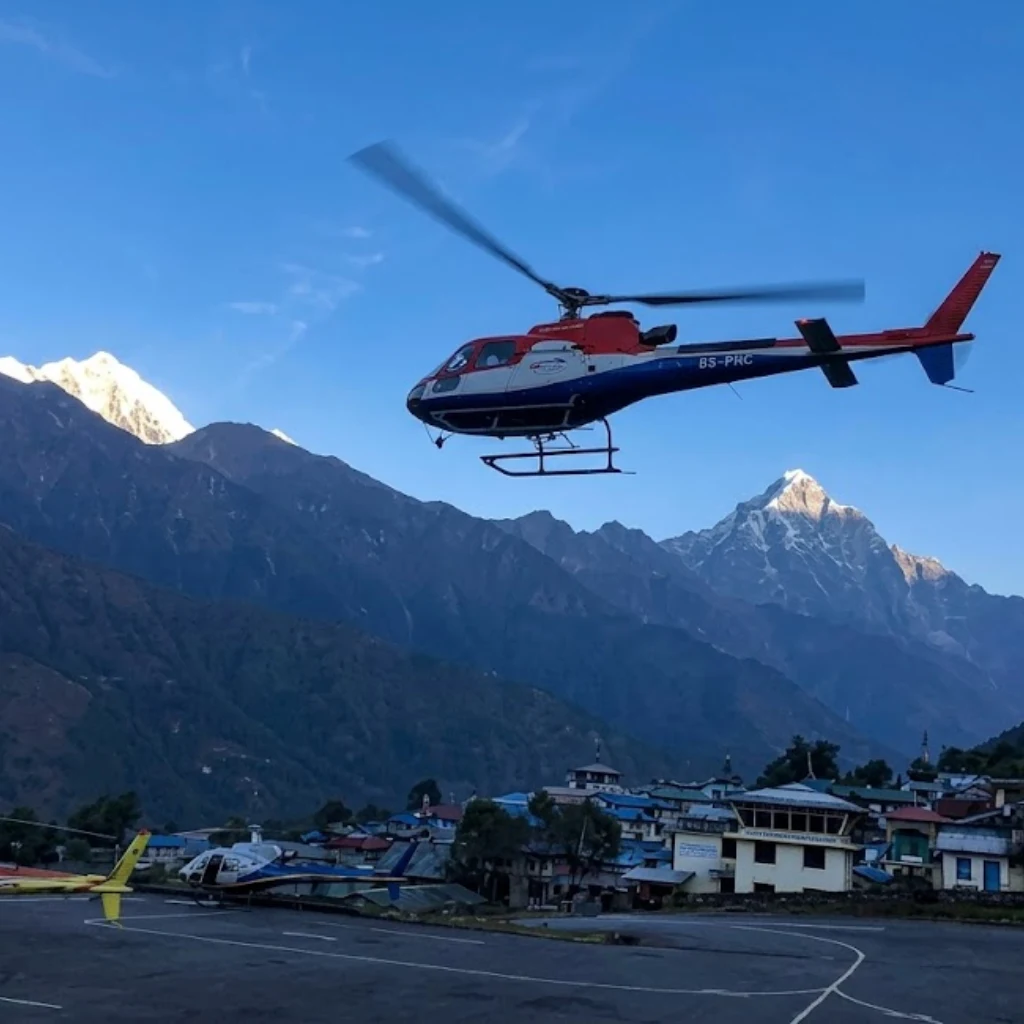
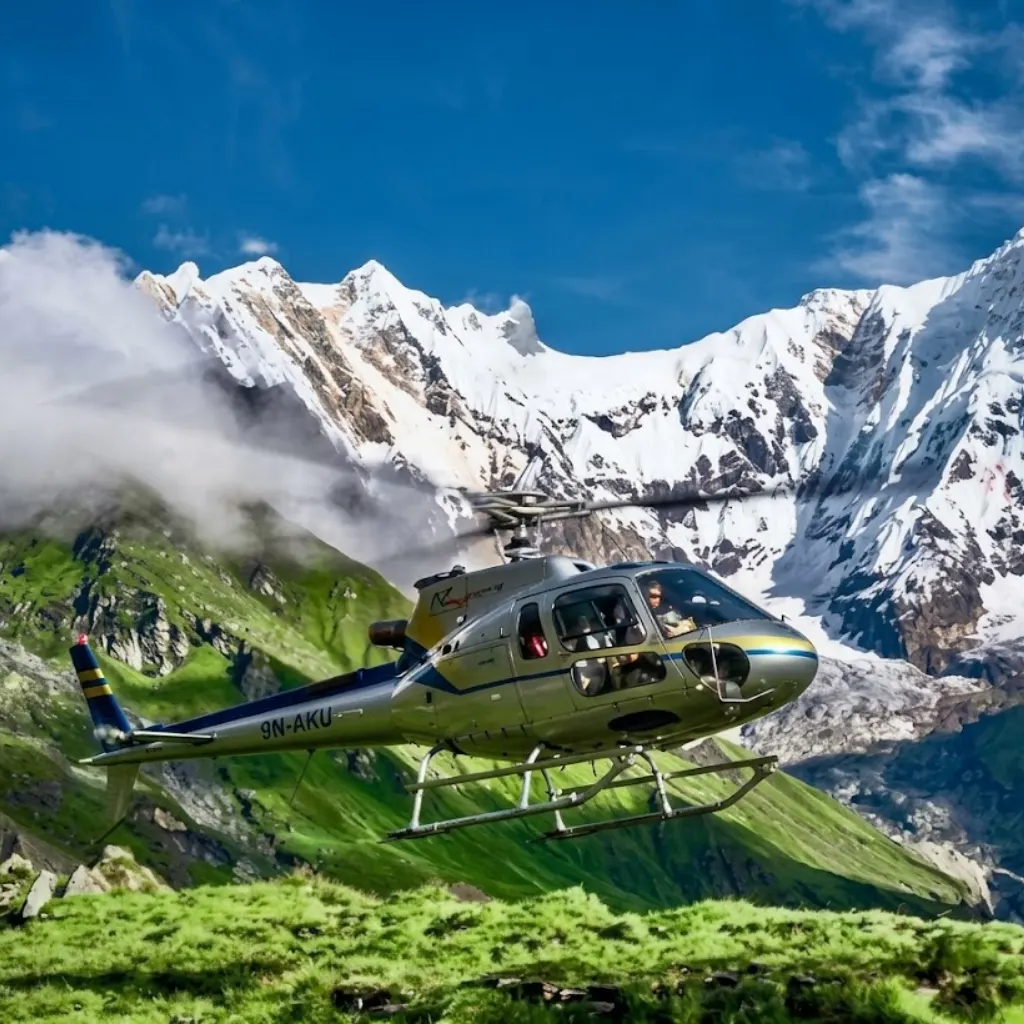
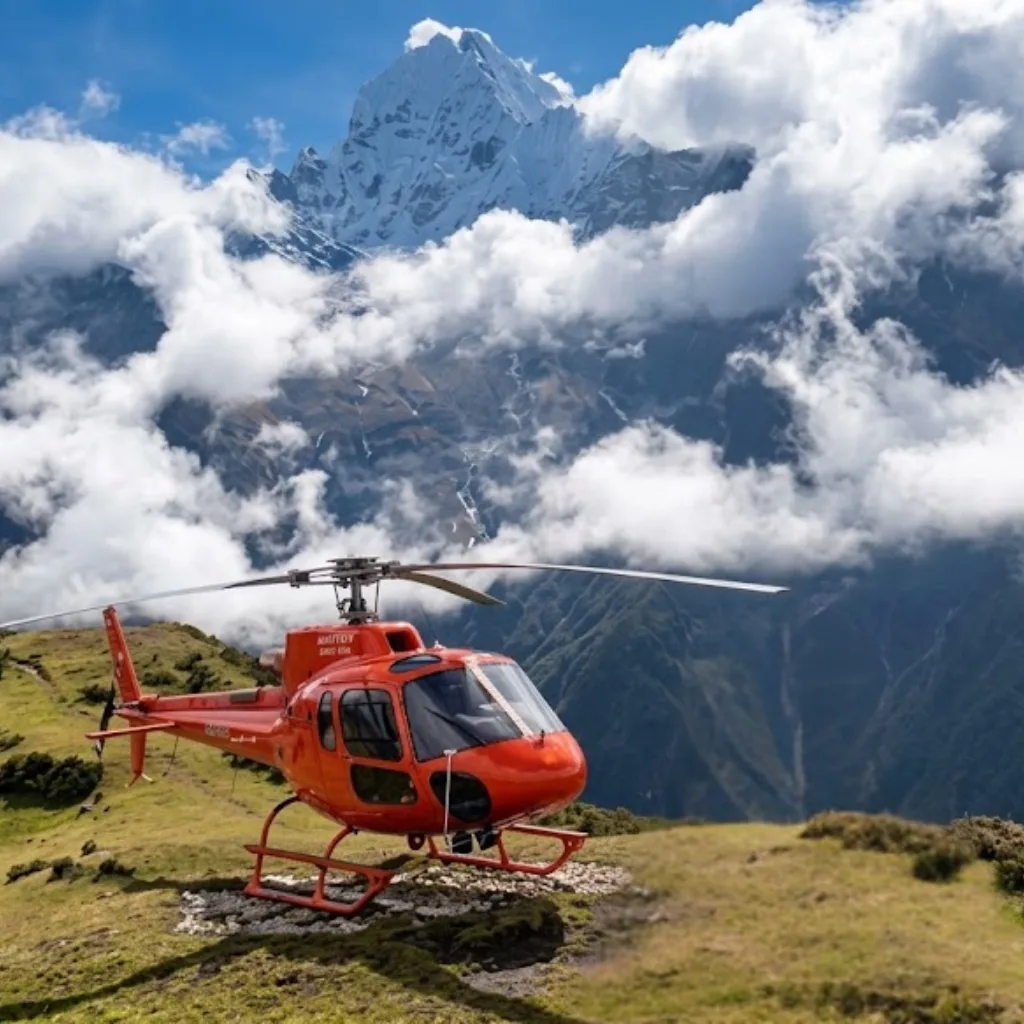
Tour Highlights
The Everest Base Camp helicopter overfly packs the best of the Khumbu into a single morning. Highlights include:
- Everest Base Camp Overflight — 5,364 m / 17,598 ft: Circle the famous base camp from the air, with its tents during the climbing season and the full Khumbu Icefall below.
- Kala Patthar Overflight — 5,545 m / 18,192 ft: The highest point of the tour; fly beside the famous viewpoint for panoramic views of Everest’s summit pyramid and Lhotse.
- Breakfast at Hotel Everest View — 3,880 m / 12,730 ft: A sit-down breakfast or refreshment stop with Everest, Ama Dablam, Lhotse and Thamserku across the valley.
- The Khumbu Icefall and Khumbu Glacier: See the constantly moving icefall and glacier system from above, including the crevasses and seracs that climbers cross.
- Scenic Flight over Namche Bazaar and Tengboche: Fly the trekking corridor over the Sherpa capital and the famous Tengboche monastery before continuing up-valley.
- The Sherpa Villages of Dingboche, Lobuche and Gorak Shep: Trace the classic Everest Base Camp route from the air, from alpine settlements to the final outpost at the foot of the icefall.
- Aerial Views of Everest and Lhotse: The world’s two highest mountains in a single view, framed by Nuptse, Pumori and Ama Dablam.
- Lukla Stop — 2,860 m / 9,383 ft: A short refuelling landing at the world’s most famous mountain airstrip.
- Short and Accessible: One morning, maximum altitude about 5,545 m, and no walking at all — the most time-efficient way to reach the Everest region.
Everest Base Camp Helicopter Tour Overview
The Everest Base Camp Helicopter Tour is a 1-day flyover in the Everest (Khumbu) region that lifts off from Kathmandu in the early morning, overflies Everest Base Camp and Kala Patthar, and returns the same day after breakfast at Hotel Everest View. The journey reaches a maximum altitude of around 5,545 m / 18,192 ft at the Kala Patthar overflight, and because there is no walking involved, the tour is graded easy and open to almost any reasonably healthy traveller.
Starting and ending in Kathmandu, the flight heads northeast past Lukla and follows the famous Everest Base Camp trekking corridor from the air — over Namche Bazaar, Tengboche, Dingboche, Lobuche and Gorak Shep — before circling Everest Base Camp and Kala Patthar for 10–15 minutes of close-up views of the Khumbu Glacier, the Khumbu Icefall and the summit ridges of Everest, Lhotse and Nuptse.
With Nepal Lion Tours, the Everest Base Camp helicopter trip starts from USD 1,424.05 per person (Standard tier, from; normally USD 1,499 with a 5% discount applied), including hotel pick-up and drop-off, the round-trip helicopter flight, breakfast at Hotel Everest View, 2 free hotel nights in a 3-star Kathmandu hotel with breakfast, and all required permits and paperwork.
What Makes the Everest Base Camp Helicopter Tour Special?
The defining experience is the aerial overflight of Everest Base Camp and Kala Patthar. From around 5,364 m to 5,545 m, the helicopter circles above the expedition camps during the climbing season, so you can see the Khumbu Glacier and the Khumbu Icefall from a perspective that even most trekkers never get — without a single step of high altitude.
The tour is also fast. You are picked up around 5:30–6:30 in the morning, flying within the hour, and you are usually back in Kathmandu before 11:00 AM. In roughly four and a half to five hours of flying you cover what a 12-to-14-day Everest Base Camp trek does on foot, making it an efficient option for travellers who want big Everest views on a tight schedule.
The breakfast stop at Hotel Everest View adds a second highlight. After the high-altitude sightseeing, the helicopter descends to around 3,880 m / 12,730 ft for a meal with views of Everest, Lhotse, Ama Dablam and Thamserku — one of the most photographed settings in the Khumbu.
Why Choose the Everest Base Camp Helicopter Overfly?
For anyone short on time, this is the most practical way to see Mount Everest and Everest Base Camp. There is no trekking, no acclimatisation schedule and no luggage planning — you travel with a small daypack, fly in the morning and are back in Kathmandu before lunch.
The route is self-contained: a private hotel pick-up, a short domestic terminal transfer, the helicopter flight with a refuelling stop at Lukla, and a return transfer to your hotel. Because every leg is arranged, the tour suits first-time visitors, layover passengers, family groups and travellers who want a grand Himalayan panorama without the physical demands of a base camp trek.
Who Is This 1-Day Helicopter Tour Suitable For?
The Everest Base Camp helicopter overfly is a good choice for:
- First-time visitors who want to see Everest without trekking
- Travellers with only one or two spare days in Nepal
- Couples and honeymooners looking for a memorable aerial experience
- Families with children old enough for an early start
- Older travellers and those with limited mobility
- Photographers and videographers after aerial mountain images
- Those combining Kathmandu sightseeing or Chitwan with a quick Khumbu experience
No trekking experience or fitness training is required. The main demands are the early-morning start and the brief altitude exposure during the overflight, both of which are well within the reach of most healthy travellers.
Guide’s Note — Nepal Lion Tours
“From our experience operating Everest helicopter departures, the moment people remember most is those first minutes above the Khumbu Icefall — the scale of the glacier is hard to judge from the ground. We recommend sitting on the right-hand side of the cabin for the best views of Everest and Lhotse on the outbound leg.”
— Nepal Lion Tours Lead Trekking Guide
Quick Facts
| Tour Fact | Details |
|---|---|
| Tour Name | Everest Base Camp Helicopter Tour (Overfly) |
| Duration | 1 day (around 4–5 hours of flying; full outing about 5.5 hours) |
| Region | Everest (Khumbu), Koshi, Nepal |
| Maximum Altitude | 5,545 m / 18,192 ft (Kala Patthar overflight) |
| Difficulty | Easy |
| Main Highlight | Overflight of Everest Base Camp and Kala Patthar, plus breakfast at Hotel Everest View |
| Start / End | Kathmandu to Kathmandu |
| Route | Kathmandu – Lukla – Namche Bazaar – Tengboche – Dingboche – Lobuche – Gorak Shep – Everest Base Camp & Kala Patthar – Hotel Everest View – Kathmandu |
| Typical Flight Time | 4–5 hours door to door; morning flight, back before noon |
| Best Season | Spring and Autumn (year-round operation with weather caveats) |
| Price From | USD 1,424.05 per person (Standard, from) |
| Accommodation | 2 free nights in a 3-star Kathmandu hotel with breakfast |
| Guide | Pilot safety briefing plus ground team; no trekking guide on board |
Everest Base Camp Helicopter Tour Route and Elevation
The route follows the Everest Base Camp trekking corridor by air, with two landing stops — Lukla for refuelling and Hotel Everest View for breakfast. The outbound leg climbs steadily from Kathmandu’s valley floor to the high Khumbu, while the return leg retraces the route downhill to Tribhuvan International Airport.
Everest Base Camp Helicopter Tour Route at a Glance
| Time | Route | Altitude | Highlights |
|---|---|---|---|
| 5:30–6:30 AM | Hotel pick-up and transfer to the domestic terminal | Kathmandu ~1,400 m / 4,593 ft | Private vehicle, check-in assistance |
| 6:30–7:00 AM | Check-in and safety briefing | Kathmandu | Meet the pilot, flight and safety briefing |
| 7:00–7:45 AM | Kathmandu to Lukla by helicopter | Up to ~2,860 m / 9,383 ft | Terraced hills, green valleys, first snow peaks |
| 7:45–8:00 AM | Refuelling stop at Lukla | ~2,860 m / 9,383 ft | Step out at the gateway to the Khumbu |
| 8:00–8:40 AM | Scenic flight over the Khumbu corridor | Rising to ~4,940 m / 16,207 ft | Namche, Tengboche, Dingboche, Lobuche, Gorak Shep |
| 8:40–8:55 AM | Everest Base Camp and Kala Patthar overflight | 5,364–5,545 m / 17,598–18,192 ft | Khumbu Icefall, Everest, Lhotse, Nuptse, Pumori |
| 8:55–9:10 AM | Flight to Hotel Everest View | Descending to ~3,880 m / 12,730 ft | Khumbu Valley, Sherpa settlements, forest ridges |
| 9:10–9:50 AM | Breakfast at Hotel Everest View | ~3,880 m / 12,730 ft | Views of Everest, Ama Dablam, Lhotse, Thamserku |
| 9:50–10:00 AM | Return flight to Lukla for refuelling | ~2,860 m / 9,383 ft | Second aerial pass over the Khumbu Valley |
| 10:00–11:00 AM | Return flight to Kathmandu and hotel transfer | Kathmandu ~1,400 m / 4,593 ft | Alpine forests, terraced hills, winding rivers |
Everest Base Camp Helicopter Tour Elevation Profile
The profile is a rapid out-and-back rather than a gradual climb. Kathmandu sits around 1,400 m / 4,593 ft; the helicopter then climbs to roughly 2,860 m / 9,383 ft at Lukla before rising above 4,000–5,000 m through the Khumbu and peaking at the Kala Patthar overflight around 5,545 m / 18,192 ft. The tour then drops back to the Hotel Everest View at 3,880 m / 12,730 ft for breakfast before descending all the way to Kathmandu.
What this means physically is that you gain altitude in minutes rather than days. Because you do not sleep at altitude and the exposure is short, the tour avoids the acclimatisation pattern of a multi-day trek — though the speed of the ascent is precisely why the briefing, hydration and the operator’s altitude awareness matter. Nepal Lion Tours provides a trekking map and can share the flight’s elevation profile with you before departure.
How to Get to the Everest Base Camp Helicopter Tour
This tour starts in Kathmandu, so there is no separate approach journey to a trailhead. The adventure begins with a private hotel pick-up between 5:30 and 6:30 AM, a short transfer to the domestic terminal of Tribhuvan International Airport, and a same-morning helicopter departure.
Kathmandu to Lukla: Flight or Road?
Because the aircraft itself covers the distance, the only real question is how you reach the Everest region — and for this tour there is only one answer.
| Option | Approx. Travel Time | Best For |
|---|---|---|
| Tour helicopter | ~40–45 minutes | The standard and only option for this package |
| Scheduled fixed-wing flight to Lukla | ~25–35 minutes | Trekkers starting a multi-day EBC walk, not this tour |
| Road to Jiri or Ramechhap | 4–9 hours | Overland alternatives, not part of the heli tour |
The tour’s own helicopter handles the entire Kathmandu–Lukla leg and continues straight into the high Khumbu, so you never need a connecting mountaineering flight. The aircraft is fuelled at Lukla on the way out and again on the way back, which keeps the schedule self-contained. From our experience, the morning departure is deliberate — high-altitude helicopter flying benefits from the early, stable air before daytime winds build over the mountains.
Flying over the Khumbu Corridor
After the refueling stop at Lukla, the scenic section begins. The helicopter follows the Everest Base Camp trekking route for around 40 minutes, passing directly over Namche Bazaar, the Tengboche monastery, and the valley villages of Dingboche, Lobuche and Gorak Shep — the same settlements trekkers reach over eight to ten days of walking. Ama Dablam rises on the right as the aircraft turns up the valley toward the icefall.
The Landing Stops: Lukla and Hotel Everest View
Two landings give you time outside the cabin. The first is the refueling stop at Lukla Airport (~2,860 m / 9,383 ft), where you can step out and feel the mountain air of the Khumbu. The second is Hotel Everest View (~3,880 m / 12,730 ft) for breakfast or refreshments. Both are short, crew-managed stops, and the pilot will indicate where you may walk.
Guide’s Note — Nepal Lion Tours
“The Lukla runway is world famous for being short and steep, but from the cockpit it is a routine mountain airstrip. We use experienced pilots and carry out a refuelling stop exactly so the aircraft is never pushed for endurance above the Khumbu. Listen to the briefing and you will enjoy the flight far more.”
— Nepal Lion Tours Lead Trekking Guide
Returning to Kathmandu After the Overfly
Once breakfast is finished, the helicopter returns via Lukla for a second refueling stop and then flies the length of the corridor back to Tribhuvan International Airport. A Nepal Lion Tours vehicle meets you on arrival and transfers you to your Kathmandu hotel — you are usually back and unpacked before 11:30 AM.
With the rest of the day free, you can add Kathmandu sightseeing, visit Durbar Square or relax before onward travel. Guests staying for the 2 free hotel nights simply continue their Nepal itinerary, and the team is happy to arrange extensions.
A Practical Tip for International Travellers
Carry your passport or a valid photo ID plus your booking confirmation — the domestic terminal performs document checks before boarding. Because the flight depends on morning weather conditions, and returning to the international terminal is easy the same day, we suggest keeping your international departure flexible and not booking an outbound flight tightly around the tour’s finishing time.
Everest Base Camp Helicopter Tour Difficulty, Fitness & Altitude
The tour is graded easy — there is no walking beyond a few steps at the landing stops — but easy does not mean there is nothing to think about. The real factors are the very early start, the 4–5 hours of flying and a brief ascent to over 5,000 m during the overflight.
Where the Effort Actually Is?
There is no physical hiking effort on this tour, but three things still deserve attention:
The early start is the most common adjustment. Pick-up between 5:30 and 6:30 AM means an early night before, especially for visitors still tired from international travel. Plan your sleep the evening before rather than relying on catching up in the aircraft.
The rapid altitude gain is the main physiological factor. In under an hour the helicopter climbs from 1,400 m to roughly 5,000 m, and even though the exposure is shortened to the overflight window, some travellers feel the effects for a few minutes — a mild headache or breathlessness is possible. Hydrating well beforehand and staying calm are the practical answers.
The flight time itself can fatigue passengers who are not used to small aircraft: 4–5 hours of flying, engine noise, cold air at altitude and a 10–15 minute hover-and-circle sequence around Everest Base Camp. There is no physical training needed, but arriving rested makes the whole morning more enjoyable.
Guide’s Note — Nepal Lion Tours
“From our experience flying Everest departures, passengers who rested the night before and drank water steadily through the morning report the altitude window far more comfortably. The overflight itself is gentle — it is the early alarm and the rapid gain above 5,000 m that most people notice.”
— Nepal Lion Tours Lead Trekking Guide
How to Prepare for the Everest Base Camp Helicopter Tour
Preparation is simple and mostly about logistics and comfort:
- Sleep well the night before: The 5:30–6:30 AM pick-up is far easier after a full night’s rest.
- Hydrate the day before and the morning of: Drinking water before the flight reduces the impact of the rapid altitude gain.
- Dress in layers: The cabin can be warm at Kathmandu’s altitude and cold during the high-altitude sightseeing, so layers are more useful than a single heavy jacket.
- Keep your daypack light: One small bag with ID, camera, water and a light layer is all you need; heavy luggage is uncomfortable in the cabin.
- Eat a light breakfast or wait for Hotel Everest View: Many guests prefer breakfast at the hotel at 3,880 m; if you are prone to motion discomfort, avoid a heavy meal before the flight.
- Tell the team about any health concerns: Heart, respiratory or panic-disorder conditions should be mentioned at booking so the crew can advise on suitability.
How Easy Is This Compared with Longer Everest Treks?
Extraordinarily easy when set against walking routes. A 12–14 day Everest Base Camp trek involves 6–8 hours of walking daily, nights above 4,000–5,000 m and real acclimatisation planning; the helicopter tour replaces all of that with a single morning in the air. The equivalent comparison works the other way too — the tour trades the slow, ground-level immersion of a trek for speed, comfort and that one-of-a-kind aerial perspective.
Altitude, Acclimatization and Safety
The tour reaches 5,545 m / 18,192 ft at the Kala Patthar overflight, with the Everest Base Camp circle at about 5,364 m / 17,598 ft. Because there is no overnight above 1,400 m, standard trekking acclimatisation does not apply — but the speed of the climb is a factor in its own right.
Everest Base Camp Helicopter Tour Altitude Profile
- Kathmandu — ~1,400 m / 4,593 ft: Departure and overnight city.
- Lukla — ~2,860 m / 9,383 ft: Refuelling stop; brief cabin exit.
- Namche Bazaar and Tengboche — 3,440–3,867 m / 11,286–12,684 ft: Scenic flyover of the acclimatisation villages of the Khumbu.
- Lobuche and Gorak Shep — 4,940–5,164 m / 16,207–16,942 ft: Overflown en route to the base camp.
- Everest Base Camp — 5,364 m / 17,598 ft: The main overflight highlight.
- Kala Patthar — 5,545 m / 18,192 ft: Maximum altitude of the tour.
- Hotel Everest View — 3,880 m / 12,730 ft: Breakfast stop.
How the Body Adapts to Altitude
At altitude the body works harder for the same oxygen. Because you stay at height for only a short window, most passengers feel little or nothing, but the principle is worth knowing: stay hydrated, keep your movements slow at the landing stops, and do not try to rush. The crew’s briefing covers exactly what to expect during the overflight.
Symptoms of Altitude Sickness to Watch For
Mild and common reactions to brief altitude exposure include:
- Mild headache or light-headedness
- Slightly fast breathing or breathlessness
- Fatigue or unusual tiredness
- A feeling of being “slow” at the landing stops
- Generally feeling unwell for a few minutes
More concerning symptoms, which are rare on a short overflight, include:
- Severe or worsening headache
- Nausea and vomiting
- Confusion or difficulty concentrating
- Shortness of breath at rest
- Coughing or a rattling chest
If you feel unwell, tell the pilot or crew immediately. Because the helicopter can descend quickly to lower altitude, this is the great safety advantage of a helicopter over a trek — the aircraft itself is the evacuation resource when a passenger is affected.
How Nepal Lion Tours Supports Your Safety
- Experienced pilots and crew familiar with high-altitude Khumbu flying and emergency procedures.
- A full safety briefing before departure covering routes, weather, emergency protocols and the overflight sequence.
- A refuelling and endurance plan that keeps the aircraft within safe margins at all times.
- Rapid descent capability — the quickest possible change of altitude if a passenger feels affected.
- No overnight at altitude — the tour returns to Kathmandu the same day, so you are never sleeping above 1,400 m.
Best Time to Take the Everest Base Camp Helicopter Tour
The best time for the Everest Base Camp helicopter overfly is spring (March to May) and autumn (September to November), when the Khumbu skies are at their clearest. Because the tour flies and returns in a single morning, weather windows matter more than seasonal average conditions — the operator watches the morning forecast closely.
| Season | Months | Weather and Flight Conditions | Mountain Views | Overall |
|---|---|---|---|---|
| Autumn | Sep–Nov | Best visibility; stable, clear mornings | Excellent | Best overall |
| Spring | Mar–May | Clear, drier air; Everest climbing season activity | Very good | Highly recommended |
| Winter | Dec–Feb | Cold but often crystalline clear; windy days possible | Good on clear days | Possible with flexible dates |
| Monsoon | Jun–Aug | Cloud and rain common; morning windows still occur | Frequently limited | Less predictable |
Autumn — September to November
Autumn is the classic choice. After the monsoon rains clear, the air becomes exceptionally dry and stable, and mornings in the Khumbu are often free of clouds. Everest, Lhotse, Nuptse and Ama Dablam stand out sharply from the first light, and this is when we see the highest on-the-day success rates for the full overflight.
Spring — March to May
Spring offers clear mornings, warmer temperatures in Kathmandu, and the extra spectacle of the spring climbing season, when Everest Base Camp is a busy tented city and the Khumbu Icefall is dotted with climber traffic. March can still carry winter clouds, while late April and May are consistently fine — a particularly rewarding window for photography.
Winter — December to February
Winter brings cold but often brilliant clarity, especially on still days. High-altitude winds are the main risk, so the tour is very much weather-dependent, and mornings may require patience. For travellers with flexible dates who want the empty-season Khumbu, winter can deliver exceptional photographic conditions.
Monsoon — June to August
The monsoon brings frequent clouds and rain, and views are often limited by morning mist. The tour still operates where the forecast allows — weather systems in the Himalayas can open morning windows even in July — but this is the least predictable season for the full overflight.
Which Season Should You Choose?
If you have a choice, October and November give the best odds of a textbook overflight, followed by April and May. If your dates are fixed, check the operator’s morning forecast advice before leaving — a single bad-weather morning can shift to an alternate clear day, and the team will advise on the best reschedule window.
Guide’s Note — Nepal Lion Tours
“On clear autumn mornings the views above Gorak Shep typically open up in sequence — first Ama Dablam catching the light, then the icefall, then Everest’s summit ridge. Mornings genuinely matter more than calendar dates, so keep one flexible morning if you can.”
— Nepal Lion Tours Lead Trekking Guide
Everest Base Camp Helicopter Tour Permits and Regulations
The helicopter route overlies the Everest (Khumbu) region and touches down at Lukla and Hotel Everest View, which sit within the Sagarmatha National Park area on the trekking corridor. Because this is a same-day overflight with no walking itinerary, the standard trekking permit set does not ordinarily apply, and Nepal Lion Tours arranges any applicable paperwork as part of the tour.
Permits at a Glance
| Requirement | Who Needs It? | Who Arranges It? |
|---|---|---|
| Sagarmatha National Park Entry Permit | Trekkers walking in the park; not required for the heli overflight itself | Nepal Lion Tours (if adding trek days) |
| Khumbu Pasang Lhamu Rural Municipality Permit | Trekkers in the Khumbu; replaces TIMS on walking routes | Nepal Lion Tours (if adding trek days) |
| Helicopter tour documentation and airport checks | All passengers on the flight | Nepal Lion Tours |
| Restricted-area permit | Not applicable — no restricted zones on this route | Not applicable |
Sagarmatha National Park Entry Permit
Were you to extend the flight into a walking itinerary around Lukla or Hotel Everest View, the Sagarmatha National Park Entry Permit would be required — around NPR 3,000 for foreign visitors and NPR 1,500 for SAARC nationals at the current rate, issued via a registered agency. Fees are set by the authorities and can be revised, so confirm the current figure at booking.
Khumbu Pasang Lhamu Rural Municipality Permit
The Khumbu Pasang Lhamu Rural Municipality Permit (around NPR 3,000 foreign / NPR 2,000 SAARC) is the Khumbu’s local tourism registration, which replaces the TIMS card on standard Everest walking routes. As with the national park permit, it applies to trekkers walking the corridor rather than to the same-day helicopter overflight.
Do You Need a Restricted-Area Permit?
No — the standard overflight route is not a restricted area, so no restricted-area permit is needed. The route overflies open trekking corridors and lands only at Lukla and Hotel Everest View. If you later modify the itinerary toward restricted high-valley routes, different rules would apply and Nepal Lion Tours would let you know at booking.
Who Arranges the Permits?
Nepal Lion Tours handles all required paperwork and airport checks as part of the package — you are not asked to obtain anything in advance for this tour. Carry an original passport or valid ID for the domestic terminal check, and confirm current fees and rules with the team before your departure date, as government rates can change.
Food and Accommodation on the Everest Base Camp Helicopter Tour
The tour pairs breakfast at Hotel Everest View with a 3-star Kathmandu hotel stay that includes 2 free nights with breakfast. It is a short, comfortable package — the focus is the morning flight and the mountain meal, not overnights in the Khumbu.
Your Kathmandu Hotel and the 2 Free Nights
The package includes 2 free nights in a 3-star Kathmandu hotel with breakfast, which frames the flight day neatly: arrive, sleep, fly in the morning, and keep a free evening in the city before continuing your Nepal itinerary. Standard hotels sit in or near the tourist centre of Thamel, with comfortable rooms, hot water, Wi-Fi and easy access to the domestic terminal by the included private transfer.
Twin-sharing rooms are standard; solo travellers are accommodated under the booking terms. Bathrooms are private in city hotels and electricity is reliable — very different from mountain lodges, which is worth remembering if you are also planning a trekking departure alongside the helicopter day.
Breakfast at Hotel Everest View
The signature meal is breakfast or refreshments at Hotel Everest View (~3,880 m / 12,730 ft) after the overflight. The hotel is famous for its terrace views of Everest, Lhotse, Ama Dablam and Thamserku, and the stop is designed to be leisurely — a real mountain breakfast rather than a rushed snack. Continental options, tea and coffee are typical; the setting is the point.
What Food and Drink Are Included?
| Included in the Tour | Usually Paid Separately |
|---|---|
| Breakfast at Hotel Everest View | Lunch and dinner on non-hotel days |
| Breakfast during the 2 Kathmandu hotel nights | Extra snacks and drinks in the city |
| Tea or coffee at the breakfast stops | Alcoholic drinks and bar bills |
| Water on request during the tour | Shopping, souvenirs and personal expenses |
If you have dietary requirements — vegetarian, vegan, gluten-free or allergies — tell Nepal Lion Tours at booking so the breakfast stop and city hotel can be advised in advance.
Drinking Water on the Tour
Hydration genuinely matters before and during the flight, especially as the aircraft climbs above 5,000 m. Carry a small reusable bottle, use bottled or filtered water for drinking, and plan to drink steadily from the morning pickup onward. Kathmandu tap water is not suitable for direct drinking, so bottled, boiled or treated water is the safe standard throughout.
Staying Comfortable on an Early Morning Start
- Confirm your pickup time the evening before and set an early alarm; the window between 5:30 and 6:30 AM is firm.
- Pack your daypack the night before with ID, booking confirmation, camera, water and a light layer.
- Wear comfortable clothing and shoes — footwear matters only around the landing stops, so slip-on shoes are fine.
- Have a light snack before you leave if you prefer not to wait for the Hotel Everest View breakfast.
- Let the team know about any dietary needs or health conditions before departure so the day is arranged around you.
Why Book with Nepal Lion Tours?
Booking the Everest Base Camp helicopter tour with Nepal Lion Tours means a single local team coordinating the whole morning — the hotel pick-up, the domestic terminal formalities, the flight, the mountain breakfast and the return transfer.
- Local, licensed and experienced flight coordination.
Our team works closely with experienced high-altitude helicopter pilots and handles every airport and paperwork step for you, so the day runs to its early schedule.
- A registered company you can verify.
Nepal Lion Tours is a Kathmandu -based, registered trekking and tour company, and our licence and company details are available to travellers on request.
- Private departures and flexible dates.
The helicopter is booked for your group, not a shared fixed schedule — within availability you choose the date that suits you, and the team helps you find the clearest morning.
- The complete overflight experience, arranged end to end.
Hotel pick-up, Lukla refuelling stop, the Everest Base Camp and Kala Patthar overflight, the Hotel Everest View breakfast and the return transfer are all part of one package, so there is no piecemeal booking.
- 2 free hotel nights in Kathmandu included.
The 3-star stay with breakfast frames the flight day and gives you a comfortable base without extra accommodation planning.
- Budget-friendly pricing without cutting the experience.
Standard tier pricing starts from USD 1,424.05 (from, normally USD 1,499 with 5% off), with group discounts for 2–4, 5–9 and 10+ travellers — the core overflight experience stays identical across tiers.
- A local team you can contact before and during your tour.
Message us on WhatsApp at +977-9851039020 with questions about timing, weather windows or extensions, and we will answer directly.
Book the Everest Base Camp Helicopter Tour
Few experiences match the rush of lifting off from Kathmandu at dawn and circling Everest Base Camp before breakfast. If you want the summit of the world’s highest mountain in your photos without a two-week walk, this one-morning tour is the way to do it.
Tour at a Glance
- Duration: 1 day (around 4–5 hours flying; full outing about 5.5 hours)
- Price: From USD 1,424.05 per person (Standard, from; Luxury tier from USD 1,922)
- Difficulty: Easy
- Maximum Altitude: 5,545 m / 18,192 ft (Kala Patthar overflight)
- Accommodation: 2 free nights in a 3-star Kathmandu hotel with breakfast
- Meals: Breakfast at Hotel Everest View, plus hotel breakfasts
- Permits and Paperwork: Arranged by Nepal Lion Tours
- Transportation: Private Kathmandu transfers plus round-trip helicopter flight
- Guide and Crew: Experienced pilot with a full safety briefing, plus ground coordination
- Cancellation: Free cancellation up to 14 days before departure, subject to booking terms
Ready to Start Your Everest Adventure?
Secure your date through the booking form or message us directly on WhatsApp at +977-9851039020, and we will confirm availability, weather planning and your hotel pickup details. Whether you are flying solo, as a couple, or with family, the Everest Base Camp helicopter overflight is one of the most time-efficient mountain experiences in Nepal. Your flight path over the Khumbu is waiting — choose your morning and start planning today.
Related Everest Treks
If you have more time, the Everest region offers walking alternatives to the helicopter overflight that reach the same mountains on foot.
| Trek | Duration | Difficulty | Max Altitude | Best For |
|---|---|---|---|---|
| Everest Panorama Trek | 6 days | Easy–Moderate | 3,880 m (Everest View Hotel) | Shortest route to big Everest views, flight-based |
| Everest Panorama Trek | 8–9 days | Easy–Moderate | 3,867 m (Tengboche) | Family-friendly walking view intro |
| Everest Base Camp Trek | 12–14 days | Moderate | 5,545 m (Kala Patthar) | The classic EBC plus Kala Patthar experience |
| Gokyo Lakes and Cho La Pass Trek | 12–14 days | Moderate–Challenging | 5,357 m (Gokyo Ri) | Turquoise lakes and the Cho La crossing |
| Everest Three Passes Trek | 18–21 days | Challenging | 5,535 m | The full high-altitude Khumbu traverse |
Each option can be paired with the helicopter overflight as a scenic opener or closing day, and Nepal Lion Tours also operates the Everest Basecamp Helicopter Tour with Kala Patthar landing and Annapurna Base Camp helicopter departures for guests combining regions.
Trip Essentials
Packing advice, required equipment & gear recommendations
Essential
Everest Base Camp Helicopter Tour Packing List
Packing for a helicopter overflight is easy — this is a light daypack tour, not a trek. Nepal Lion Tours still provides a down jacket, all-season sleeping bag, duffel bag and trekking map on request (generally for guests continuing on to a walking tour), but for the flight itself you need little more than the essentials below.
Carry-On Essentials for the Cabin
- Daypack — 20–25 litre: For ID, camera, water, a light layer and personal items
- Passport or valid photo ID: Required for the domestic terminal check
- Booking confirmation: Printed or on your phone for verification
- Water bottle: A small reusable bottle for hydration before the flight
- Camera or smartphone: The overflight views are the whole point of the tour
- Spare batteries or power bank: Cold air at altitude drains batteries faster than usual
Clothing: Layers for an Early Mountain Morning
Base layers:
- A light thermal or merino top under normal clothing
- Comfortable trousers with easy movement
Mid-layers:
- A fleece or mid-weight jumper for the high-altitude overflight window
Outer layers:
- A windproof or insulated jacket — the cabin is cold during the Khumbu sightseeing
Footwear:
- Comfortable, slip-on-able shoes for the landing stops
Headwear:
- A light beanie or sun hat, plus sunglasses for the bright mountain light
Sleeping and Evening Comfort in Kathmandu
- Comfortable sleepwear and a light change of clothes for the hotel nights
- Toiletries in travel sizes for your Kathmandu hotel stay
- A small towel is provided by the hotel; no need to carry one
- Earplugs and an eye mask if you sleep lightly before an early start
Toiletries and Personal Health Items
- Toothbrush, toothpaste and any daily medications in your carry-on
- Lip balm and moisturiser for the dry high-altitude air
- Headache tablets if you usually take them
- Personal hygiene items for the hotel nights
- Tissues and hand sanitiser
- Motion-sickness tablets if you are prone to discomfort in small aircraft
- Essential medications carried in hand luggage, never in checked bags
- A thin scarf or buff for cabin comfort
- Small pack of wet wipes for the landing stops
- Sunscreen for exposed skin during the briefing and landing stops
- Contact-lens solution or spare glasses if you wear lenses
- A light compression or comfort aid if you prefer it for flying
- A basic first-aid strip for minor cuts at the landing stops
Electronics
- Phone or camera with enough memory for a trip of a lifetime
- Power bank (10,000 mAh is plenty) for the day
- Charging cables for your Kathmandu hotel evenings
- Note that in-flight use is at the pilot’s discretion; the briefing will cover when photography is allowed
Documents and Money
- Passport or valid photo ID — mandatory for the domestic terminal
- Booking confirmation and any paperwork issued by Nepal Lion Tours
- Nepali rupees in small notes for personal purchases, drinks or tips
- A backup debit or credit card for larger city expenses
- A photocopy or photo of your passport on your phone as a backup
Read Before You Book
Permits, terms, medical considerations & advisory guidelines
Advisory
How Much Should You Pack?
Less than you think. A 20–25 litre daypack holds everything needed for the flight, and your Kathmandu hotel provides the room and amenities for the rest. If you are combining the helicopter with a walking trek, the duffel bag from Nepal Lion Tours carries your trek gear while your daypack stays in the cabin with you. Pack light, arrive early, and let the morning do the work — the day is over in time for a full Kathmandu afternoon.
What to Know Before Booking
Booking the Everest Base Camp helicopter overfly is straightforward, but a few practical details make the difference between a good morning and a great one.
Accommodation and Facilities
The package includes 2 free nights in a 3-star Kathmandu hotel with breakfast, in or near Thamel. Rooms are twin-sharing by default, with private bathrooms, hot water and Wi-Fi — a far more comfortable base than mountain lodges, and a good night's sleep matters before the early pickup.
Food and Dietary Requirements
Breakfast is served at Hotel Everest View, and city hotel breakfasts are included for the 2 nights. Tell the team about vegetarian, vegan, gluten-free or allergy needs at booking so the stops can be arranged around you.
Altitude, Health and Insurance
The overflight reaches around 5,545 m briefly, but you never sleep above 1,400 m. Travel insurance should still cover helicopter touring and any medical emergency; mention any heart, respiratory or anxiety conditions at booking so the crew can advise on suitability.
Money and Tipping
Small notes of Nepali rupees cover personal purchases, drinks and tips. Tipping the pilot and driver is optional and appreciated; a guide is not part of the usual overflight team, so there is no trekking-guide tip expectation.
Culture and Responsible Travel
The Everest region is the homeland of the Sherpa people, and your flight passes Tengboche and other sacred monasteries:
- Do not walk onto the helipad or runway areas beyond the crew’s direction
- Follow the pilot’s instructions around photography, especially near sensitive sites
- Keep the cabin and landing areas clean; carry rubbish back to the aircraft
- Respect local custom at the breakfast stop and when interacting with hotel staff
- Consider a donation to or purchase from a Sherpa-run enterprise if you want to give back
- The airstrip at Lukla is a working mountain facility — stay where guided
Route Options
The standard tour is the overflight with breakfast. Nepal Lion Tours also operates the Everest Basecamp Helicopter Tour with Kala Patthar landing, which adds a landing at the famous viewpoint, and the Annapurna Base Camp Helicopter Tour for the western Himalaya — similar single-morning formats if you want to compare regions.
Booking and Before You Arrive
Make sure you understand the following before confirming:
- Your passport or valid ID must be carried for the domestic terminal
- The early pickup is firm — the morning weather window is the point
- Weather delays are possible; keep the day flexible if you can
- The 2 free hotel nights are part of the package framing, so plan your arrival a night before and the flight day
- Payment and cancellation follow the booking terms, with free cancellation up to 14 days before departure
- Tell the team about dietary needs and health conditions at booking
- Confirm your pickup address and time one day before the flight
A Few Final Tips
Wear layers, hydrate before the flight, keep your camera charged, and settle into the right-hand side of the cabin for the best Everest views on the way out. Keep your international departure a little flexible on flight day, and you remove the last stress from one of Nepal’s most unforgettable mornings.
Day-by-Day Itinerary
Explore each day's route, trekking elevation, and activities
5:30 AM – 6:30 AM: Hotel Pickup & Transfer to Domestic Airport Terminal
Your Everest Base Camp Helicopter Overfly adventure begins with an early-morning pickup from your hotel in Kathmandu. A private vehicle will transfer you to the domestic terminal of Tribhuvan International Airport, where our team will assist you with check-in, luggage arrangements, and boarding procedures. The peaceful morning drive through Kathmandu provides a comfortable beginning to your Himalayan adventure. Please carry your passport or valid identification along with your booking confirmation for airport verification.
6:30 AM – 7:00 AM: Flight Check-in & Safety Briefing
Upon reaching the airport, our ground team will assist you with the final check-in and boarding formalities. You will then meet your experienced helicopter pilot and receive a detailed safety briefing covering helicopter procedures, flight routing, weather conditions, high-altitude considerations, and emergency protocols. Once the necessary operational checks are completed, you will be ready for takeoff toward the Everest region.
7:00 AM – 7:45 AM: Helicopter Flight from Kathmandu to Lukla
The helicopter departs Kathmandu and heads northeast toward the Everest region. As the aircraft leaves the Kathmandu Valley, enjoy aerial views of green hills, terraced farmland, winding rivers, and traditional settlements. Gradually, the landscape changes into rugged Himalayan terrain, with snow-covered peaks appearing across the horizon. After approximately 40–45 minutes, the helicopter lands at Lukla Airport, situated at around 2,845m and widely known as the gateway to the Everest region.
7:45 AM – 8:00 AM: Refueling Stop at Lukla
The helicopter makes a short stop at Lukla for refueling and necessary flight preparations. During this brief break, you may step outside, experience the crisp mountain air, and observe the lively atmosphere around the famous Lukla airstrip. Meanwhile, the flight crew completes the required operational checks before continuing toward the upper Khumbu Valley.
8:00 AM – 8:40 AM: Scenic Flight over Namche Bazaar, Tengboche, Dingboche, Lobuche & Gorakshep
After departing Lukla, the helicopter follows the famous Everest Base Camp trekking corridor from the air. Fly above Namche Bazaar, the vibrant Sherpa trading town, before continuing over Tengboche and its renowned monastery. The flight then proceeds toward the alpine settlements of Dingboche and Lobuche before reaching the rugged surroundings of Gorakshep. Along the way, enjoy spectacular aerial views of deep valleys, suspension bridges, glaciers, monasteries, Sherpa villages, and towering Himalayan peaks.
8:40 AM – 8:55 AM: Everest Base Camp & Kala Patthar Overfly
The highlight of the journey begins with an aerial overflight of Everest Base Camp and Kala Patthar, reaching approximately 5,364m–5,545m. From above, witness the dramatic Khumbu Glacier, Khumbu Icefall, expedition camps during the climbing season, and remarkable views of Mount Everest, Lhotse, Nuptse, Pumori, and surrounding peaks. The helicopter provides approximately 10–15 minutes of aerial sightseeing around these iconic landmarks, creating excellent opportunities for photography without requiring a high-altitude landing.
8:55 AM – 9:10 AM: Flight to Hotel Everest View
Leaving the high-altitude glacier landscape behind, the helicopter descends toward Hotel Everest View at approximately 3,880m. During this short flight, enjoy magnificent views of the Khumbu Valley, traditional Sherpa settlements, alpine forests, and snow-covered mountain ridges before landing near the scenic hotel.
9:10 AM – 9:50 AM: Breakfast at Hotel Everest View
Enjoy breakfast or refreshments at Hotel Everest View while surrounded by spectacular Himalayan scenery. Take time to relax and appreciate panoramic views of Mount Everest, Ama Dablam, Lhotse, Thamserku, and other surrounding peaks. The peaceful mountain setting, fresh alpine air, and exceptional views make this a memorable stop during the helicopter journey.
9:50 AM – 10:00 AM: Return Flight to Lukla for Refueling
After breakfast, board the helicopter for the return flight toward Lukla. The short journey provides another aerial perspective of the Khumbu Valley, Sherpa settlements, mountain terrain, and surrounding Himalayan landscapes before the helicopter makes a brief refueling stop.
10:00 AM – 11:00 AM: Helicopter Flight Back to Kathmandu & Hotel Transfer
Following the refueling stop, the helicopter begins the return journey to Kathmandu. Retrace the scenic Himalayan landscape from the air, with views of alpine forests, terraced hills, winding rivers, mountain villages, and rugged valleys along the route. After landing at Tribhuvan International Airport, our representative will arrange your comfortable transfer back to your hotel. Your Everest Base Camp Helicopter Overfly Tour concludes with lasting memories of an extraordinary aerial journey through the Everest region.
Want to customize this itinerary?
Tailor duration, lodges, acclimatization days, or add private helicopter flights.
Inclusions & Exclusions
Everything that is covered and what you'll need to budget separately
What is Included
Fully covered in your package price
- Pick-up or Drop-off service from and to Airport (in our own vehicle)
- 3 star hotel in Kathmandu with breakfast
- Transportation from Kathmandu to Lukla and back to Kathmandu (by flight)
- Food all along the trip(Breakfast, Lunch, Dinner and a cup of coffee or tea) and accommodations during the trip in hotels with family environment
- One licensed English or Chinese or Korean or Hindi along with Nepali speaking trekking guide
- Transportation, food, accommodation and insurance of Guide during the trip
- Down jacket, all-season sleeping bag, duffel bag and trekking map(in case if you don't have your own. Down jacket, sleeping bag and duffel bag must be returned after completion of the trip)
- First Aid Medical Kit(Carried by the guide)
- All the required permits and paperworks
- 2 Nights hotel free
What is Excluded
Personal expenses & optional extras
- International Airfare
- Visa Charges
- Your travel and medical insurance
- Personal Expenses such as shopping, bar bills, hot shower, telephone, laundry, titbits etc
- Services not mentioned or not promised by the Agent / Agency
- Emergency expenses such as expenses on charted Flights / Helicopter
Our Customer Reviews
Authentic experiences and feedback from our travelers
Write a Review
Share your adventure experience with other travelers
Thank You!
Your review has been submitted and is awaiting approval.
Please Wait
You've submitted several reviews recently. Please wait a few minutes before trying again.
No reviews yet
Be the first to share your experience with this trek!
Frequently Asked Questions
Essential information on preparation, route specifics, safety standards, and logistical details.