Everest Base Camp Helicopter Return Trek | Nepal Lion Tours
Trek to Everest Base Camp and Fly Back by Helicopter Over the Majestic Himalayas
Everest Basecamp Trek with helicopter return


Tour Highlights
The 10-day route condenses the classic Everest trail, then finishes with the scenic flight that gives the package its name.
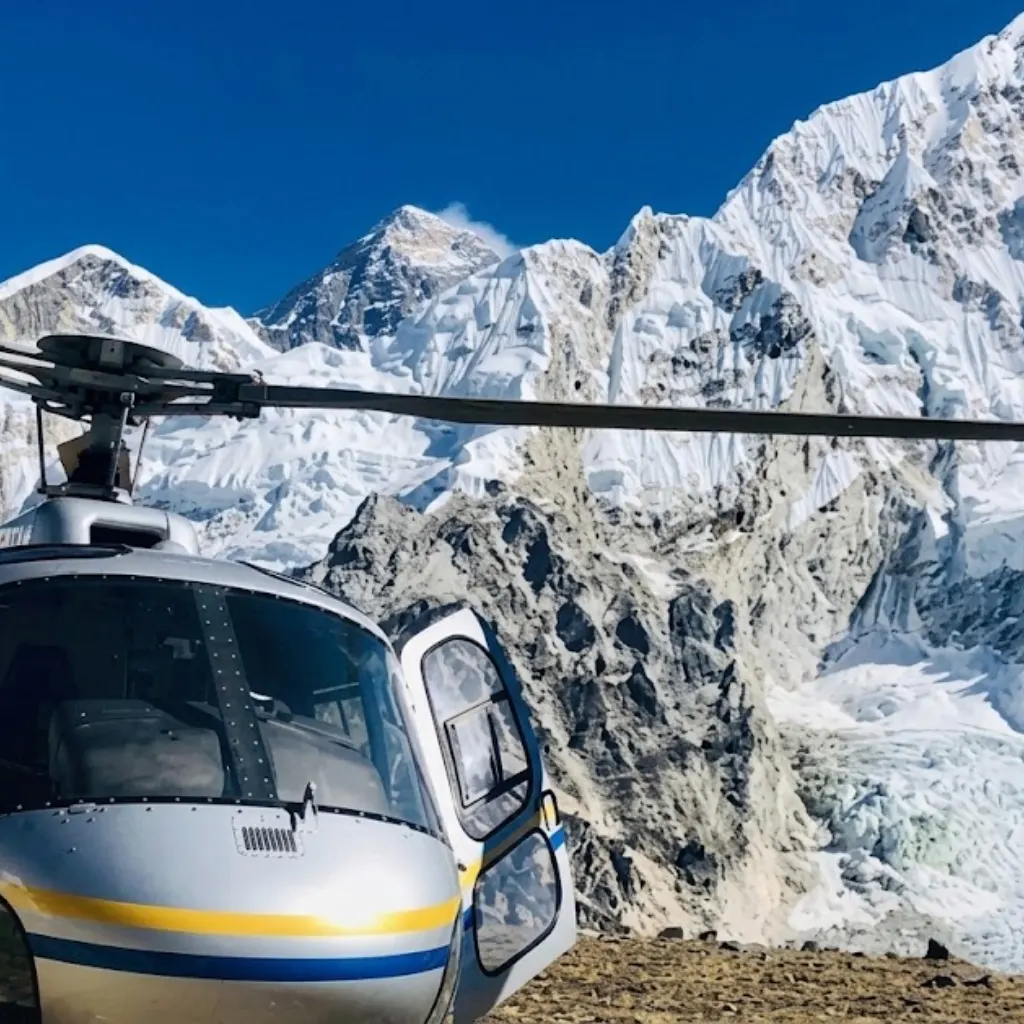
- Kala Patthar – 5,545 m / 18,192 ft: The famous rocky viewpoint opposite Everest, reached by an afternoon climb on Day 8, with the cleanest panorama of Everest, Nuptse, Changtse and the Khumbu Icefall you can photograph without climbing the mountain.
- Everest Base Camp – 5,364 m / 17,598 ft: The legendary starting point of Everest expeditions, reached on the moraine of the Khumbu Glacier on Day 9 — the destination the whole route is built around.
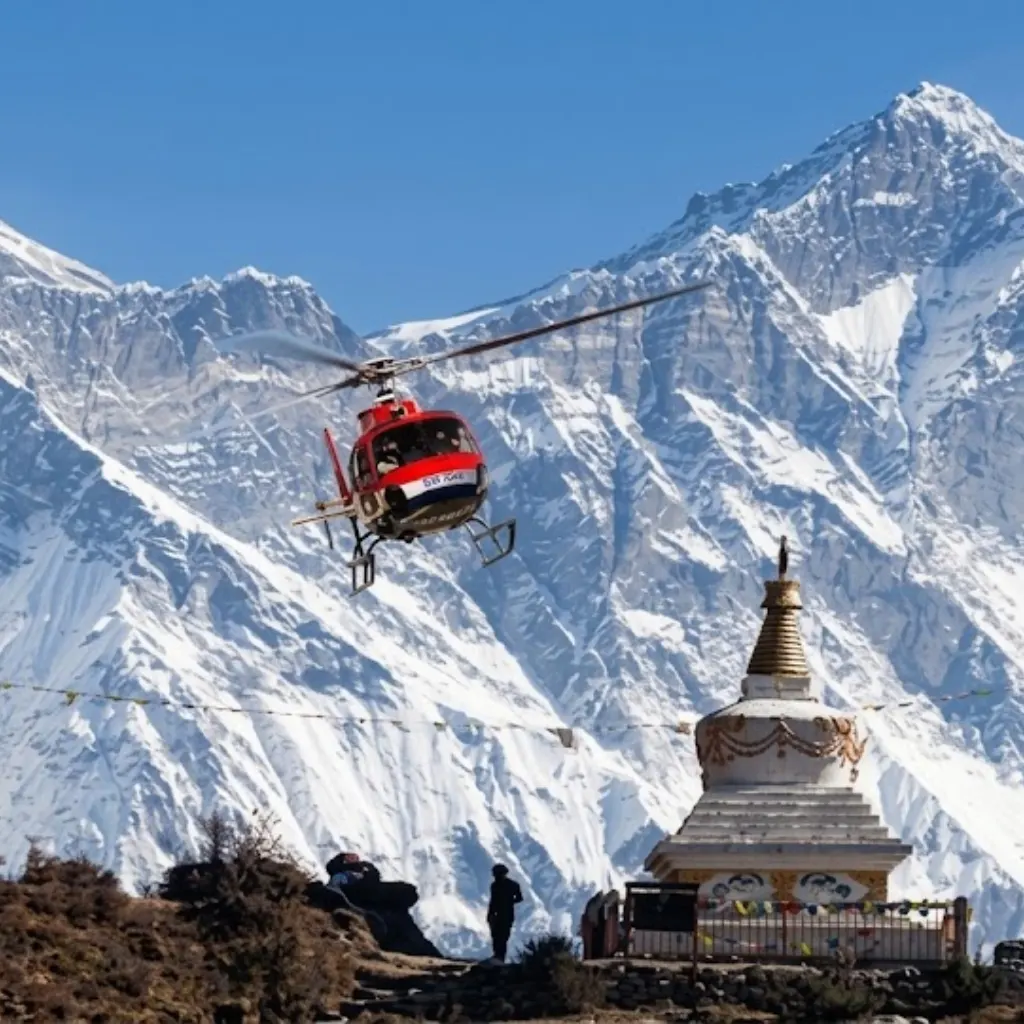
- Helicopter flight home – Gorak Shep to Kathmandu: A scenic two-hour flight on Day 10 that lifts you along the Khumbu Glacier, past Everest and Ama Dablam, and over the valley you walked, landing in Kathmandu the same morning.
- Sagarmatha National Park: A UNESCO World Heritage Site protecting the southern slopes of Everest, entered through its gate on the second day of walking, with forests, musk deer and the rare snow leopard on its higher slopes.
- Tengboche Monastery – 3,956 m / 12,979 ft: The largest and most famous monastery in the Khumbu, set beneath the fluted face of Ama Dablam. Arrive in time for evening prayers and the monks’ chanting.
- Sherpa culture and Namche Bazaar – 3,440 m / 11,286 ft: The mountain capital of the Khumbu, with its market, bakeries and museums, and the acclimatisation-day hike to Khumjung village or the Hotel Everest View.
- The Khumbu Icefall: Seen close from Kala Patthar and Everest Base Camp — the river of glacial seracs that expedition climbers navigate, and one of the most dramatic sights in the Himalaya.
- The memorials at Dughla – 4,620 m / 15,158 ft: Stone cairns and prayer flags honouring climbers who died on Everest, a sombre and moving stop on the way to Lobuche.
- Suspension bridges, chortens and prayer flags: The Khumbu’s classic trail furniture from Lukla to the high valley, matched by views of Ama Dablam (6,812 m), Lhotse and Pumori.
Everest Base Camp Helicopter Return Trek Overview
The Everest Base Camp Helicopter Return Trek is a 10-day high-altitude trek in the Khumbu region of Nepal, following the classic Everest Base Camp trail from Lukla through Namche Bazaar, Tengboche, Dingboche and Lobuche to the foot of the world’s highest mountain, then returning to Kathmandu in a scenic two-hour helicopter flight from Gorak Shep. Graded strenuous, it keeps the walking itinerary of a classic Everest route but replaces the long walk-out with an aerial descent — the most time-efficient way to stand at Kala Patthar and Everest Base Camp in a single trip.
Starting and ending in Kathmandu, this Everest Base Camp trek with helicopter return covers the 35–40 minute flight to Lukla, eight days of acclimatisation-aware walking into the high Khumbu, the climb to Kala Patthar (5,545 m / 18,192 ft) for close-up views of Mount Everest (8,849 m / 29,032 ft), the walk to Everest Base Camp (5,364 m / 17,598 ft), and the helicopter flight home over the Khumbu glaciers. The route passes through Sagarmatha National Park, past the monastery at Tengboche and the Sherpa capital of Namche Bazaar en route.
With Nepal Lion Tours, the Everest Base Camp Helicopter Return Trek starts from USD 2,326.55 per person (list price USD 2,449). The package includes your licensed English-speaking guide, the Sagarmatha National Park and Khumbu Pasang Lhamu permits, teahouse accommodation and meals during the trek, the Kathmandu–Lukla flight, the Gorak Shep–Kathmandu helicopter return, and a welcome or farewell dinner in Kathmandu.
Guide’s Note — Nepal Lion Tours
From our experience operating Everest Base Camp departures, the moment that stays with most guests is not the base camp itself but Kala Patthar at first light — the whole Khumbu unfolds above the icefall, with the snow-fluted Ama Dablam catching the first colour. On this itinerary the memories double: after days of walking the same valley, the helicopter lifts you over the trail you climbed, and guests almost always fall silent looking down at their own footsteps below.
— Nepal Lion Tours Lead Trekking Guide
What Makes the Everest Base Camp Helicopter Return Trek Special?
The signature experience is Kala Patthar, the rocky viewpoint at 5,545 m (18,192 ft) directly opposite Mount Everest, where the entire south side of the mountain — the Khumbu Icefall, Nuptse and Changtse — sits before you in a single panorama. The trek then continues to Everest Base Camp itself at 5,364 m (17,598 ft), the legendary starting point for summit expeditions that you reach as a walker rather than a climber.
The helicopter return is the second differentiator. Where a classic Everest Base Camp trek ends with two or three days of downhill walking, this 10-day version finishes with a two-hour scenic flight from Gorak Shep to Kathmandu, banking along the Khumbu Glacier and over the peaks you have lived beneath for a week. It is the same route, split between feet and rotor.
Why Choose the Everest Base Camp Helicopter Return Trek?
Time, comfort and altitude logistics are the three reasons. The trek is complete in 10 days from Kathmandu, cutting the standard 12–14-day Everest route short by walking out by helicopter instead of on foot. The helicopter day doubles as a flightseeing tour, and the aircraft carries you from above 5,000 m to Kathmandu in a single morning, removing the two-day descent that tires many trekkers after base camp.
Because the itinerary keeps the Namche and Dingboche acclimatisation days, the walking build-up is identical to the classic route, so you earn the scenery properly. The result suits travellers with a limited holiday window who still want the complete Everest Base Camp experience rather than a fly-over version.
Who Is This 10-Day Everest Base Camp Trek Suitable For?
- Experienced trekkers comfortable with altitude, cold and sustained high-altitude walking
- Fit hikers who have trekked above 4,000 m and want the Everest Base Camp experience in under two weeks
- Time-pressed travellers who would otherwise sacrifice the EBC itinerary to a shorter window
- Solo and couple travellers on private departures, plus small private groups
- Trekkers who dislike prolonged descents — the helicopter removes the long walk-out
- Photographers chasing Kala Patthar panoramas and aerial Khumbu light
- Return visitors to Nepal who have done the foothills and now want the big mountains
- Adventure travellers drawn to the Khumbu Icefall, Sherpa culture and Sagarmatha National Park
The trek is graded strenuous because of altitude rather than technical difficulty — there is no scrambling or glacier walking, but the overnight heights above 4,000 m and the cold, dry conditions demand good fitness and a careful pace. Read the difficulty section below before booking.
Quick Facts
| Trek Fact | Details |
|---|---|
| Trek Name | Everest Base Camp Helicopter Return Trek |
| Duration | 10 days / 9 nights |
| Region | Everest (Khumbu), Koshi, Nepal |
| Maximum Altitude | 5,545 m / 18,192 ft at Kala Patthar |
| Difficulty | Strenuous |
| Main Highlight | Kala Patthar’s Everest panorama, Everest Base Camp and the helicopter flight home |
| Start / End | Kathmandu to Kathmandu |
| Route | Kathmandu – Lukla – Phakding – Namche Bazaar – Tengboche – Dingboche – Lobuche – Gorak Shep – Everest Base Camp – helicopter to Kathmandu |
| Typical Walking | 3–7 hours per day (two acclimatisation days; helicopter on Day 10) |
| Best Season | Spring and Autumn |
| Price From | USD 2,326.55 per person (list USD 2,449) |
| Accommodation | Teahouses throughout the trek, final hotel night in Kathmandu |
| Guide | Licensed English-speaking trekking guide |
Everest Base Camp Helicopter Return Trek Route and Elevation
The route is the classic Everest Base Camp walk with the return leg replaced by a helicopter. From Kathmandu you fly to Lukla, walk north up the Dudh Koshi valley through Phakding, Namche Bazaar, Tengboche and Dingboche to Lobuche and Gorak Shep, day-hike to Kala Patthar and Everest Base Camp, then fly by helicopter from Gorak Shep to Kathmandu on the final day.
Everest Base Camp Helicopter Return Trek Route at a Glance
| Day | Trek Route | Altitude | Highlights |
|---|---|---|---|
| Day 01 | Kathmandu to Lukla by flight, trek to Phakding | Lukla 2,860 m / 9,383 ft; Phakding 2,651 m / 8,698 ft | 35–40 minute mountain flight, first Khumbu views |
| Day 02 | Phakding to Namche Bazaar | 3,440 m / 11,286 ft | Sagarmatha gate, suspension bridges, the big climb to Namche |
| Day 03 | Acclimatisation day in Namche Bazaar | Hike to 3,700 m / 12,139 ft | Khumjung village, Everest View Hotel panorama |
| Day 04 | Namche Bazaar to Tengboche | 3,956 m / 12,979 ft | Prayer flags and chortens, Tengboche Monastery, Ama Dablam |
| Day 05 | Tengboche to Dingboche | 4,380 m / 14,370 ft | Debuche, Pangboche, Lhotse and Island Peak views |
| Day 06 | Acclimatisation day in Dingboche | Ridge hike to 5,083 m / 16,677 ft | Makalu views, Nangkartshang hike, Pheriche walk option |
| Day 07 | Dingboche to Lobuche | 4,938 m / 16,202 ft | Dughla memorials, Khumbu Glacier, Pumori |
| Day 08 | Lobuche to Gorak Shep, afternoon Kala Patthar | Gorak Shep 5,164 m / 16,942 ft; Kala Patthar 5,545 m / 18,192 ft | Khumbu Icefall, Everest panorama at last light |
| Day 09 | Gorak Shep to Everest Base Camp and back | 5,364 m / 17,598 ft | Everest Base Camp, close-up Khumbu Icefall |
| Day 10 | Helicopter Gorak Shep to Kathmandu | 1,400 m / 4,593 ft | Aerial Khumbu, arrival and hotel night in Kathmandu |
Everest Base Camp Helicopter Return Trek Elevation Profile
The profile climbs steadily from the Dudh Koshi valley to the high Khumbu over six walking days, with two full acclimatisation days at Namche Bazaar (3,440 m) and Dingboche (4,380 m) before the route enters the world above 4,900 m. Nights rise through Tengboche (3,956 m) and Lobuche (4,938 m) to Gorak Shep (5,164 m), the highest overnight of the itinerary, from which both Kala Patthar (5,545 m) and Everest Base Camp (5,364 m) are day trips. The helicopter then carries you from Gorak Shep back to 1,400 m in Kathmandu in about two hours.
What that shape means physically: the walking gains roughly one sleep-altitude per day, which is the classic, cautious Everest pattern. The steepest hot spots are the Lamduge to Namche climb on Day 2, the Tengboche ridge on Day 4, and the afternoon Kala Patthar ascent on Day 8 — the itinerary’s single hardest hour, tackled with a full rest before it. Because you sleep at Gorak Shep, 5,164 m, and day-hike higher, every day follows the walk-high, sleep-low principle. Nepal Lion Tours provides a trekking map and elevation profile ahead of departure.
How to Get to the Everest Base Camp Helicopter Return Trek
Access to Everest Base Camp is flight-based at both ends: the Kathmandu–Lukla flight gets you to the trailhead, and the Gorak Shep–Kathmandu helicopter brings you home. Both are weather-dependent in ways the rest of the itinerary is not, so the route is structured around morning departures.
Kathmandu to Lukla: The Gateway Flight
From Kathmandu you fly to Lukla (2,860 m / 9,383 ft) on a short mountain flight of roughly 35–40 minutes, landing at the famous Tenzing-Hillary Airport. The aircraft threads through the foothills with front-row views of Gauri Shankar and the peaks of the eastern Himalaya before setting down on the dramatic runway above the Dudh Koshi valley. Flights run in the morning when the mountain air is calmest, and your itinerary departs early to give the morning the best chance of flying.
From Lukla the Trek Begins
After landing you meet your trekking team and porters and begin the first walking day straight away, descending from Lukla into the river valley and walking three to four hours to Phakding (2,651 m). From there the trail climbs along the Dudh Koshi through forest and suspension bridges, entering Sagarmatha National Park before the long ascent to Namche Bazaar on Day 2. From Namche the classic route — Tengboche, Dingboche, Lobuche, Gorak Shep — unfolds as described in the itinerary.
The Helicopter Return: Gorak Shep to Kathmandu
On Day 10 the helicopter picks you up at Gorak Shep. The flight typically heads down the Khumbu valley, often routing via Lukla or a staging point to refuel, before continuing over the flanks of the Himalaya to Kathmandu — roughly two hours in the air, depending on routing and wind. Seats on the high-altitude pick-up are weight-limited, so luggage stays with your porter-assisted logistics and a light backpack goes with you. The exact routing and departure time are weather-dependent and confirmed at the helipad in the morning; Nepal Lion Tours schedules it for the first slot of the day.
Guide’s Note — Nepal Lion Tours
From our experience operating Everest Base Camp departures, the flight days are where flexibility matters most. The Lukla approach can be delayed by cloud in the valley, and the Gorak Shep pick-up depends on morning visibility, so we build the itinerary on early departures and keep a buffer in your international plans. When the heli does lift off from Gorak Shep, it is one of the biggest moments of the trip — guests rarely stop looking down until Lukla appears below.
— Nepal Lion Tours Lead Trekking Guide
Ramechhap: High-Season Airport Routing
During the busiest autumn and spring weeks, some Kathmandu–Lukla flights operate from Ramechhap (Manthali) airport instead of Kathmandu’s domestic terminal. In that case the day starts with a 4-hour road transfer to Ramechhap followed by the short mountain flight — which is why the itinerary notes an early departure from Kathmandu. Your Nepal Lion Tours consultant confirms the operating airport for your dates, and the ground transfer and flight are handled for you either way.
A Practical Tip for International Travellers
Keep at least one full day between your helicopter arrival back in Kathmandu and any international departure. The Lukla and helicopter legs can be delayed by weather in the valley, and a buffer turns a tight connection into a calm finish. The trek contains no long overland legs — two flights and the walking itself — so the total travel is straightforward; only the mountain weather deserves your respect.
Everest Base Camp Helicopter Return Trek Difficulty, Fitness & Altitude
The Everest Base Camp Helicopter Return Trek is graded strenuous, and the grade is about altitude rather than technique. There is no scrambling, no glacier travel and no climbing — but the trek sleeps above 4,900 m, crosses its highest point at 5,545 m, and puts three demanding high-altitude days back to back at the end. That combination of height, dry cold and sustained effort makes preparation essential.
Where the Effort Actually Is?
The physical load concentrates in four places. The Day 2 ascent from Phakding to Namche is the classic wake-up call — a long climb of about 800 m through forest on a hot day. The Day 8 afternoon climb to Kala Patthar is the single hardest hour of the itinerary: a steep, rocky 380 m ascent from Gorak Shep at over 5,000 m, usually tackled with tired legs. The Day 9 loop to Everest Base Camp is long (6–7 hours) and exposed on the glacier moraine, and every night above 4,000 m taxes recovery, breathing and sleep in ways lower treks never do.
Between those, the trail is well made and the pace is deliberately slow — the Khumbu route is designed around steady, conversation-speed walking with rest stops, and the two acclimatisation days at Namche and Dingboche punctuate the climb so the body adjusts in stages.
Guide’s Note — Nepal Lion Tours
From our experience running Everest Base Camp departures, trekkers rarely underestimate how high they will go — they underestimate the height at which they sleep and the effort involved in each morning. The two stretches that matter are the Phakding-to-Namche ascent on Day 2, which quietly rewrites the idea of a five-hour day, and the Kala Patthar climb on Day 8, where no amount of fitness removes the effort of a steep 380 m at over 5,000 m. The cure on both is the same: start early, walk slowly and let the route do the acclimatising.
— Nepal Lion Tours Lead Trekking Guide
How to Prepare for the Everest Base Camp Helicopter Return Trek
- Walk long before you fly: Build to several consecutive days of 5–7 hour walks; the itinerary is short, so each walking day carries real distance.
- Practice hills and altitude: Include sustained uphill climbs in training — the Lamduge ascent and Kala Patthar climb are the physical heart of the route.
- Sleep at altitude on a warm-up if you can: An earlier Nepal trek above 3,000–3,500 m dramatically improves your acclimatisation for the Khumbu.
- Get used to cold mornings: High-camp days start early and pass tops stay cold; practise layering and early starts.
- Strengthen your legs and core: Squats, lunges and step-ups build the engine for the long days above 4,000 m.
- Pack right: Warm down or down-jacket layers, a strong sleeping bag liner, quality boots and walking poles make the high nights far more restful.
How Difficult Is This Trek Compared with Longer Treks?
Measured against the Everest panorama treks (which reach about 3,880 m and sleep much lower, and are graded easy to moderate), this route is a genuine step up: it sleeps above 4,900 m and day-hikes to 5,545 m. Compared with the Everest three passes trek (18–21 days, passes above 5,500 m and a physically relentless layout) it is easier — one pass-size climb rather than three, and a helicopter instead of a walk-out. In its own class it sits at the demanding end of the classic Everest Base Camp experience, harder only in that the same high-altitude programme is packed into fewer days before the flight home.
Altitude, Acclimatization & Safety
The trek’s overnight altitudes range from 2,651 m at Phakding to 5,164 m at Gorak Shep, and the highest point — Kala Patthar at 5,545 m — is the summit of the route. This is the highest terrain in this package family, so the programme treats altitude with maximum respect: a rest day at Namche (3,440 m), a rest day at Dingboche (4,380 m), a steady gain of roughly 300–500 m per walking day, and a sleep-height that rises more slowly than the day-hike height.
Everest Base Camp Helicopter Return Trek Altitude Profile
- Kathmandu — 1,400 m / 4,593 ft: Arrival city, overnight before the morning flight.
- Lukla — 2,860 m / 9,383 ft: Tenzing-Hillary Airport and the start of the walking.
- Phakding — 2,651 m / 8,698 ft: First night on the trail, warm and forested.
- Namche Bazaar — 3,440 m / 11,286 ft: The Khumbu capital, two nights with an acclimatisation day.
- Tengboche — 3,956 m / 12,979 ft: Monastery stop beneath Ama Dablam.
- Dingboche — 4,380 m / 14,370 ft: High stone-walled settlement, two nights with an acclimatisation day.
- Lobuche — 4,938 m / 16,202 ft: Last low-breath village before the high camp; Dughla memorials at 4,620 m along the way.
- Gorak Shep — 5,164 m / 16,942 ft: The highest overnight of the itinerary, in the shadow of the Khumbu.
- Kala Patthar — 5,545 m / 18,192 ft: The route’s high point and the classic Everest viewpoint.
- Everest Base Camp — 5,364 m / 17,598 ft: The expedition staging ground on the Khumbu glacier moraine.
How the Body Adapts to Altitude
Above roughly 2,500 m the body breathes faster and slowly produces more red blood cells to move the thinner air, but the adjustment takes days — which is exactly why the itinerary spreads the gain across two acclimatisation stops. Practical habits complete the picture: drink more water than you think you need, eat at every meal even when appetite drops, walk at a conversation pace, sleep fully, and treat the Namche and Dingboche rest days as working hikes rather than lie-ins.
Symptoms of Altitude Sickness to Watch For
Mild and common symptoms, usually settling with rest, hydration and a slow day:
- Headache
- Loss of appetite
- Mild nausea
- Poor sleep or waking breathless
- Fatigue or breathlessness on effort
More concerning symptoms that must be reported to your guide immediately:
- Severe headache not relieved by rest
- Vomiting or persistent nausea
- Clumsiness or unsteady walking
- Confusion, drowsiness or disorientation
- Persistent coughing or breathlessness at rest
The rule is unchanged: stop ascending, tell your guide, rest and hydrate; if symptoms persist or worsen, descend. Because the helicopter is on standby conceptually for the whole trip, high-ground evacuations from the Gorak Shep area are more achievable on this itinerary than on walk-out versions — but regular climb-high, sleep-low behaviour remains the real prevention.
How Nepal Lion Tours Supports Altitude Safety
- A deliberately paced route with acclimatisation days at Namche and Dingboche
- Sleeping below the day-hike height every day, including Kala Patthar from Gorak Shep
- Experienced, licensed high-altitude guides monitoring condition, pace and hydration daily
- An early-reporting culture — any symptom, however minor, is handled immediately
- Insurance confirmed before departure covering trekking above 5,000 m and helicopter evacuation, with the Himalayan Rescue Association post near Pheriche as an on-route back-up
Best Time to Trek Everest Base Camp with Helicopter Return
The package’s season label is spring and autumn, and those two windows are indeed the right ones. The Khumbu is a dry, high valley with dramatic seasonal swings — clear and cold in the main seasons, wet through the monsoon and bitter in deep winter — so the two bookends of the year give the best balance of visibility, comfort and reliable flights.
| Season | Months | Weather & Trail Conditions | Mountain Views | Overall |
|---|---|---|---|---|
| Autumn | Oct–Nov | Clear, calm, dry; cool nights; peak trail season | Excellent, near-daily peak views | Best overall |
| Spring | Mar–May | Longer days, warmer; clear mornings; busiest weeks | Very good, with Khumbu clarity | Highly recommended |
| Winter | Dec–Feb | Extreme cold above 4,000 m; snow possible; quiet trails | Good on clear days, harsh conditions | With preparation |
| Monsoon | Jun–Aug | Rain and cloud on the trail, leeches, limited mountain views | Frequent cloud; views rare above 4,000 m | Less suitable |
Autumn — October to November
Autumn is the clean winner for this itinerary. The monsoon has ended, the air is exceptionally clear, the Khumbu shows its full panorama of Everest, Lhotse, Nuptse and Ama Dablam, and the mornings are calm for both the Lukla flight and the helicopter return. October brings the peak crowds of the year, but the route handles them well, and lodge comfort is at its best. Weather windows at Kala Patthar are most reliable in late September through early November.
Spring — March to May
Spring offers the longest days and the most comfortable temperatures for the walking sections, with clear mornings and only light afternoon wind at high altitude. It is the busiest stretch of the year after autumn, matching crowds on the trail and high demand for the helicopter slots. March can still bring cold and snow at the top of the valley — late April and May are the steadiest spring weeks.
Winter — December to February
Winter is possible but genuinely cold: brilliant clear skies, hard frosts, and temperatures far below freezing at Gorak Shep and on Kala Patthar, where the wind is the real challenge. Trails are quiet, lodges above 4,000 m thin out, and the helicopter and Lukla flights operate only in good windows. It suits experienced, well-equipped winter trekkers rather than first-timers.
Monsoon — June to August
The monsoon brings cloud, rain and leeches to the Khumbu trail, with mountain views often hidden behind the cloud base, and the valley flights and helicopter legs frequently delayed. Parts of the route remain walkable, but visibility and flight reliability make this the least rewarding window — if your summer dates are fixed, ask Nepal Lion Tours about the current weather pattern before booking.
Which Season Should You Choose?
If clear Kala Patthar panoramas and reliable helicopter slots are your priorities, book autumn. If you prefer longer, warmer walking days and can accept more company, choose spring. Winter is for well-prepared repeat visitors, and the monsoon is best avoided. Whichever window you pick, hold a flexible final day — the helicopter needs a visible morning to fly.
Guide’s Note — Nepal Lion Tours
From our experience in the Khumbu, the early bird does not just win the sunrise here — it wins the flight. The clearest air of the day sits in the first two hours after dawn, which is why this itinerary schedules Kala Patthar in the afternoon (the light is best for photography) and the helicopter for the morning slot. In autumn, even a hazy forecast over Kathmandu usually sharpens to full peak views by the time you reach Gorak Shep.
— Nepal Lion Tours Lead Trekking Guide
Everest Base Camp Helicopter Return Trek Permits & Regulations
Two permits govern trekking in the Khumbu, and both are arranged and included by Nepal Lion Tours before you arrive. The Khumbu is not a restricted area — the permits are entry and municipality fees rather than limited-issue documents — but a licensed guide is mandatory for foreign trekkers, and the requirements are enforced at the national park gate.
Everest Base Camp Trek Permits at a Glance
| Requirement | Who Needs It? | Who Arranges It? |
|---|---|---|
| Sagarmatha National Park Entry Permit | Foreign and SAARC trekkers entering the park | Nepal Lion Tours |
| Khumbu Pasang Lhamu Rural Municipality Permit | All trekkers in the Khumbu | Nepal Lion Tours |
Sagarmatha National Park Entry Permit
The trek enters Sagarmatha National Park on Day 2, one day out of Lukla, and the entry permit is checked at the park gate near Monjo. The published fee is roughly NPR 3,000 for foreign nationals (about USD 22) and about NPR 1,500 for SAARC nationals, and it is confirmed at booking. The permit is issued in your name and tied to your itinerary dates, so keep it with your passport for the whole trek.
Khumbu Pasang Lhamu Rural Municipality Permit
Alongside the national park permit, all trekkers in the Khumbu hold a Khumbu Pasang Lhamu Rural Municipality Permit, which was introduced in recent years and replaces the TIMS card in the Everest region. The published fee is roughly NPR 3,000 for foreign nationals (about USD 22) and about NPR 2,000 for SAARC nationals — confirm the current rate at booking. It is a tourism and trail-management fee covering the Khumbu’s local infrastructure.
Do You Need a TIMS Card for the Everest Base Camp Trek?
No. The Trekkers’ Information Management System (TIMS) card is not required on the standard Everest-region routes, because the Khumbu Pasang Lhamu Rural Municipality Permit fulfils the same trail-registration role. If a teahouse or official asks to see registration, the municipality permit is the document they mean. Nepal Lion Tours arranges it as part of your paperwork and presents it, together with the park permit, at check-in points.
Who Arranges the Permits?
Nepal Lion Tours arranges both Khumbu permits as part of your preparation, and the fees are included in the package price. All you provide is a clear passport copy at booking; a licensed guide is mandatory for foreign trekkers, and permits are issued via the registered agency, which is precisely how the system works. Fees and rules are reviewed by the authorities periodically, so current amounts are confirmed when you book and any change is passed on transparently.
Food & Accommodation on the Everest Base Camp Helicopter Return Trek
The Khumbu has the best-developed teahouse network in Nepal, which is one reason the trek is walkable at all. Nights run through family-run lodges in the Khumbu’s villages — comfortable by teahouse standards, and more sparse the higher you go — with a hotel night in Kathmandu after the helicopter lands.
Teahouse Accommodation on the Everest Base Camp Trek
| Comfort | What to Expect |
|---|---|
| Rooms | Twin-sharing basic rooms; mattresses, blankets and pillows provided |
| Bathrooms | Shared facilities, typically squat toilets with simple washing areas |
| Hot showers | Available in larger villages (Namche, Tengboche, Dingboche) for a small fee; heater- or solar-powered |
| Electricity | Solar or mains power in most villages; hotspots and mains in Namche |
| Dining room | Heated communal dining room — the social and cultural heart of every lodge |
| Wi-Fi | Paid Wi-Fi from Namche upwards; strongest in Namche, weaker at Gorak Shep |
| Bedding | Mats and wool blankets supplied; your Nepal Lion Tours sleeping bag adds warmth |
The standard stays — Lukla, Phakding, Namche, Tengboche, Dingboche, Lobuche and Gorak Shep — are part of the Everest ecosystem and accustomed to trekkers, so hot food, warm rooms and bakeries are reliable in the main seasons. Above Lobuche and Gorak Shep the choices narrow and facilities are simpler, which is part of the high-mountain experience; the dining room at Gorak Shep is the social heart of the final nights.
What Food Is Available on the Everest Base Camp Trek?
Expect the classic Nepali teahouse menu with a Khumbu accent: dal bhat (rice, lentil curry and vegetables — the energy staple trekkers are urged to order), momos, noodles and fried rice, pasta and soups, potatoes and eggs, breakfast items such as porridge, pancakes and toast, and the Khumbu’s famous bakeries in Namche and Tengboche serving fresh bread, apple pie and cakes. At Gorak Shep the choice is leaner but filling. Vegetarian food is widely available, and the air-dried meat of the higher lodges is best avoided; tell Nepal Lion Tours about vegan, gluten-free or allergy needs in advance.
What Food and Accommodation Are Included?
Included in the Trek Package | Usually Paid Separately |
|---|---|
Teahouse lodging during the trek (twin-sharing) | Private room upgrades where available |
Meals during the trek: breakfast, lunch and dinner | Alcoholic and bottled drinks, extra tea and snacks |
A cup of coffee or tea with meals | Hot showers, phone and Wi-Fi charges |
Hotel night in Kathmandu after the helicopter return | Extra hotel nights and city meals in Kathmandu |
Welcome or farewell dinner in Kathmandu | The helicopter’s baggage above the weight limit, if any |
The position on Kathmandu is the same as for any Nepal package: the itinerary covers the teahouse nights on the trail and the hotel night after you land; extra Kathmandu nights and city meals are arranged at cost by Nepal Lion Tours. Everything on the trek proper — rooms, three daily meals and tea or coffee — is included.
Drinking Water on the Trek
Mountain tap water is not safe to drink directly. Lodges sell boiled and filtered water, and refill stations are common in the larger villages, so a reusable bottle cuts both plastic and cost. Purification tablets or a small filter are a useful back-up, especially above Lobuche where boiled water costs more. The dry, cold air of the high Khumbu dehydrates fast, so drink regularly from the moment you land at Lukla.
Staying Comfortable at Teahouses
- Carry a refillable water bottle and a purifier or tablets as back-up
- Bring your sleeping bag (provided) for warmth and hygiene at high lodges
- Keep a power bank charged — sockets are limited and paid at altitude
- Take small cash in Nepali rupees for drinks, showers, Wi-Fi and snacks
- Layer clothing — the gap between a warm dining room and a freezing night is enormous
- Tell Nepal Lion Tours about dietary needs in advance
Why Book with Nepal Lion Tours?
Nepal Lion Tours is a Kathmandu-based registered trekking company with deep experience on the Everest route — the flights, the helicopter logistics, the permits and the high-altitude pacing are exactly the kind of detail a local operator handles best.
1. Local, licensed guides with Everest experience
Government-licensed guides who have walked the Khumbu route on repeated departures, speak English, Chinese, Korean or Hindi as well as Nepali, and manage checkpoints, lodge bookings, pacing and the helicopter coordination from Kathmandu to the helipad.
2. A registered trekking company you can verify
Based in Kathmandu with company and licence details on request, and a documented track record on the Everest region routes.
3. Private departures from two trekkers
Your dates, your pace; solo and couple departures run as private rather than merged into anonymous fixed groups.
4. Complete flight-and-helicopter logistics
The Kathmandu–Lukla flight, the Gorak Shep–Kathmandu helicopter return, the permits and the trail management are all arranged in one package.
5. Straightforward, end-to-end transfers —
Airport pickups, the domestic flight, the trailhead transfer and the helipad coordination are handled by one team, with a WhatsApp line open from the trail.
6. Budget-friendly pricing without cutting the experience
Transparent per-person pricing from USD 2,326.55, with group discounts at 2+, 5+ and 10+ trekkers and a luxury tier for higher comfort.
7. A local team you can contact before and during your trek
WhatsApp +977-9851039020 connects you to the same Kathmandu office before you fly and from the mountain.
Book the Everest Base Camp Helicopter Return Trek
The Everest route fills early in autumn and spring — flight seats, helicopter slots and the best lodges all book ahead, and the permit dates tie to your itinerary. Booking early secures the morning flight windows that make this 10-day version work.
Trek at a Glance
- Duration: 10 days / 9 nights (eight walking days, two acclimatisation days, helicopter return on Day 10)
- Price: From USD 2,326.55 per person (list USD 2,449, 5% off; luxury tier from USD 3,141)
- Difficulty: Strenuous — sustained high-altitude walking to 5,545 m, no technical climbing
- Maximum Altitude: 5,545 m / 18,192 ft at Kala Patthar
- Accommodation: Teahouses throughout the trek, final hotel night in Kathmandu
- Meals: Breakfast, lunch and dinner during the trek; welcome or farewell dinner in Kathmandu
- Permits & Registration: Sagarmatha National Park and Khumbu Pasang Lhamu permits, arranged and included
- Transportation: Kathmandu–Lukla flight, trekking days, Gorak Shep–Kathmandu helicopter return, Kathmandu transfers
- Guide: Licensed English-speaking trekking guide throughout
- Cancellation: Free cancellation up to 14 days before departure (subject to booking terms)
Ready to Start Your Everest Adventure?
Send us your preferred travel date and group size through the booking form or WhatsApp at +977-9851039020, and we will confirm flight availability, the helicopter slot and the exact price for your dates. Solo, couple, friends or family — your route to the foot of the world’s highest mountain starts with a single message.
Related Everest and Khumbu Treks
Everest is the most complete trekking region in Nepal, and the helicopter-return version sits alongside routes that climb the same valley at different depths. If 10 days and a mid-air finish appeal, these Khumbu options are worth comparing.
Trek | Duration | Difficulty | Max Altitude | Best For |
|---|---|---|---|---|
Everest Panorama Trek | 6 days | Easy–Moderate | 3,880 m | Shortest route to big Everest views, flight-based |
Everest Base Camp Trek | 12–14 days | Moderate | 5,545 m | The classic full EBC and Kala Patthar round-trip |
Everest Base Camp Helicopter Return Trek | 10 days | Strenuous | 5,545 m | The EBC experience with a scenic flight home |
Gokyo Lakes & Cho La Pass Trek | 12–14 days | Moderate–Challenging | 5,357 m | Turquoise lakes and the Cho La crossing |
Everest Three Passes Trek | 18–21 days | Challenging | 5,535 m | Full high-altitude Khumbu traverse |
Island Peak Climbing Trek | 18–20 days | Challenging | 6,189 m | First Himalayan climbing peak |
For families or short stays, the Everest Panorama Trek reaches superb viewpoints without the high sleeps. Combining the Everest Base Camp Helicopter Return Trek with Kathmandu sightseeing, a Chitwan Jungle Safari or the Gokyo Lakes loop builds an easy two-week-plus Nepal itinerary.
Trip Essentials
Packing advice, required equipment & gear recommendations
Essential
Everest Base Camp Helicopter Return Trek Packing List
This is a high-altitude teahouse trek with a cold, dry climate and a helicopter day at the end, so the list balances serious warmth, sun protection and a light pack for the flight. Nepal Lion Tours provides a down jacket, sleeping bag, duffel bag and trekking map ahead of departure.
Hiking Gear
- Daypack with rain cover and a secure zip
- Trekking boots, waterproof and well broken-in; the Khumbu trail is rugged from Namche up
- Trekking poles for the Lamduge ascent, Kala Patthar and the glacier moraine
- Reusable water bottle (1–2 litre) with purification tablets or a filter
- Headlamp or torch with spare batteries — Kala Patthar and early starts included
- Sunglasses (category 3 or 4) — the high-altitude Khumbu light is fierce
- High-SPF sunscreen and lip balm — the sun above 4,000 m burns fast
Clothing: Use Layers Rather Than Bulk
Base layers - Two or three sets of merino or synthetic baselayer tops - Thermal leggings and tops for the cold mornings at Lobuche and Gorak Shep
Mid-layers - Fleece or softshell jacket for daytime plateau temperatures - Insulated vest or light down for the coldest evenings
Outer layers - Waterproof and windproof shell jacket and trousers — wind at Gorak Shep is relentless - Nepal Lion Tours down jacket for Kala Patthar and the early starts
Trekking clothes - Two or three quick-dry trekking shirts - Convertible or regular trekking trousers - A pair of sturdy shoes or sandals for evenings in villages
Headwear and gloves - Warm beanie or hat plus a sun hat or cap - Lightweight gloves plus warm expedition-style gloves for the passes
Sleeping and Evening Comfort
- Sleeping bag (provided) — add a silk liner for hygiene
- Warm sleepwear — nights at Gorak Shep fall well below freezing
- Thick socks for walking and a spare pair for evening wear
- A small hot-water bottle is a god-send at high lodges
Toiletries and Personal Health Items
- Toothbrush, toothpaste and a small towel
- Toilet paper and hand sanitiser (not standard in small lodges)
- Personal first-aid basics: plasters, blister care, mild painkillers
- Prescribed medication, carried in your daypack
- Diamox (acetazolamide) only after consulting your doctor
- Wet wipes for washing without a shower
- Moisturiser and lip balm against the dry air
- Ear plugs for shared-lodge nights
- A basic medical kit and oxygen pulse monitor are also carried by your guide
Electronics
- Power bank charged for the plateau evenings
- Phone and charger plus a universal adapter
- Camera with spare batteries and plenty of storage — the aerial Khumbu deserves it
- Headlamp spare batteries
- Binoculars are optional but rewarding on Kala Patthar
Documents and Money
- Passport and a photocopy — needed for the park and municipality permits
- Permit paperwork copies, carried with your passport
- Nepali rupees in cash — there are no ATMs above Namche and none at all above Lukla-road level
- Travel insurance documents and emergency numbers — your policy must cover helicopter evacuation
- A credit or debit card for Kathmandu and Pokhara purchases
Read Before You Book
Permits, terms, medical considerations & advisory guidelines
Advisory
How Much Should You Pack?
Light is right, and the helicopter makes it more so: the aircraft’s payload at Gorak Shep is weight-limited, so keep your onboard bag small. Most trekkers manage with a duffel bag around 10–13 kg carried by porter and logistics, and a daypack under 5 kg on the trail and in the heli. Nepal Lion Tours can arrange a porter for extra comfort on the long high days.
What to Know Before Booking
A few things worth understanding before confirming, so the 10-day format meets your expectations.
Accommodation and Facilities
Nights alternate between hotels in Kathmandu and teahouse lodges on the trail, with the highest stays at Lobuche (4,938 m) and Gorak Shep (5,164 m) noticeably simpler than the Namche-Tengboche standard. “Strenuous” reflects the altitude and terrain, not the facilities — the walk you have chosen is Khumbu's classic, and the lodges along it are the best-developed in Nepal.
Food and Dietary Requirements
Teahouse kitchens serve dal bhat, momos, noodles, fried rice, pasta, soups and eggs, with the famous Khumbu bakery items in Namche and Tengboche. Vegetarian food is standard, and vegan, gluten-free and allergy needs are handled with advance notice to Nepal Lion Tours. Budget separately for extra drinks, bottled water, Wi-Fi and hot showers; the included meals cover the day properly.
Altitude, Health and Insurance
The trek rises to 5,545 m, and travel insurance covering trekking above 5,000 m and helicopter evacuation is required and confirmed before departure. This itinerary’s helicopter is the return flight, not an emergency call-out — but the same aircraft logistics make evacuation from the Gorak Shep area far easier than on walk-out treks. Disclose health conditions to your guide, and report any symptom early; the route’s walk-high, sleep-low design is your main protection.
Money and Tipping
Carry Nepali rupees in cash from Kathmandu — there are no ATMs above Namche, and high-lodge extras are cash-only. Tipping your guide and porter is customary; roughly USD 10–15 per day for a guide and USD 8–10 per day for a porter is a sensible reference for a strenuous high-altitude trek, discussed at booking. Budget for drinks, laundry and personal items separately.
Culture and Responsible Trekking
- Respect monasteries and stupas — pass clockwise, and ask before entering Tengboche and Khumjung’s gompas
- Photograph monks and local people with permission only
- Dress modestly and remove hats in religious buildings
- Carry out non-biodegradable rubbish; the Khumbu is increasingly waste-conscious and every piece you pack out helps
- The route’s bakeries, teahouses and shops are local businesses — buying in the villages supports Sherpa families
- Follow your guide’s lead on village customs and trail etiquette
Route Options
The 10-day helicopter version is a full Everest Base Camp route in compressed form — the walking itinerary matches the classic programme through Gorak Shep, so nothing is skipped except the walk-out. If you prefer more time on the ground, the classic 12–14-day Everest Base Camp Trek walks back out through the valley, and the Gokyo Lakes loop or Three Passes traverse extend the experience further. Nepal Lion Tours can tailor any of these lengths to your dates.
Booking and Before You Arrive
Make sure you understand the following before confirming:
- The permits are date-bound to your itinerary and registered via the agency, so date changes need lead time.
- Flight and helicopter days are weather-sensitive; morning departures and a Kathmandu buffer day keep risk low.
- Hotels in Kathmandu beyond the itinerary are excluded and arranged at cost.
- Group discounts apply at 2+, 5+ and 10+ trekkers; the luxury tier upgrades comfort throughout.
- The high-season Lukla airport may be Ramechhap, with a 4-hour road transfer added to Day 1.
- Free cancellation applies up to 14 days before departure subject to the booking terms.
- Your passport must be valid and carried for permit registration and the helicopter manifest.
A Few Final Tips
- Book autumn or spring for the best views and flight reliability
- Allow a day’s weather buffer around the Lukla flight and the helicopter return
- Walk at a slow, steady pace above Namche — speed buys nothing at this altitude
- Hydrate more than the dry cold makes obvious, and eat at every meal
- Keep your international exit at least a day after you land back in Kathmandu
Day-by-Day Itinerary
Explore each day's route, trekking elevation, and activities
Morning
Begin the journey very early from Kathmandu, traveling to the airport designated for flights to Lukla. The early departure allows sufficient time for the road journey before the mountain flight.
Midday
Board the short flight to Lukla and enjoy the first aerial views of the Himalayan landscape. After landing, collect your baggage and meet the trekking team and porters.
Afternoon
Begin the first walking section of the trek from Lukla toward Phakding. The trail passes through forests and crosses rivers as you gradually enter the Everest trekking region. The relatively short walk provides a gentle introduction to the trek.
Evening
Arrive in Phakding and check into your teahouse. Enjoy dinner and take time to rest after the early start and first day of travel.
Morning
After breakfast, begin trekking from Phakding toward Namche Bazaar. The trail follows the river and passes through forests, traditional settlements, and suspension bridges as you gradually gain elevation.
Midday
Enter Sagarmatha National Park and pass through the park entrance gate. The surroundings become increasingly mountainous as the trail continues deeper into the Khumbu region. Stop along the route for lunch and a short rest.
Afternoon
Continue the steady ascent toward Namche. The trail becomes more demanding as you climb toward the famous mountain town, but the changing Himalayan scenery provides plenty of motivation.
Evening
Arrive at Namche Bazaar and check into your lodge. Enjoy dinner and receive information from your guide about the following day's acclimatization activities before resting for the night.
Morning
Spend the morning acclimatizing to the higher altitude around Namche. After breakfast, take an active hike rather than spending the entire day resting, helping your body gradually adjust to the thinner mountain air.
Midday
One option is to hike toward Khumjung Village, where you can explore the Sherpa community and learn about the area's history. Alternatively, your guide may recommend a hike toward Hotel Everest View.
Afternoon
Continue exploring the surrounding area while enjoying views of Everest, Lhotse, Ama Dablam, and Thamserku. The active acclimatization walk also provides excellent opportunities to experience the mountain environment around Namche.
Evening
Return to Namche Bazaar and relax at the teahouse. Enjoy dinner and prepare your trekking equipment for the journey toward Tengboche the following day.
Morning
After a filling breakfast, leave Namche and follow the trail toward Tengboche. The route passes through beautiful mountain scenery, with prayer flags, chortens, stupas, and other Buddhist features along the way.
Midday
Continue through forested sections and traditional settlements while enjoying views of the surrounding Himalayan peaks. Take a break for lunch and prepare for the final section toward Tengboche.
Afternoon
Continue toward Tengboche, one of the most important spiritual centers in the Everest region. The trail gradually opens to spectacular mountain views, particularly toward Ama Dablam.
Evening
Visit Tengboche Monastery, the largest and most famous monastery in the Everest region. If the timing is suitable, you may have an opportunity to quietly observe evening prayers and listen to the monks' chanting. Return to your teahouse for dinner and overnight stay.
Morning
After breakfast, begin the trek from Tengboche toward Dingboche. Descend through the surrounding forests and continue toward Debuche and Pangboche.
Midday
Cross bridges over fast-flowing rivers and continue through the changing landscape. As the altitude increases, the forests gradually become thinner and the valley begins to open. Stop for lunch along the route.
Afternoon
Continue toward Dingboche, following the trail into the wide upper valley. The scenery becomes more open and alpine, with dramatic views of Lhotse, Island Peak, and Taboche.
Evening
Arrive in Dingboche, a quiet settlement surrounded by stone walls and yak pastures. Check into your teahouse and enjoy dinner before resting for the night.
Morning
Spend another day in Dingboche to allow your body to adjust to the increasing altitude. After breakfast, begin an active acclimatization hike toward a nearby ridge or Nangkartshang Peak (5,083m), depending on conditions and your guide's recommendation.
Midday
As you climb higher, enjoy increasingly impressive views of the surrounding Himalayan peaks. The panorama includes Makalu, Lhotse, Ama Dablam, and Island Peak.
Afternoon
Return gradually to Dingboche and rest at the teahouse. Alternatively, you may take a walk through the valley toward Pheriche, where the Himalayan Rescue Association maintains a health post providing information and assistance related to altitude sickness.
Evening
Return to Dingboche and relax with a warm drink before dinner. Use the evening to prepare for the higher-altitude trekking ahead.
Morning
Leave Dingboche after breakfast and begin the trek toward Lobuche. The landscape becomes increasingly barren as trees disappear and the trail enters a world of rock, snow, and high mountain winds.
Midday
Reach Dughla at approximately 4,620m, where stone memorials commemorate climbers who lost their lives on Everest. Take a quiet moment here before continuing along the trail.
Afternoon
Continue toward the Khumbu Glacier, with towering peaks surrounding the route. Views of Pumori, Lingtren, and Khumbutse become increasingly prominent as you approach Lobuche.
Evening
Arrive at Lobuche, a small high-altitude settlement surrounded by massive Himalayan peaks. Check into your teahouse, enjoy dinner, and rest in preparation for the major days ahead.
Morning
Begin the trek from Lobuche toward Gorakshep, following the trail alongside the Khumbu Glacier. The route is rocky and demanding, but every step brings you closer to the Everest Base Camp area.
Midday
Continue toward Gorakshep and arrive at the small settlement beneath the surrounding peaks. Check into your teahouse, have lunch, and take some time to rest before the afternoon hike.
Afternoon
Begin the ascent toward Kala Patthar, one of the most famous viewpoints in the Himalayas. The climb is steep, but the higher you go, the more expansive the Everest panorama becomes.
Evening
From Kala Patthar, enjoy spectacular views of Mount Everest, Nuptse, Changtse, and the Khumbu Icefall, particularly as the changing light creates dramatic mountain scenery. Descend back to Gorakshep, have dinner, and rest for the night.
Morning
Start early from Gorakshep and begin the gradual hike toward Everest Base Camp. Follow the rocky trail alongside the Khumbu Glacier while surrounded by towering Himalayan peaks.
Midday
Reach Everest Base Camp, the legendary starting point for climbers attempting Mount Everest. Take time to appreciate the dramatic surroundings, photograph the iconic location, and experience the atmosphere of the base camp.
Afternoon
After spending time at Everest Base Camp, begin retracing the trail toward Gorakshep. The return journey follows the same high-altitude landscape alongside the glacier.
Evening
Arrive back at Gorakshep and rest at the teahouse. Enjoy dinner and prepare your belongings for the following day's scenic helicopter flight back to Kathmandu.
Morning
After breakfast at Gorakshep, prepare for your scenic helicopter journey back to Kathmandu. The flight provides a comfortable and time-saving alternative to retracing the trekking route on foot.
Midday
Board the helicopter and enjoy spectacular aerial views of the Himalayan mountains, glaciers, valleys, and trekking trails. The flight offers a different perspective of the landscapes you experienced during the trek.
Afternoon
Continue the scenic flight toward Kathmandu before landing in the city. Upon arrival, transfer to your hotel and settle in after the journey from the high Himalayas.
Evening
Relax at your hotel and enjoy a final evening in Kathmandu. Celebrate the completion of your Everest Base Camp trek with helicopter return with dinner and a well-earned rest.
Want to customize this itinerary?
Tailor duration, lodges, acclimatization days, or add private helicopter flights.
Inclusions & Exclusions
Everything that is covered and what you'll need to budget separately
What is Included
Fully covered in your package price
- Airport pickup and drop services in a private vehicle
- Transportation from Kathmandu to Pokhara and back to Kathmandu in tourist bus (optional flight with extra costs)
- Food all along the trip (Breakfast, Lunch, Dinner and a cup of coffee or tea) and accommodations during the trip in hotels with family environment (including two nights stay in Pokhara)
- Licensed English speaking trekking guide
- Transportation, food, accommodation and insurance of guide and porter during the trip
- First Aid Medical Kit carried by the guide
- All the required permits and paperworks
- Mobile SIM Card that works all over Nepal and a map of the trekking region
- Complimentary welcome or farewell dinner in Kathmandu at a cultural restaurant
What is Excluded
Personal expenses & optional extras
- International airfare
- Visa charges
- Your travel and medical insurance
- Personal expenses such as shopping, bar bills, hot shower, telephone, laundry, titbits etc
- Food and accommodation in Kathmandu
- Emergency expenses such as expenses on charted helicoptor
- Tips for guides and porters
Our Customer Reviews
Authentic experiences and feedback from our travelers
Write a Review
Share your adventure experience with other travelers
Thank You!
Your review has been submitted and is awaiting approval.
Please Wait
You've submitted several reviews recently. Please wait a few minutes before trying again.
No reviews yet
Be the first to share your experience with this trek!
Frequently Asked Questions
Essential information on preparation, route specifics, safety standards, and logistical details.